

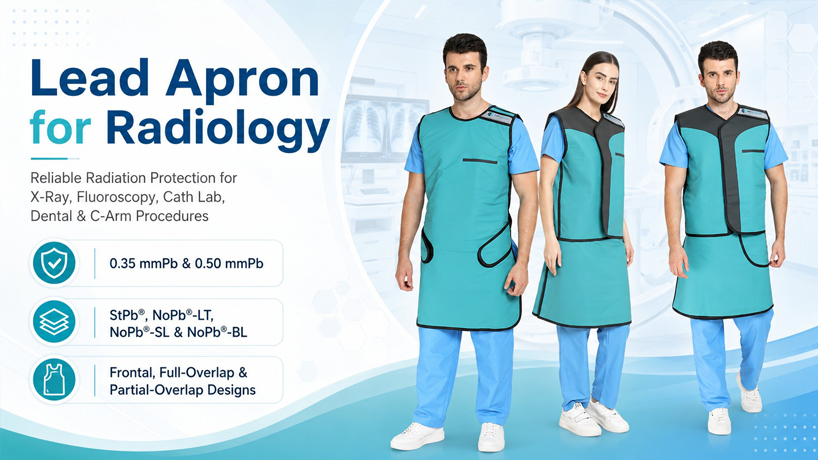
Reliable radiation protection aprons for radiology, X-ray, fluoroscopy, cath lab, dental, C-arm and medical imaging procedures.
A radiology lead apron is one of the most important radiation protection garments used in hospitals, diagnostic centres, dental clinics, cath labs, operation theatres, veterinary clinics and medical imaging departments. It helps reduce exposure to scattered X-ray radiation during diagnostic and interventional procedures.
IndoSurgicals Private Limited is a trusted manufacturer, supplier and exporter of radiology lead aprons in India, offering high-quality radiation protection aprons designed for professional medical use.

What is a Radiology Lead Apron?
A radiology lead apron is a protective garment used to reduce exposure to scattered ionizing radiation during X-ray-based procedures. It is made with a radiation protection core material that absorbs and attenuates X-ray radiation before it reaches the body.
Radiation Safety Support
Lead aprons help reduce exposure to scattered X-ray radiation during diagnostic and interventional procedures.
Core Shielding Layer
The apron uses a radiation protection core material designed to attenuate X-ray radiation before it reaches the body.
Clinical Use
They are used by doctors, radiographers, technicians, dentists, surgeons, nurses, veterinary professionals and patients.
Common Application Areas
- Diagnostic radiology
- X-ray rooms
- Fluoroscopy
- Cath labs
- Dental X-ray rooms
- C-arm procedures
- Operation theatres
- Interventional radiology
- Urology procedures
- Veterinary radiology
- Patient shielding applications
Important Safety Note
A lead apron is an important part of radiation safety, but it should always be used along with proper distance, shielding barriers, safe working practices and institutional radiation safety protocols.
Why Lead Aprons are Important in Radiology
During X-ray and fluoroscopy procedures, scattered radiation may be produced when the primary X-ray beam interacts with the patient or surrounding surfaces.
Repeated Exposure Protection
Healthcare professionals standing near the procedure area may receive repeated low-level exposure if proper protection is not used. A good quality radiology lead apron helps reduce occupational radiation exposure and supports safer working conditions.
Comfort + Long-Term Safety
For doctors, radiographers, technicians, nurses and surgeons who regularly work around X-ray equipment, choosing the right lead apron is not only a comfort decision but also a long-term safety decision.
Lead Equivalency Options
Lead apron protection is usually described in mmPb, which means millimetre lead equivalence. It indicates the shielding performance of the apron compared with a sheet of lead of the same stated thickness.
0.35 mmPb Lead Apron
A 0.35 mmPb lead apron is suitable for routine diagnostic X-ray, dental radiology, veterinary X-ray and selected medical imaging applications where moderate protection with better comfort is required.
It is generally lighter than a 0.50 mmPb apron and can be preferred where mobility and wearing comfort are important.
0.50 mmPb Lead Apron
A 0.50 mmPb lead apron provides a higher level of radiation protection and is commonly preferred for fluoroscopy, C-arm use, cath labs, interventional procedures and environments where staff may remain near scattered radiation for longer periods.
Core Material Options in IndoSurgicals Lead Aprons
IndoSurgicals offers multiple radiation protection core materials so users can choose between traditional lead-based protection and modern lead-free or lightweight options.
StPb® Core Material
StPb® is a traditional lead-vinyl radiation protection core material. It is a cost-effective option for users who prefer conventional lead-based shielding.
NoPb®-LT Core Material
NoPb®-LT is a lead-free lightweight radiation protection core material designed for reliable X-ray shielding with good flexibility, durability and reduced weight.
NoPb®-SL Core Material
NoPb®-SL is a super lightweight lead-free radiation protection core material designed for better wearing comfort during long medical procedures.
NoPb®-BL Core Material
NoPb®-BL is a premium lead-free radiation protection core material tested under broad beam geometry conditions. It is suitable where dependable shielding performance and technical documentation are both important.
Types of Radiology Lead Aprons Offered by IndoSurgicals
Different clinical environments require different apron designs. IndoSurgicals offers multiple lead apron patterns so users can select the right balance of protection, comfort, mobility and weight distribution.
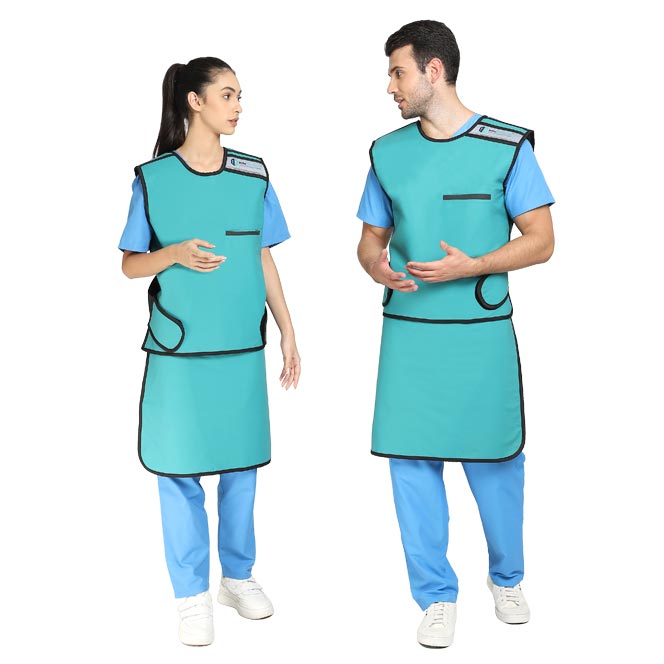

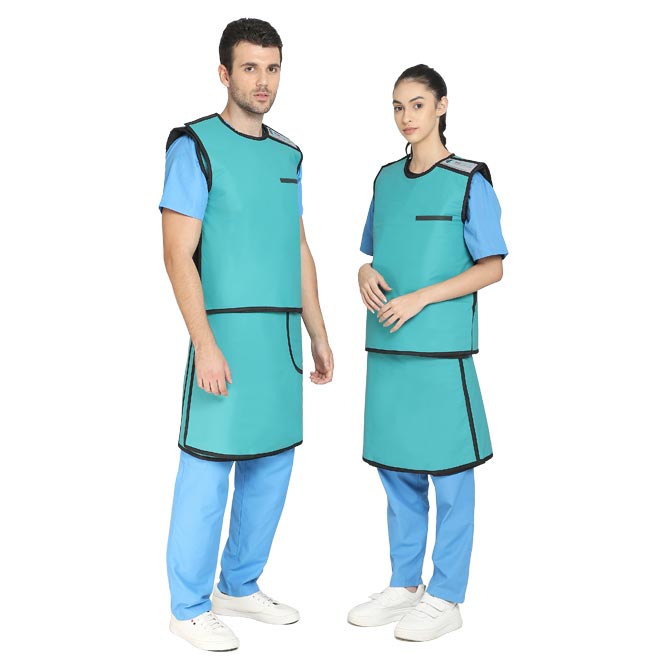
1. Frontal Protection Lead Apron
A frontal protection lead apron protects the front side of the body, including the chest, abdomen and pelvic region.
- General X-ray
- Diagnostic radiology
- Dental X-ray
- Veterinary X-ray
- Patient protection
- Routine imaging support
2. Frontal Protection Lead Vest & Skirt
A frontal protection lead vest and skirt divides apron weight between the shoulders and waist for improved wearing comfort.
- Longer diagnostic procedures
- Radiology staff
- Dental and veterinary imaging
- Better weight distribution
3. Full Protection Full-Overlap Lead Apron
A full protection full-overlap lead apron provides front and back coverage for users who need protection from multiple directions.
- C-arm procedures
- Fluoroscopy
- Cath lab support
- Interventional radiology
- Urology procedures
- Operation theatres using imaging
4. Full Protection Full-Overlap Lead Vest & Skirt
This model provides wrap-around full protection with improved weight distribution between the upper body and waist.
- Long procedures
- Cath lab use
- Fluoroscopy
- Interventional radiology
- Full protection with better comfort
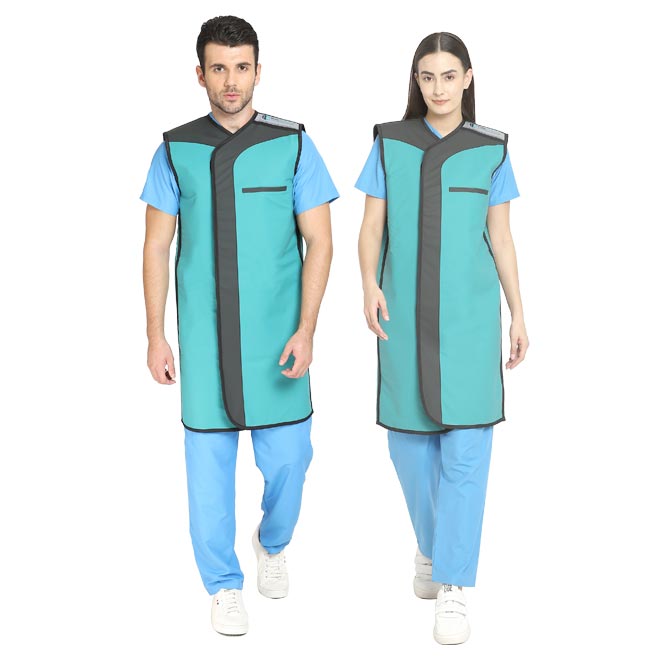
5. Full Protection Partial-Overlap Lead Apron
A full protection partial-overlap lead apron provides front and back protection with a flexible overlap design.
- Cath lab procedures
- C-arm procedures
- Fluoroscopy
- Interventional radiology
- Additional front overlap protection
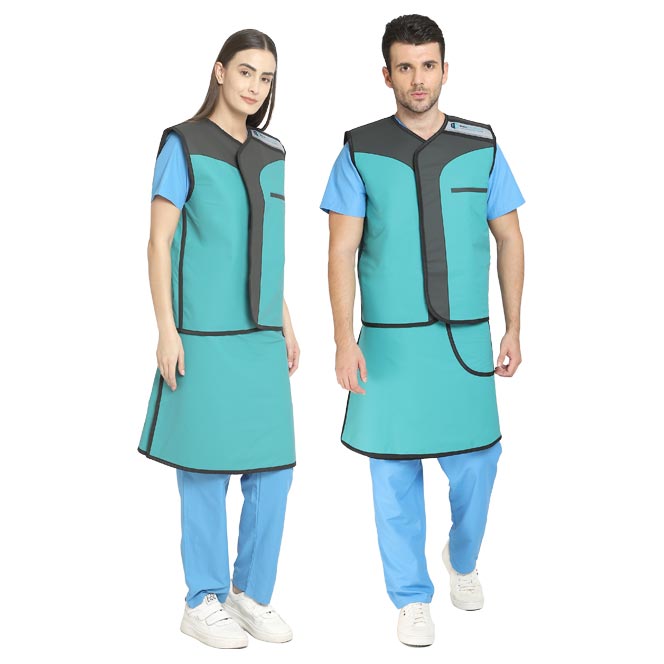
6. Full Protection Partial-Overlap Lead Vest & Skirt
This design combines partial-overlap protection with the comfort of a two-piece vest and skirt.
- Long procedures
- Cath labs
- Interventional radiology
- C-arm procedures
- Improved comfort and mobility
Partial-Overlap Protection Explained
In partial-overlap aprons, both front panels are made with the full claimed lead equivalent protection. Therefore, the overlapped front centre area provides additional shielding.
| Claimed Protection | Each Front Panel | Back Panel | Overlapped Front Area |
|---|---|---|---|
| 0.35 mmPb | 0.35 mmPb | 0.25 mmPb | Approx. 0.70 mmPb |
| 0.50 mmPb | 0.50 mmPb | 0.25 mmPb | Approx. 1.00 mmPb |
How to Choose the Right Lead Apron
Choosing the right lead apron depends on the type of procedure, exposure level, wearing duration and comfort requirement.
| Requirement | Recommended Option |
|---|---|
| Routine X-ray use | Frontal protection lead apron |
| Dental X-ray | Frontal protection apron or dental apron |
| Fluoroscopy | Full protection apron |
| C-arm procedures | Frontal or full protection apron |
| Cath lab use | Full-overlap or partial-overlap full protection apron |
| Long procedures | Vest and skirt design |
| Lightweight comfort | NoPb®-SL or NoPb®-LT |
| Conventional economical option | StPb® |
| Premium tested lead-free option | NoPb®-BL |
| Higher protection requirement | 0.50 mmPb |
A hospital, clinic or diagnostic centre should select lead aprons according to procedure-specific protection requirements and internal radiation safety policy.
Comfort and Ergonomic Design
Radiation protection should not come at the cost of user comfort. A heavy or poorly fitted apron can cause shoulder, neck and back strain, especially during long procedures.
Balanced Weight
Vest and skirt models distribute weight more evenly across the body and reduce shoulder load during long procedures.
Mobility
Proper sizing, adjustable closures and suitable core material selection help improve comfort during daily clinical use.
Lightweight Choices
For users who wear lead aprons for long hours, lightweight lead-free materials such as NoPb®-SL can be a suitable option.
Outer Covering and Cleaning
The outer covering of a lead apron plays an important role in hygiene, durability and ease of maintenance.
Basic Cleaning Guidance
- Wipe the surface with a soft damp cloth
- Use mild soap solution if required
- Do not use harsh chemicals unless approved by the manufacturer
- Allow the apron to dry completely before storage
- Inspect regularly for cracks, tears, peeling or surface damage
Do Not
- Do not machine wash
- Do not dry clean
- Do not iron
- Do not autoclave the apron
- Do not fold sharply or crush during storage
How to Store Lead Aprons Properly
Lead aprons should not be folded sharply, crushed or left on chairs for long periods. Incorrect storage can damage the internal protective core and reduce the service life of the apron.
Lead Apron Inspection and Maintenance
Every lead apron should be inspected regularly to ensure it remains safe for use. Visual inspection can help detect outer damage, cracks, tears, loose stitching, peeling, surface cuts or deformation.
Inspection Points
- Check the outer cover for cuts, cracks or tears
- Feel the apron for internal cracks, lumps or separation
- Check stitching, straps, buckles and hook-and-loop closures
- Confirm that the label and lead equivalency marking are readable
- Remove damaged aprons from active use until inspected properly
- Maintain an inspection record for each apron
Facility Policy
Hospitals, diagnostic centres and clinics should follow their internal quality assurance and radiation safety guidelines for inspection frequency.
A well-maintained lead apron performs better and lasts longer.
Why Buy Radiology Lead Aprons from IndoSurgicals?
IndoSurgicals Private Limited is a trusted manufacturer, supplier and exporter of medical equipment and radiation protection products in India. Our radiology lead aprons are designed for professional use in hospitals, clinics, diagnostic centres, dental clinics, radiology departments, cath labs and operation theatres.
Wide Range
Frontal and full-protection models with vest and skirt options for different clinical requirements.
Protection Options
Available in 0.35 mmPb and 0.50 mmPb protection levels.
Material Choice
Traditional lead and lead-free material options including StPb®, NoPb®-LT, NoPb®-SL and NoPb®-BL.
Professional Use
Suitable for X-ray, fluoroscopy, cath lab, C-arm, dental, veterinary and OT imaging use.
Key Advantages
- Wide range of lead apron models
- 0.35 mmPb and 0.50 mmPb protection options
- Traditional lead and lead-free material options
- Comfortable designs for long working hours
- Custom size options available
- Durable outer covering
Designed For
- Hospitals
- Diagnostic centres
- Radiology departments
- Dental clinics
- Cath labs
- Operation theatres
- Veterinary imaging applications
- Dealers and distributors
FAQs About Radiology Lead Aprons
Short and useful answers for hospitals, clinics, diagnostic centres, doctors, radiology professionals and buyers.
1. What is a lead apron used for?
A lead apron is used to reduce exposure to scattered X-ray radiation during diagnostic imaging, fluoroscopy, dental radiography, C-arm procedures and other X-ray-based medical procedures.
2. Who should wear a lead apron?
Doctors, radiographers, technicians, dentists, surgeons, nurses, veterinary professionals and patients may wear lead aprons when radiation protection is required during X-ray or fluoroscopy procedures.
3. What does mmPb mean in a lead apron?
mmPb means millimetre lead equivalence. It indicates the radiation shielding performance of the apron compared with a sheet of lead of the same stated thickness.
4. Which lead apron protection level is better: 0.35 mmPb or 0.50 mmPb?
0.35 mmPb is suitable for many routine X-ray and diagnostic applications, while 0.50 mmPb provides higher protection and is commonly preferred for fluoroscopy, C-arm, cath lab and interventional procedures.
5. Which lead apron is suitable for cath lab use?
For cath lab use, full protection lead aprons are generally preferred, including full-overlap or partial-overlap designs. Many cath lab users prefer 0.50 mmPb protection, depending on institutional radiation safety requirements.
6. Are lead-free aprons lighter than traditional lead aprons?
Lead-free aprons can be lighter, depending on the core material. IndoSurgicals offers NoPb®-LT, NoPb®-SL and NoPb®-BL lead-free options. NoPb®-SL is designed as a super lightweight material for improved comfort.
7. How should lead aprons be stored?
Lead aprons should be stored flat or hung on a proper lead apron hanger. They should not be folded, crushed or placed under heavy objects.
8. How often should lead aprons be inspected?
Lead aprons should be inspected regularly according to the facility’s internal radiation safety policy. Visual inspection should include checking for outer damage, cracks, tears, loose stitching and unreadable labels.
Conclusion
A radiology lead apron is an essential radiation protection garment for medical professionals working around X-ray, fluoroscopy, C-arm and imaging equipment. Choosing the right apron depends on the required protection level, procedure type, apron pattern, wearing duration and comfort preference.
IndoSurgicals offers a wide range of radiology lead aprons, frontal protection lead aprons, full protection lead aprons, lead vest and skirt aprons, dental aprons and lead-free radiation protection aprons with multiple core material options including StPb®, NoPb®-LT, NoPb®-SL and NoPb®-BL.
With reliable protection, practical designs and professional manufacturing quality, IndoSurgicals lead aprons are suitable for hospitals, radiology departments, diagnostic centres, dental clinics, cath labs, C-arm procedures, operation theatres and veterinary imaging applications.
Looking for Radiology Lead Aprons for Your Hospital or Diagnostic Centre?
IndoSurgicals Private Limited manufactures practical, reliable and professional radiation protection aprons for medical imaging environments. Choose from multiple protection levels, apron patterns and core material options based on your clinical requirement.