Radiation Protection Core Material Guide
Lead Vinyl & Lead-Free Core Materials Explained
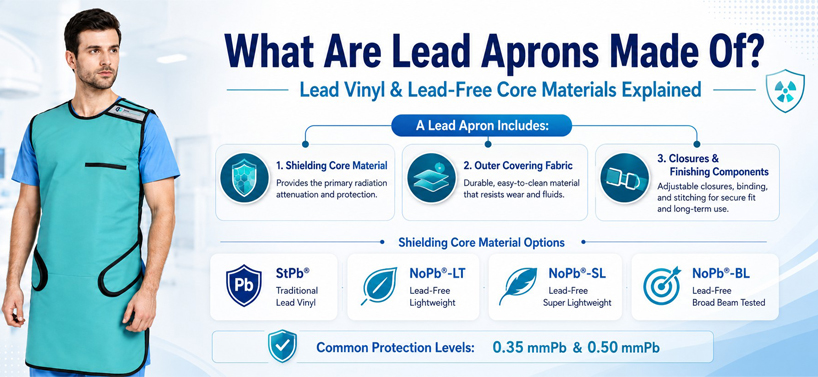
Lead aprons are made of special radiation protection core materials covered with durable outer fabric. Unlike ordinary aprons or medical garments, lead aprons are designed to reduce exposure to scattered X-ray radiation during medical imaging and interventional procedures.
A lead apron may be made with traditional lead vinyl core material or modern lead-free radiation protection materials. The main purpose of both types is the same: to provide reliable shielding against diagnostic X-ray radiation while keeping the apron practical for regular clinical use.
IndoSurgicals manufactures radiation protection aprons using different core material options, including StPb®, NoPb®-LT, NoPb®-SL and NoPb®-BL, so users can choose the right balance of protection, weight, comfort, flexibility and budget.
4core materials
2standard lead equivalents
3common apron patterns
16technical tables
Jump directly to the part of the guide you need:
Basic Structure of a Lead Apron
A radiation protection apron is usually made of three main parts:
| Part |
Purpose |
| Radiation protection core material |
Main shielding layer that reduces X-ray radiation exposure |
| Outer covering fabric |
Protects the core material and gives durability, cleanability and finished appearance |
| Accessories and finishing components |
Includes stitching, binding, hook and loop closure, buckles, shoulder padding, pocket and labels |
The most important part is the inner core material, because this determines the apron’s lead equivalency, shielding efficiency, weight and flexibility.
What Is Lead Equivalent in Lead Aprons?
Lead apron protection is commonly written as mmPb, which means millimetre lead equivalent.
This does not always mean the apron contains pure lead of that exact thickness. It means the apron provides radiation protection equivalent to a certain thickness of lead.
IndoSurgicals supplies radiation protection aprons mainly in two protection levels:
| Protection Level |
Common Use |
| 0.35 mmPb |
Routine X-ray, radiology, dental, veterinary and general diagnostic use |
| 0.50 mmPb |
Higher protection requirement, cath lab, C-arm, fluoroscopy and interventional use |
How IndoSurgicals Lead Aprons Are Constructed
IndoSurgicals uses specific sheet combinations to achieve the required lead equivalent protection.
| Claimed Apron Protection |
Core Sheet Construction |
| 0.35 mmPb Lead Equivalent |
2 sheets of 0.175 mmPb |
| 0.50 mmPb Lead Equivalent |
2 sheets of 0.25 mmPb |
This construction applies to frontal protection aprons and relevant apron designs, depending on the pattern and protection requirement.
Traditional core material
What Is Traditional Lead Vinyl Core Material?
Traditional lead aprons are made with a lead vinyl core material. In this type of material, lead particles are bonded inside a flexible polymer or vinyl matrix.
This makes the shielding material flexible enough to be used inside wearable radiation protection garments.
StPb® Lead Vinyl Core Material
StPb® is IndoSurgicals’ traditional lead vinyl radiation protection core material. It is suitable for users who prefer conventional lead-based shielding with a cost-effective construction.
StPb® is commonly used in:
- Lead aprons
- Frontal protection aprons
- Full protection aprons
- Thyroid shields
- Gonad shields
- Dental aprons
- Patient protection shields
- X-ray protective garments
StPb® Material Structure
| Component |
Description |
| Standard lead shielding particles |
Main radiation attenuation component |
| Polymer / vinyl matrix |
Flexible binder that holds lead particles together |
| Core structure |
Lead-particle-filled flexible radiation protection sheet |
StPb® Approximate Core Weight
| Protection Level |
Construction |
Approx. Core Area Density |
| 0.35 mmPb |
2 × 0.175 mmPb |
4.62 kg/m² |
| 0.50 mmPb |
2 × 0.25 mmPb |
6.60 kg/m² |
StPb® is a practical option for standard X-ray protection applications where conventional lead-based material is preferred.
Lead-free material overview
What Are Lead-Free Aprons Made Of?
Lead-free aprons are made using non-lead radiation attenuation materials. Instead of traditional lead particles, they may use shielding compounds such as bismuth oxide, antimony oxide, barium sulfate, samarium oxide, cerium oxide, gadolinium oxide, lanthanum oxide and other high-density materials.
These compounds are bonded inside a flexible polymer matrix to form a radiation protection sheet.
Lead-free apron materials are developed to reduce or eliminate lead content while maintaining shielding performance and improving comfort or technical performance depending on the formulation.
Core option 01
NoPb®-LT Lead-Free Lightweight Core Material
NoPb®-LT is IndoSurgicals’ lead-free lightweight radiation protection core material. It is designed for users who want a lead-free apron with reliable X-ray shielding, good flexibility and reduced weight.
The upgraded NoPb®-LT material is based on MS-A Medical Radiation Protection Material. It uses lead-free attenuation powders bonded inside a POE polymer matrix.
NoPb®-LT Composition
| Component |
Percentage |
| Ultra-fine samarium oxide powder |
41% |
| Ultra-fine cerium oxide powder |
31% |
| Ultra-fine lanthanum oxide powder |
2% |
| Ultra-fine gadolinium oxide powder |
2% |
| Barium sulfate |
2% |
| Ultra-fine bismuth oxide powder |
4% |
| POE polymer matrix |
18% |
NoPb®-LT Approximate Core Weight
| Protection Level |
Construction |
Approx. Core Area Density |
| 0.35 mmPb |
2 × 0.175 mmPb |
4.50 kg/m² |
| 0.50 mmPb |
2 × 0.25 mmPb |
6.00 kg/m² |
NoPb®-LT is suitable for hospitals, diagnostic centers, radiology departments, dental clinics, C-arm procedures and general medical X-ray protection where a lead-free lightweight option is preferred.
Core option 02
NoPb®-SL Lead-Free Super Lightweight Core Material
NoPb®-SL is IndoSurgicals’ super lightweight lead-free radiation protection core material. It is designed for better wearing comfort during long medical procedures.
This material is especially suitable for healthcare professionals who wear aprons for extended periods, such as radiologists, cath lab staff, technicians, dentists, C-arm users and interventional procedure teams.
NoPb®-SL Composition
| Component |
Percentage |
| Ultra-fine antimony oxide powder |
35.0% |
| Ultra-fine samarium oxide powder |
30.0% |
| Ultra-fine cerium oxide powder |
11.0% |
| Ultra-fine bismuth oxide powder |
4.0% |
| Barium sulfate |
2.0% |
| POE polymer matrix |
18.0% |
NoPb®-SL Approximate Core Weight
| Protection Level |
Construction |
Approx. Core Area Density |
| 0.35 mmPb |
2 × 0.175 mmPb |
3.90 kg/m² |
| 0.50 mmPb |
2 × 0.25 mmPb |
5.20 kg/m² |
NoPb®-SL is the lightest among IndoSurgicals’ current core material options and is suitable where wearing comfort is a major priority.
Core option 03
NoPb®-BL Lead-Free Broad Beam Tested Core Material
NoPb®-BL is IndoSurgicals’ premium lead-free broad beam tested radiation protection core material. It is suitable for users who require strong technical documentation and professional-grade shielding performance.
Broad beam tested materials are especially useful for lead-free radiation protection garments because they provide meaningful performance data under broader radiation testing conditions.
NoPb®-BL Composition
| Component |
Percentage |
| Ultra-fine antimony oxide powder |
28.7% |
| Ultra-fine cerium oxide powder |
24.6% |
| Ultra-fine bismuth oxide powder |
16.4% |
| Ultra-fine gadolinium oxide powder |
4.9% |
| Ultra-fine samarium oxide powder |
4.1% |
| Ultra-fine lanthanum oxide powder |
3.3% |
| POE polymer matrix |
18.0% |
NoPb®-BL Approximate Core Weight
| Protection Level |
Construction |
Approx. Core Area Density |
| 0.35 mmPb |
2 × 0.175 mmPb |
Approx. 4.29 kg/m² |
| 0.50 mmPb |
2 × 0.25 mmPb |
Approx. 6.00 kg/m² |
NoPb®-BL is suitable for premium lead-free aprons used in radiology departments, cath labs, C-arm procedures, interventional radiology and diagnostic imaging environments.
Comparison of IndoSurgicals Lead Apron Core Materials
| Core Material |
Type |
0.35 mmPb Core Weight |
0.50 mmPb Core Weight |
Main Benefit |
| StPb® |
Lead vinyl |
4.62 kg/m² |
6.60 kg/m² |
Conventional and cost-effective |
| NoPb®-LT |
Lead-free lightweight |
4.50 kg/m² |
6.00 kg/m² |
Balanced lead-free option |
| NoPb®-SL |
Lead-free super lightweight |
3.90 kg/m² |
5.20 kg/m² |
Lightest and comfort-focused |
| NoPb®-BL |
Lead-free broad beam tested |
Approx. 4.29 kg/m² |
Approx. 6.00 kg/m² |
Premium tested performance |
What Is the Outer Covering of a Lead Apron Made Of?
The outer covering protects the shielding core and improves durability, cleanability and appearance. Depending on the apron model, the outer covering may include coated fabric, textile layers, binding and stitched finishing.
The outer covering does not provide the main radiation protection. The actual shielding comes from the inner core material.
However, outer fabric, hook and loop closure, binding, pockets, buckles and stitching affect the final finished weight, comfort and durability of the apron.
Lead Apron Patterns and Material Use
Different apron patterns use the core material differently.
 Frontal Protection Lead Apron • SKU 91161
Frontal Protection Lead Apron
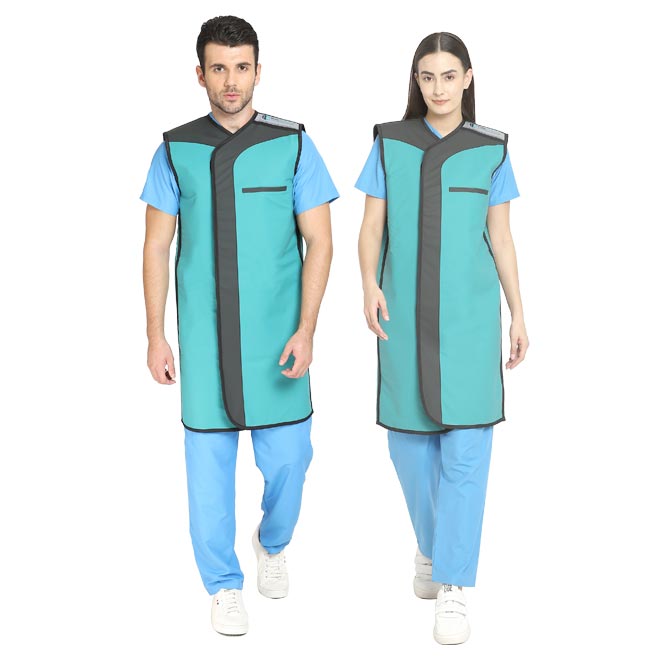
A frontal protection apron has shielding mainly on the front side. It is suitable for users who face the radiation source during procedures.
| Protection Level |
Construction |
| 0.35 mmPb |
2 sheets of 0.175 mmPb |
| 0.50 mmPb |
2 sheets of 0.25 mmPb |
| Protection Level |
Front Panel 1 |
Front Panel 2 |
Back Panel |
| 0.35 mmPb |
0.175 mmPb |
0.175 mmPb |
0.25 mmPb |
| 0.50 mmPb |
0.25 mmPb |
0.25 mmPb |
0.25 mmPb |
| Claimed Protection |
Each Front Panel |
Back Panel |
Overlapped Front Area |
| 0.35 mmPb |
0.35 mmPb |
0.25 mmPb |
Approx. 0.70 mmPb |
| 0.50 mmPb |
0.50 mmPb |
0.25 mmPb |
Approx. 1.00 mmPb |
In partial-overlap aprons, wherever both front panels overlap, the protection level is effectively doubled. This means 0.35 mmPb becomes approximately 0.70 mmPb and 0.50 mmPb becomes approximately 1.00 mmPb in the overlapped front area.
Are Lead-Free Aprons Better Than Lead Aprons?
Lead-free aprons are not automatically better in every situation. The right choice depends on the user’s requirement.
| Requirement |
Suitable Material |
| Economical conventional protection |
StPb® |
| Lead-free lightweight option |
NoPb®-LT |
| Maximum wearing comfort |
NoPb®-SL |
| Premium broad beam tested lead-free protection |
NoPb®-BL |
Traditional lead vinyl aprons are still widely used because they are cost-effective and familiar. Lead-free aprons are preferred when users want reduced lead content, lower weight, better comfort or advanced technical performance.
Frequently Asked Questions
What are lead aprons made of?
Lead aprons are made of an inner radiation protection core material and an outer covering fabric. The core may be made from lead vinyl or lead-free shielding compounds.
What is the material inside a lead apron?
The material inside a lead apron is the radiation shielding core. It may be made of lead particles bonded in vinyl or lead-free compounds such as bismuth oxide, antimony oxide, barium sulfate, samarium oxide and cerium oxide.
Are lead aprons made of pure lead?
Not usually. Modern lead aprons are generally made using flexible lead vinyl material, where lead particles are bonded inside a polymer or vinyl matrix. Lead-free aprons use non-lead attenuation materials.
What are lead-free aprons made of?
Lead-free aprons are made with high-density attenuation compounds such as bismuth oxide, antimony oxide, rare-earth oxides, barium sulfate and polymer binders.
Which lead apron material is lightest?
Among IndoSurgicals core materials, NoPb®-SL is the lightest option. It is designed for better comfort during long procedures.
What is the difference between lead and lead-free aprons?
Lead aprons use lead-based shielding material, while lead-free aprons use non-lead radiation attenuation compounds. Both are designed to reduce X-ray exposure, but they differ in weight, composition and material formulation.
Conclusion
Lead aprons are made of a radiation protection core material covered with durable outer fabric and finishing components. The core material may be traditional lead vinyl or modern lead-free shielding material.
IndoSurgicals offers multiple core material options: StPb® for conventional lead vinyl protection, NoPb®-LT for lead-free lightweight protection, NoPb®-SL for super lightweight comfort, and NoPb®-BL for premium broad beam tested lead-free protection.
By understanding what lead aprons are made of, users can choose the right apron based on protection level, weight, comfort, application and budget.
Explore the Complete IndoSurgicals Product Range – Click Here