

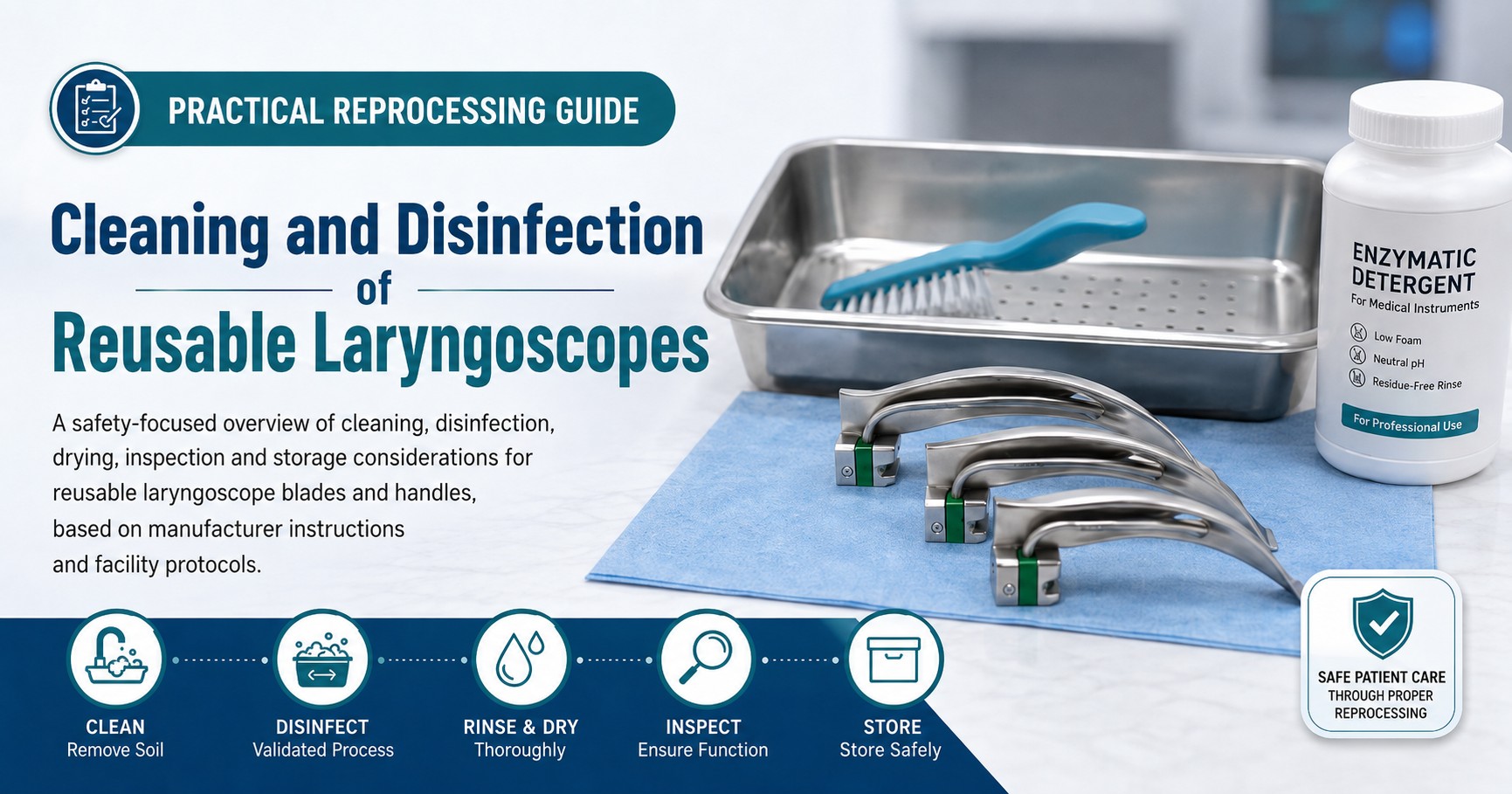
Cleaning and Disinfection of Reusable Laryngoscopes: A Practical Reprocessing Guide
A safety-focused overview of cleaning, disinfection, drying, inspection and storage considerations for reusable laryngoscope blades and handles, based on manufacturer instructions and facility protocols.
Cleaning and Disinfection of Reusable Laryngoscopes
Safe reuse of a laryngoscope depends on more than wiping its visible surface. Cleaning, disinfection or sterilisation, rinsing, drying, inspection, storage and documentation must form one controlled process based on the instructions supplied with the exact blade, handle and illumination system.
No Universal Cycle Applies to Every Laryngoscope
This guide intentionally does not prescribe a universal temperature, chemical concentration, contact time, autoclave cycle or number of permitted reuses. Conventional blades with electrical lamps, fibre-optic blades, removable light carriers, battery handles and sealed electronic components may have different processing limits. The validated instructions for the exact product must always take priority.
Cleaning, Disinfection and Sterilisation Are Not the Same
These terms describe separate stages or levels of medical-device processing. Using them interchangeably can lead to an incomplete or unsafe procedure.
| Process | Main Purpose | Important Limitation |
|---|---|---|
| Cleaning | Physically removes blood, secretions, organic material, debris and processing residues from the device. | Cleaning alone does not provide the required microbial reduction for reuse of a semicritical blade. |
| Disinfection | Uses a validated physical or chemical process to inactivate many or all disease-causing microorganisms, depending on the disinfection level. | Not every disinfection level is suitable for a device that contacts mucous membranes. |
| Sterilisation | Uses a validated process intended to render a device free from viable microorganisms, including bacterial spores. | A device must be compatible with the selected sterilisation method. Stainless-steel construction alone does not prove that every assembled component can tolerate a particular cycle. |
What Does “Reprocessing” Mean?
Reprocessing is the complete multistep procedure used to prepare a reusable medical device for another patient. It includes the relevant point-of-use actions, transport, disassembly, cleaning, rinsing, disinfection or sterilisation, drying, inspection, packaging, storage and quality-control records.
Why Reusable Laryngoscope Blades Require High-Level Processing
A laryngoscope blade contacts the mouth and mucous membranes and may be exposed to saliva, respiratory secretions or blood. It is therefore generally classified as a semicritical medical device.
Semicritical devices require thorough cleaning followed by, at minimum, an appropriate validated high-level disinfection process before reuse. Sterilisation may be required or preferred when specified by the product instructions, the healthcare facility’s policy or the clinical application.
| Component | Contamination Consideration | Processing Decision |
|---|---|---|
| Reusable blade | Directly contacts mucous membranes and may be visibly or microscopically contaminated. | Clean thoroughly, then apply the validated high-level disinfection or sterilisation method stated in the approved procedure. |
| Handle | May be contaminated through gloved hands, secretions, contact with the blade or surrounding surfaces. | Process according to its own instructions, contamination risk and facility policy. Do not assume the handle can undergo the blade’s process. |
| Blade-mounted lamp | May be exposed to cleaning fluids, chemicals, heat and mechanical force. | Remove or retain only as directed by the exact product instructions. |
| Fibre-optic carrier | Optical surfaces and fibres can be damaged by incompatible chemicals, abrasion, bending or excessive heat. | Follow the validated method for the particular integrated or removable light carrier. |
Blade and handle should not be treated as one identical item. They may have different contamination risks, construction, immersion limits and approved processing methods.
Why Cleaning Must Happen Before Disinfection or Sterilisation
Disinfection or sterilisation cannot reliably compensate for inadequate cleaning. Blood, mucus and other organic material can shield microorganisms, interfere with chemical contact and remain trapped around joints, electrical contacts, lamp fittings or connection points.
Residual material can prevent a disinfectant or sterilising agent from reaching every contaminated surface.
Delays after use can allow secretions and blood to dry onto the instrument and around difficult-to-clean areas.
Deposits around hinges, contacts, lamps and fibre surfaces can interfere with connection, movement and illumination.
A visibly clean and dry device can be examined more effectively for corrosion, cracks, pitting, damaged fibres and retained soil.
Cleaning Is a Measurable Process, Not a Quick Wipe
The facility procedure should identify the approved detergent, water quality, required tools, contact or soak conditions where applicable, brushing method, rinse procedure, inspection criteria and actions to take when visible contamination remains.
Cleaning the Laryngoscope Blade and Handle
The blade and handle form one instrument during use but may require separate reprocessing procedures after use.
- Distal tip and underside of the blade
- Flange, tongue and edges
- Heel, hinge and hook-on fitting
- Lamp, socket or electrical contact area
- Fibre-optic entry and exit surfaces
- Crevices and joints permitted to be brushed
- Size and identification markings
- Knurled or textured gripping surface
- Handle head and blade connection
- Electrical or optical contact area
- Battery cap and surrounding threads
- Seams, joints and external recesses
- Handle-mounted lamp or light window
- Areas touched by contaminated gloves
Do Not Immerse the Handle Unless Its Instructions Permit Immersion
Battery compartments, electrical contacts, lamps, seals and electronic components may be damaged by fluid entry or an incompatible processing method. Remove batteries or other components only when the product instructions specifically require it.
A Practical Reprocessing Framework
The following sequence is a general workflow framework. It is not a replacement for the validated instructions for a specific laryngoscope.
Contain the used instrument and follow the approved procedure intended to prevent contamination from drying.
Move contaminated equipment in a closed, leak-resistant and correctly identified container.
Identify the exact blade, handle, lamp and light-carrier model before choosing the processing procedure.
Separate the blade and handle and remove only those components identified in the product instructions.
Use the approved detergent, tools, water and method to remove visible and hidden contamination.
Remove detergent and loosened residue using the water quality and rinse method stated in the procedure.
Confirm that no soil remains and that the device has not been damaged during use or cleaning.
Apply the validated process selected for the exact device and its intended use.
For a chemical process, use the validated rinse method needed to remove residual processing chemicals.
Dry all permitted surfaces, joints and recesses before inspection, packaging or storage.
Check assembly, movement, connection, illumination and component condition.
Protect the processed device from damage, moisture, dust and recontamination until required.
Appropriate Personal Protective Equipment Is Part of the Process
Personnel handling contaminated devices and preparing processing chemicals should use the protective equipment specified by the facility’s risk assessment, chemical safety information and standard operating procedure.
How Should the Final Reprocessing Method Be Chosen?
The final method should be selected through a documented review of the device instructions, intended use, facility policy and available validated equipment.
| Question | Why It Matters |
|---|---|
| Is the item a blade, handle, bulb, removable carrier or assembled set? | Different components may have different immersion, heat and chemical limits. |
| Is it conventional or fibre optic? | Electrical lamp assemblies and fibre carriers can require different handling. |
| Does the IFU permit immersion? | Immersion can damage a non-sealed handle, battery compartment or electronic component. |
| Does the IFU permit steam sterilisation? | Not every bulb, fibre bundle, adhesive, seal or handle can tolerate heat and moisture. |
| Which chemicals are materially compatible? | An incompatible detergent or disinfectant may cause corrosion, clouding, cracking, fibre damage or residue. |
| Is manual or automated cleaning validated? | A process should not be substituted merely because equipment is available in the facility. |
| What rinse and drying steps are required? | Residual detergent, disinfectant or moisture can compromise safety, function and storage. |
| Are there reuse, inspection or replacement limits? | The device should be removed from service when it no longer meets the manufacturer’s acceptance criteria. |
Stainless Steel Does Not Automatically Mean “Autoclavable as Assembled”
A blade may contain a lamp, socket, optical fibres, adhesive, seals or removable components in addition to its stainless-steel body. The complete construction—not only the main metal—determines which process is approved.
Rinsing, Drying, Inspection and Clean Storage
Reprocessing is not complete when the disinfection or sterilisation exposure ends. The device must be rinsed where required, dried, inspected and protected from recontamination.
Rinsing
Use the water quality, quantity and technique required by the validated procedure. Chemical residues should not remain on patient-contact surfaces.
Drying
Dry the instrument and all permitted recesses thoroughly. Retained moisture can support microbial survival, cause corrosion or damage electrical and optical components.
Visual Inspection
Inspect under suitable lighting and magnification where required. Any remaining soil means that the cleaning stage has failed and must be repeated.
Functional Inspection
Confirm secure connection, smooth movement, adequate illumination and absence of loose, cracked, bent or damaged components.
Post-Reprocessing Inspection Checklist
Packaging and Clean Storage
Processed laryngoscopes should be stored in a clean, dry and protected location that prevents contact with contaminated equipment, dust, moisture and unnecessary handling.
- Separate clean equipment from used or awaiting-processing instruments.
- Use packaging or a protected container appropriate to the final processing method.
- Do not place a wet blade or handle into a closed storage case.
- Avoid storage arrangements that can bend blades or damage fibre carriers.
- Maintain identification and traceability where required by facility policy.
- Reprocess again if package integrity or clean-storage conditions have been compromised.
Laryngoscope Reprocessing Documentation Checklist
The required records depend on the healthcare facility, processing method and applicable quality system. A documented programme may include the following information.
Common Laryngoscope Reprocessing Mistakes
Wiping the blade and returning it to service
A quick surface wipe does not replace the required cleaning and validated high-level processing of a reusable blade.
Allowing blood or secretions to dry
Delayed transport and processing can make contamination harder to remove and increase cleaning difficulty.
Skipping cleaning before disinfection
Disinfectant contact with a visibly dirty instrument does not constitute an adequate reprocessing procedure.
Applying one method to every blade and handle
Conventional lamps, fibre-optic bundles, adhesives, seals, battery handles and electrical contacts may have different limitations.
Using an unapproved chemical or household cleaner
An unvalidated product can damage materials, leave harmful residue or fail to provide the required microbial reduction.
Assuming every stainless-steel component can be autoclaved
The lamp, fibre carrier, seal, adhesive or handle assembly may not tolerate the same heat and moisture as the metal body.
Ignoring the handle
The handle may be contaminated by gloves, secretions and contact with the used blade and must be included in the approved procedure.
Storing the instrument while damp
Moisture can support microbial survival, promote corrosion and damage electrical or optical components.
Returning damaged equipment to the trolley
A blade or handle that fails inspection or functional testing should be clearly segregated and removed from clinical service.
Frequently Asked Questions
How should a reusable laryngoscope be cleaned?
Separate and clean the blade and handle using the detergent, water, tools and method specified in their respective instructions. Cleaning must remove visible soil before the validated disinfection or sterilisation process is started.
Can a laryngoscope blade be disinfected with a surface wipe?
A reusable blade contacts mucous membranes and generally requires cleaning followed by at least validated high-level disinfection. A routine surface wipe alone is not an adequate substitute.
Can every laryngoscope blade be autoclaved?
No. Autoclave compatibility depends on the complete blade construction, including its lamp, fibre carrier, seals, adhesives and removable components. Use steam sterilisation only when it is permitted by the exact product instructions.
How do you sterilize a laryngoscope?
There is no single sterilisation cycle for all laryngoscopes. First identify the exact blade and handle model, clean it according to its instructions and then use only a sterilisation method validated for that component.
Should the bulb be removed before cleaning?
Remove the bulb only when the product instructions specifically direct its removal. Unnecessary removal may damage the lamp, socket, seal or electrical connection.
Can a laryngoscope handle be immersed?
Immersion should not be assumed. Some handles contain batteries, lamps, seals or electrical parts that may be damaged by fluid entry. Follow the instructions for the exact handle.
What is the difference between high-level disinfection and sterilisation?
High-level disinfection inactivates microorganisms at the level required for appropriately cleaned semicritical equipment, although small numbers of bacterial spores may remain. Sterilisation is intended to eliminate all viable microorganisms, including bacterial spores.
Why must a processed laryngoscope be completely dry?
Moisture may support microbial survival, promote corrosion, damage electrical parts and allow contamination to spread inside a closed storage case.
When should a reusable laryngoscope be removed from service?
Remove it from service when it remains visibly contaminated after cleaning, has corrosion, cracks, bending, a damaged tip, loose parts, poor illumination, damaged fibres, unreliable connection or any defect outside the manufacturer’s acceptance criteria.
Related Laryngoscope Guides
Authoritative Reprocessing References
Healthcare facilities should base their procedures on the device manufacturer’s validated instructions, applicable national requirements and recognised infection-control guidance.
Looking for Reusable Laryngoscope Blades and Sets?
IndoSurgicals supplies conventional LED and fibre-optic Macintosh and Miller laryngoscope sets, individual blades, handles and replacement components. Request the instructions for use applicable to the exact product as part of your technical and procurement review.
Professional-Use and Publication Disclaimer
This article provides a general safety-focused overview for trained healthcare, infection-prevention, sterile-services and procurement personnel. It is not a validated reprocessing instruction, clinical protocol or substitute for the instructions supplied with a specific product.
Before this article is published or applied operationally, IndoSurgicals should verify every product-specific statement against the current approved instructions for its conventional blades, fibre-optic blades, handles, lamps and removable components.
The healthcare facility remains responsible for developing, validating, documenting and auditing its reprocessing procedure in accordance with the product instructions, applicable regulations, chemical labeling, processing-equipment instructions and institutional infection-control policy.