

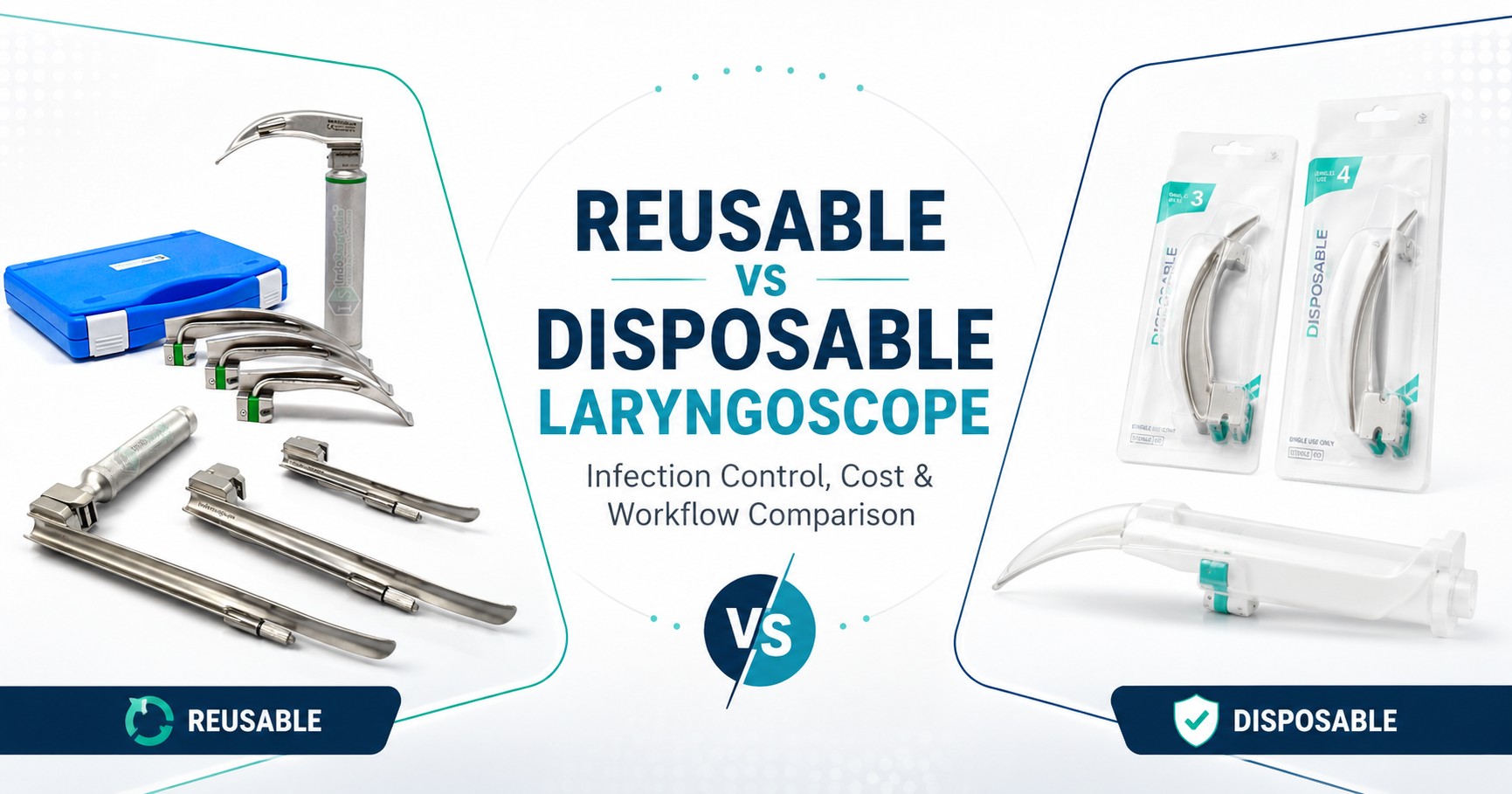
Reusable vs Disposable Laryngoscope: Infection Control, Cost and Workflow Comparison
Compare reusable and disposable laryngoscopes by infection-control requirements, reprocessing, emergency availability, recurring cost, environmental impact and hospital workflow.
Reusable vs Disposable Laryngoscope
Reusable and disposable laryngoscopes can both support effective airway-equipment planning, but they create very different requirements for reprocessing, storage, stock control, waste management and long-term cost. This guide compares the two options without assuming that one system is suitable for every hospital.
Designed for repeated use when correctly cleaned, disinfected or sterilised, inspected, stored and maintained according to validated instructions.
Supplied as a single-use device and discarded after use according to its labeling, hospital policy and applicable biomedical-waste requirements.
Important: “Disposable” does not automatically mean “sterile.” Confirm the packaging label, sterility status, expiry date and storage instructions for the exact product. A device labeled for single use should not be cleaned and reused as though it were a reusable instrument.
Reusable vs Disposable Laryngoscope at a Glance
The principal difference is not the blade pattern. Macintosh and Miller designs can be available in both reusable and disposable forms. The important distinction is whether the device is designed for validated reprocessing and repeated use or labeled for disposal after one patient use.
| Comparison Point | Reusable Laryngoscope | Disposable Laryngoscope |
|---|---|---|
| Intended use cycle | Used repeatedly after validated processing and inspection. | Used for one patient and then discarded according to labeling. |
| Reprocessing | Requires cleaning followed by the validated disinfection or sterilisation process. | No between-patient reprocessing when used and discarded as instructed. |
| Initial purchase cost | Normally higher per blade or set. | Normally lower per individual unit, but each use consumes one unit. |
| Cost per use | Depends on purchase price, lifespan, processing, labour, utilities, repairs and loss. | Depends on unit price, storage, transport, expiry, disposal and usage volume. |
| Turnaround time | Unavailable while awaiting transport, cleaning, processing, drying and release. | Ready when an intact, in-date unit is available at the point of care. |
| Infection-control dependency | Strongly dependent on correct cleaning, processing, storage and handling. | Reduces reliance on between-patient reprocessing but still requires correct storage and aseptic handling. |
| Waste generation | Less solid device waste per procedure, but processing consumes water, chemicals, energy and packaging. | Produces a discarded device and packaging after each use. |
| Stock planning | Requires enough duplicate blades and handles to cover use and reprocessing cycles. | Requires continuous stock, expiry monitoring and reliable replenishment. |
| Common role | Routine, repeated use where reliable reprocessing infrastructure is available. | Emergency backup, isolation areas, transport, remote use or workflows prioritising immediate single-use availability. |
These are general planning differences. Actual performance, packaging, compatibility, processing requirements and cost vary between products and healthcare facilities.
Infection-Control Considerations
A reusable laryngoscope blade comes into contact with mucous membranes and may be contaminated with saliva, respiratory secretions or blood. Thorough cleaning is essential because organic material can interfere with subsequent disinfection or sterilisation.
Reusable laryngoscope blades are generally treated as semicritical patient-care devices and require, at a minimum, effective cleaning followed by high-level disinfection before reuse. Sterilisation may be used when required by the manufacturer’s instructions, hospital policy or clinical application.
Visible contamination and organic material must be removed before disinfection or sterilisation can be expected to work effectively.
Detergents, disinfectants, temperatures, exposure times and equipment must be compatible with the exact blade and handle.
Processed components must be dried, protected and stored so they are not recontaminated before use.
The handle can also become contaminated through hands, secretions or contact with used equipment and must be processed according to its instructions.
Do Disposable Laryngoscopes Eliminate Infection Risk?
No medical device eliminates infection risk by itself. A disposable laryngoscope avoids the need to reprocess that particular single-use device between patients, but infection prevention still depends on intact packaging, correct storage, hand hygiene, aseptic handling, appropriate environmental cleaning and disposal after use.
Do not use a universal cleaning instruction: Reusable blades may differ in material, lamp position, electrical contacts, fibre-optic construction and heat tolerance. Always follow the validated instructions supplied with the exact device.
Typical Workflow for a Reusable Laryngoscope
The exact procedure must follow the manufacturer’s instructions and the hospital’s approved infection-control protocol. A typical workflow contains several controlled steps.
Used equipment is contained and prepared for safe transport without allowing contamination to dry unnecessarily.
The blade and handle are moved to the designated processing area using the facility’s contamination-control procedure.
Components are separated only as permitted by the product instructions.
Visible soil is removed using the approved detergent, water quality, tools and mechanical action.
The blade, handle, contacts, light carrier and moving parts are checked for cleanliness and damage.
The validated high-level disinfection or sterilisation process is completed.
Components are dried as instructed before storage or reassembly.
Processed equipment is protected, documented where required and returned to clean storage.
Reusable Equipment Requires More Than a Steriliser
A safe reusable programme requires trained staff, approved detergents and disinfectants, suitable personal protective equipment, transport containers, inspection tools, drying and storage arrangements, documentation and enough duplicate instruments to cover processing time.
Typical Workflow for a Disposable Laryngoscope
Disposable devices simplify the between-patient workflow, but they require disciplined stock management and disposal procedures.
Confirm the correct blade pattern and size, intact packaging, labeling, expiry date and sterility status where applicable.
Open the device using the facility’s approved handling procedure and avoid unnecessary contamination.
Inspect the device and confirm secure assembly and adequate illumination before clinical use.
Use the device only as labeled and only by an appropriately trained healthcare professional.
Dispose of the used device and any integrated battery according to product labeling and hospital waste procedures.
Replace the consumed unit and update stock records so the required sizes remain available.
Disposable Does Not Mean “No Inspection Required”
Every disposable device should still be checked before use. Damaged packaging, an expired product, a loose connection, inadequate light output or visible damage requires the unit to be removed from service according to hospital procedure.
Which Option Costs Less?
There is no universal answer. Reusable equipment normally requires a larger initial investment, while disposable equipment creates a recurring purchase for every use. A meaningful comparison should calculate the total cost of ownership for the individual hospital.
| Cost Element | Reusable System | Disposable System |
|---|---|---|
| Initial purchase | Complete set, required sizes, spare handles and storage cases. | Initial quantity of each required disposable size. |
| Per-use purchase | Spread across the number of safe uses achieved during the device’s service life. | One new unit is consumed for each patient use. |
| Labour | Collection, cleaning, inspection, processing, documentation, assembly and restocking. | Receiving, stock rotation, distribution, opening, disposal and replenishment. |
| Utilities and chemicals | Water, detergent, disinfectant, energy, processing equipment and protective supplies. | Normally no between-patient processing cost for the single-use device. |
| Maintenance | Replacement bulbs, batteries, repairs, inspection and damaged-component replacement. | Normally limited to stock management; complete defective units are removed from use. |
| Loss and damage | Reusable blades and handles can be lost or damaged during use, transport or processing. | Units may be wasted through damaged packs, expiry or opening without use. |
| Waste disposal | Processing waste plus disposal at the end of product life. | Device, packaging and any integrated power source after each use. |
| Stock-out risk | May occur when too many units are in processing or repair. | May occur when consumption exceeds stock or deliveries are delayed. |
A Practical Cost-per-Use Formula
Reusable cost per use may include:
Purchase + processing + labour + maintenance + replacement + loss + end-of-life disposal ÷ completed uses
Disposable cost per use may include:
Unit purchase + transport + storage + expired or damaged stock + waste disposal
Availability and Workflow Comparison
A laryngoscope that is not immediately available when required has little practical value. Hospitals should compare the complete workflow rather than only the instrument itself.
- Number of blades and handles in circulation
- Distance from the clinical area to the processing department
- Cleaning and processing turnaround time
- Drying, inspection and release time
- Equipment awaiting repair or replacement
- Correct return of processed equipment to the airway trolley
- Adequate stock of every required blade size
- Secure and accessible point-of-care storage
- Reliable purchasing and delivery schedules
- Expiry-date and batch rotation
- Protection of packaging from moisture and damage
- Prompt replacement after every consumed unit
Emergency Availability May Justify a Mixed Inventory
A hospital may use reusable laryngoscopes for routine activity while keeping suitable disposable sizes as emergency, transport, isolation or stock-out backup. The decision should be documented within the facility’s airway-equipment policy.
Environmental and Waste Considerations
Reusable equipment generally produces less discarded device material per procedure, but its environmental impact includes water, detergent, disinfectants, energy, personal protective equipment, transport and processing consumables. Disposable equipment avoids those reprocessing inputs for the device but creates packaging and product waste after each use.
| Environmental Factor | Reusable | Disposable |
|---|---|---|
| Solid product waste | Generated mainly through damaged items, replacement parts and end-of-life disposal. | Generated after every use. |
| Packaging waste | Lower per use once the equipment is in service. | Individual packaging is normally discarded for each unit. |
| Water and chemicals | Required during cleaning and reprocessing. | Not required for between-patient reprocessing of the single-use device. |
| Energy | Used for cleaning equipment, disinfection, sterilisation, drying and transport. | Embedded in manufacturing, packaging, transport, storage and disposal. |
| Battery disposal | Separate batteries can often be replaced and managed through a battery-waste programme. | A unit with an integrated power source may require a specific disposal route. |
The more sustainable choice depends on product design, number of uses, local processing efficiency, transport distance, waste treatment and actual hospital practice. Simple assumptions may not reflect the complete life cycle.
Which Laryngoscope Is Better for Your Facility?
The better choice is the one that can be made reliably available, used correctly, processed or discarded safely and supported within the facility’s clinical and financial systems.
- The hospital has validated reprocessing infrastructure.
- Staff are trained and audited for reusable-device processing.
- Procedure volume supports repeated use of the equipment.
- Enough duplicate blades and handles are available.
- Replacement parts and technical support are obtainable.
- The hospital wants to reduce discarded device material per procedure.
- Immediate point-of-care availability is a priority.
- Reprocessing capacity is limited or unavailable.
- The equipment is used in ambulances, remote sites or transport settings.
- The hospital wants a backup for reprocessing delays or equipment shortages.
- A single-use device is specified for a particular isolation workflow.
- Stock control and biomedical-waste systems can support recurring consumption.
A Hybrid Approach Is Often Practical
Many facilities do not need to choose only one option. Reusable sets can support routine operating-theatre and departmental use, while disposable devices can be reserved for emergency trolleys, ambulances, infectious-disease areas, remote locations or temporary shortages.
Hospital Procurement Checklist
Reusable and Disposable Laryngoscopes from IndoSurgicals
IndoSurgicals offers reusable conventional LED and fibre-optic laryngoscope sets as well as disposable fibre-optic Macintosh and Miller-type laryngoscopes.
| Product Type | Blade Pattern | Product Option |
|---|---|---|
| Reusable Conventional LED | Macintosh | View reusable Macintosh LED sets |
| Reusable Conventional LED | Miller | View reusable Miller LED sets |
| Reusable Fibre Optic | Macintosh | View reusable fibre-optic Macintosh sets |
| Reusable Fibre Optic | Miller | View reusable fibre-optic Miller sets |
| Disposable Fibre Optic | Macintosh | View disposable Macintosh laryngoscopes |
| Disposable Fibre Optic | Miller | View disposable Miller laryngoscopes |
Common Mistakes When Comparing Reusable and Disposable Laryngoscopes
Assuming every disposable device is sterile
Sterility must be confirmed from the package label. A single-use designation and a sterile designation are not the same thing.
Reusing a device labeled for single use
A single-use laryngoscope should be discarded after use according to its labeling and the facility’s waste procedure.
Assuming wiping is sufficient for a reusable blade
Laryngoscope blades contact mucous membranes. Between-patient processing must follow the validated cleaning and disinfection or sterilisation instructions.
Ignoring handle contamination
Handles can be contaminated during airway management and must be included in the hospital’s processing and inspection procedure.
Comparing only the unit purchase price
Reprocessing, labour, maintenance, expiry, storage, stock-outs and waste disposal can materially change the final cost per use.
Buying too few sizes
Reusable and disposable inventories should contain the blade patterns and sizes required by the hospital’s patient population and airway-management policy.
Frequently Asked Questions
What is the main difference between a reusable and disposable laryngoscope?
A reusable laryngoscope is designed to be cleaned, disinfected or sterilised and used again according to validated instructions. A disposable laryngoscope is intended for one patient use and is then discarded.
Are disposable laryngoscopes always sterile?
No. The sterility status must be confirmed on the product packaging. A device may be single use without being supplied sterile.
Can a disposable laryngoscope be reused?
A laryngoscope labeled for single use should not be reused as a routine reusable instrument. Follow the product labeling and the healthcare facility’s policy.
Do reusable laryngoscope blades require sterilisation?
Reusable laryngoscope blades generally require thorough cleaning followed by at least high-level disinfection before reuse. Sterilisation may be required or preferred according to the product instructions, hospital policy or clinical situation.
Which option has a lower infection risk?
A correctly handled disposable device avoids the risk associated with inadequate between-patient reprocessing of that unit. A correctly cleaned, processed, stored and inspected reusable device can also be used safely. Infection-control performance depends on the complete system and adherence to approved procedures.
Which option is cheaper for hospitals?
Reusable equipment may have a lower cost per use when procedure volume is high and processing is efficient. Disposable equipment may be financially practical for low-volume, emergency, remote or limited-reprocessing settings. The facility should calculate its own total cost per use.
Are disposable laryngoscopes useful in ambulances?
Disposable devices can simplify readiness where access to immediate reprocessing is limited, provided the correct sizes are stored securely, inspected regularly and replaced before expiry.
Can a hospital use both reusable and disposable laryngoscopes?
Yes. Reusable systems may support routine use, while disposable devices may be retained for backup, transport, remote locations, isolation workflows or reprocessing delays.
What information should be provided when requesting a quotation?
Specify reusable or disposable, Macintosh or Miller pattern, required sizes, conventional or fibre-optic illumination, quantity, delivery destination and any packaging, sterility or documentation requirements.
Continue Learning About Laryngoscopes
Read the complete IndoSurgicals guide for information about blade patterns, illumination systems, laryngoscope components, applications and hospital buying considerations.
Read the Complete Laryngoscope GuideNeed Reusable or Disposable Laryngoscopes?
IndoSurgicals supplies reusable conventional LED and fibre-optic laryngoscope sets along with disposable Macintosh and Miller-type fibre-optic laryngoscopes. Share the required blade pattern, sizes, quantity and delivery location for an accurate quotation.
Clinical, Infection-Control and Product Disclaimer
This article is intended for general product education, infection-control awareness and procurement planning. It does not replace a healthcare facility’s infection-prevention policy, clinical training, validated reprocessing procedure or product instructions.
Laryngoscopy and tracheal intubation must be performed only by appropriately trained healthcare professionals. Cleaning, high-level disinfection, sterilisation, storage and disposal must follow the instructions supplied with the exact device and all applicable institutional and regulatory requirements.