

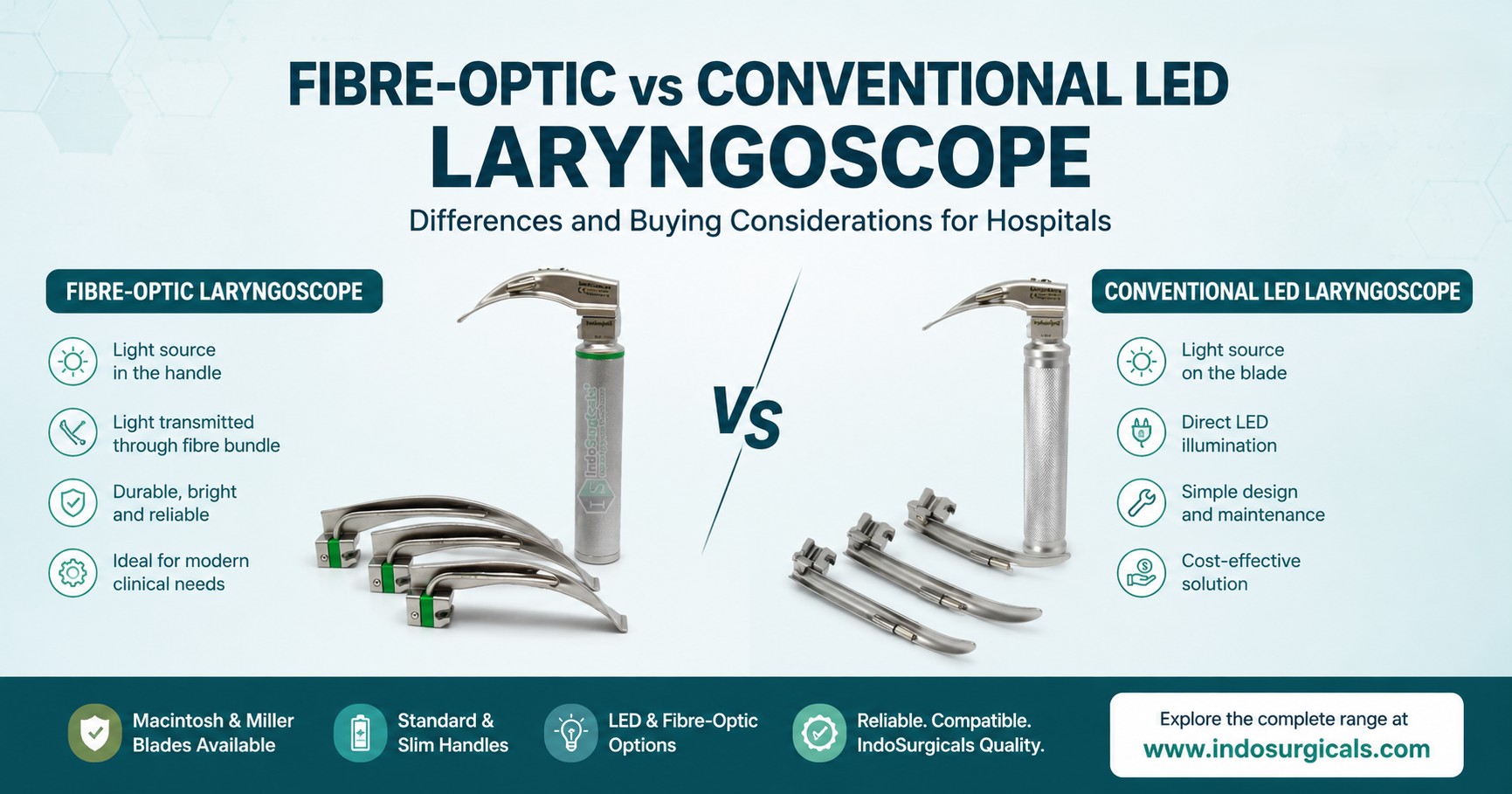
Fibre-Optic vs Conventional LED Laryngoscope: Differences and Buying Considerations
Compare conventional LED and fibre-optic laryngoscopes by illumination design, compatibility, maintenance, replacement parts and suitability for hospitals, clinics and emergency departments.
Fibre-Optic vs Conventional LED Laryngoscope
Conventional LED and fibre-optic laryngoscopes may use similar Macintosh or Miller blade patterns, but they deliver light in different ways. Understanding the location of the light source, blade-and-handle compatibility, maintenance requirements and replacement parts can help hospitals choose an appropriate system.
Electrical power travels from the handle to a compatible LED lamp positioned on the blade.
Light produced in the handle is transmitted along the blade through a fibre-optic light carrier.
An Important Point About the Term “LED Laryngoscope”
Fibre-optic and conventional are descriptions of the illumination arrangement. LED describes the type of lamp. A fibre-optic laryngoscope can also use an LED light source. The real comparison is therefore between a blade-mounted light system and a handle-mounted light source that transmits light through a fibre carrier.
Fibre-Optic vs Conventional LED Laryngoscope at a Glance
Both systems are designed to provide illumination during direct laryngoscopy. Their principal difference is where the lamp is positioned and how its light reaches the working end of the blade.
| Comparison Point | Conventional LED Laryngoscope | Fibre-Optic Laryngoscope |
|---|---|---|
| Light-source position | LED lamp is positioned on the blade. | LED or another compatible lamp is positioned in the handle. |
| How light reaches the tip | The blade-mounted lamp shines directly toward the working area. | The blade’s fibre-optic carrier transmits light from the handle. |
| Electrical component on blade | Yes. The blade normally carries a lamp and electrical contact. | The reusable blade generally carries a fibre light guide instead of an electrical lamp. |
| Component needing light inspection | Blade lamp, electrical contacts, batteries and handle connection. | Handle lamp, fibre carrier, alignment, batteries and connection. |
| Replacement light component | Compatible blade-mounted LED bulb or lamp. | Compatible handle lamp or light module, depending on the model. |
| Blade maintenance focus | Lamp, socket, contacts and blade structure. | Fibre bundle, light output, alignment and blade structure. |
| Interchangeability | Use only with a compatible conventional handle. | Use only with a compatible fibre-optic handle. |
| Available blade patterns | Commonly available in Macintosh and Miller patterns. | Commonly available in Macintosh and Miller patterns. |
Product construction can vary. The exact blade, handle, lamp and fibre-carrier arrangement should be confirmed from the manufacturer’s product specifications and instructions for use.
How a Conventional LED Laryngoscope Works
In a conventional laryngoscope, the lamp is mounted on the blade. Batteries housed inside the handle provide power. When a compatible blade is connected and moved into its operating position, the blade-and-handle contacts complete the electrical circuit and power the lamp.
Batteries Supply Power
Batteries inside the handle provide electrical energy to the system.
Contacts Complete the Circuit
Compatible contacts in the blade and handle allow electricity to reach the lamp.
Blade Lamp Produces Light
The lamp positioned on the blade directs light toward the working area.
Main Components of the Conventional System
- Compatible conventional laryngoscope handle
- Handle batteries and internal contacts
- Conventional Macintosh, Miller or another compatible blade
- Blade-mounted LED bulb or lamp
- Electrical contact between the blade and handle
How a Fibre-Optic Laryngoscope Works
In a fibre-optic system, the light source is located in the handle. When the blade is connected and opened, the handle lamp aligns with the fibre-optic carrier at the base of the blade. Light travels through the carrier and exits near the distal part of the blade.
Handle Lamp Produces Light
A compatible LED light source inside the handle generates the illumination.
Light Enters the Blade
Correct blade-and-handle alignment directs the light into the fibre carrier.
Fibre Carrier Transmits Light
The light travels through the blade and exits near its distal working area.
Main Components of the Fibre-Optic System
- Compatible fibre-optic laryngoscope handle
- Handle batteries and light source
- Fibre-optic Macintosh, Miller or another compatible blade
- Integrated or removable fibre light carrier
- Precisely aligned blade-to-handle optical connection
Light Output and Visibility Considerations
Buyers should not assume that every fibre-optic laryngoscope is brighter than every conventional laryngoscope. Actual light output depends on the lamp, battery condition, contacts, optical alignment, fibre-carrier condition, blade design and overall product quality.
Battery Condition
Weak or incorrectly fitted batteries can reduce light output in either system.
Contact Cleanliness
Dirty, damaged or corroded contacts can cause dim, intermittent or failed illumination.
Lamp Condition
A damaged, aged or incorrectly matched lamp can produce inadequate or uneven light.
Fibre Condition
Damaged, contaminated or degraded fibres can reduce the amount of light reaching the blade tip.
Optical Alignment
A fibre-optic handle and blade must align correctly so that light enters the carrier efficiently.
Blade Design
Lamp position, fibre exit point and blade geometry influence where the light is directed.
Procurement recommendation: Compare documented product specifications and inspect a sample where possible. General labels such as “LED” or “fibre optic” alone do not confirm the actual brightness, beam direction or durability of a particular model.
Why Laryngoscope Compatibility Matters
A replacement blade must match the operating system of the handle. Conventional and fibre-optic products have different electrical or optical arrangements and should not be mixed unless the manufacturer expressly confirms compatibility.
| Existing Equipment | Replacement Normally Required | What Must Be Verified |
|---|---|---|
| Conventional handle | Compatible conventional blade | Hook-on fitting, electrical contacts, lamp arrangement and manufacturer compatibility. |
| Fibre-optic handle | Compatible fibre-optic blade | Hook-on fitting, optical alignment, light-carrier position and manufacturer compatibility. |
| Unknown handle type | Do not order from appearance alone | Brand, model, product markings, lamp position, current blade and instructions for use. |
| New hospital installation | Complete matched system | Handle, required blade sizes, lamp, batteries, spares and reprocessing instructions. |
The Safest Buying Rule
When replacing only one component, provide the supplier with the brand, model, illumination type and clear photographs of the existing blade and handle. When establishing a new inventory, purchasing a complete matched set reduces uncertainty about compatibility.
Maintenance Differences Between the Two Systems
Both systems require regular inspection. The main difference is which illumination components must be checked and replaced.
- Inspect the blade-mounted LED lamp.
- Check the lamp socket and electrical contacts.
- Confirm that the lamp is securely fitted.
- Check batteries and handle contacts.
- Look for flickering when the blade is opened.
- Use only a compatible replacement bulb or lamp.
- Inspect the handle-mounted light source.
- Check the fibre carrier for visible damage.
- Inspect the fibre entry and exit surfaces.
- Confirm correct alignment between blade and handle.
- Check batteries and handle contacts.
- Investigate reduced light transmission before use.
Common Causes of Poor Illumination
- Weak, discharged, leaking or incorrectly installed batteries
- Loose blade-to-handle connection
- Dirty, wet, damaged or corroded electrical contacts
- Incorrect replacement lamp
- Damaged or degraded fibre-optic bundle
- Incorrect optical alignment
- Mechanical damage to the blade, handle or connection fitting
Cleaning and Reprocessing Considerations
Reusable blades and handles must be processed according to the instructions supplied with the exact product and the healthcare facility’s infection-prevention policy. The presence of an electrical lamp, removable light guide, integrated fibre bundle or sealed handle can affect the permitted procedure.
| Reprocessing Point | Conventional LED | Fibre Optic |
|---|---|---|
| Component requiring protection | Blade lamp, socket and electrical contact arrangement. | Fibre carrier, optical surfaces and handle light source. |
| Disassembly | Follow instructions for lamp removal or blade separation where applicable. | Follow instructions for integrated or removable fibre carriers. |
| Heat and chemical exposure | Use only cycles and chemicals validated for the specific blade, lamp and handle. | Use only cycles and chemicals validated for the fibre bundle, blade and handle. |
| Post-processing check | Inspect the lamp, contacts, connection and light output. | Inspect the light carrier, alignment, connection and light output. |
Do not assume every laryngoscope component is autoclavable. Permitted temperatures, exposure times, chemical agents and immersion limits vary between products. Always follow the manufacturer’s validated reprocessing instructions.
Which Laryngoscope System Costs Less?
The answer depends on the exact products being compared. Purchase price alone does not show the complete cost. Hospitals should consider the complete blade-and-handle system, required sizes, replacement lamps, battery use, maintenance, reprocessing and the cost of maintaining backup equipment.
| Cost Element | Questions to Ask |
|---|---|
| Initial equipment | Does the quotation include a handle, all required blade sizes, batteries and a storage case? |
| Replacement lamps | Where is the lamp located, is it replaceable and what is its current replacement cost? |
| Replacement blades | Can individual compatible blades be purchased, or must the complete set be replaced? |
| Fibre maintenance | Can a damaged light carrier be replaced or serviced, and by whom? |
| Battery use | What battery type is required and how frequently will the facility test or replace it? |
| Reprocessing | Can the facility process the components using its existing validated equipment and workflow? |
| Backup inventory | How many spare handles, blades, lamps and batteries are required for uninterrupted availability? |
A lower-priced set may become expensive if compatible spare parts are difficult to obtain. A higher initial price may also be difficult to justify if the hospital already owns and maintains a different compatible system. The best comparison is based on expected use over the product’s service life.
Which System Should a Hospital Choose?
Neither illumination system is automatically the best choice for every hospital. The decision should reflect the facility’s existing equipment, clinical policy, staff familiarity, maintenance capability and purchasing requirements.
- The facility already uses compatible conventional handles and blades.
- Existing staff and maintenance teams know the system.
- Compatible replacement blades and lamps are readily available.
- Standardisation with an existing inventory is important.
- The quoted system meets the hospital’s documented specifications and budget.
- The facility already uses compatible fibre-optic equipment.
- A handle-mounted light source is specified by the procurement team.
- Required fibre-optic blade sizes and spare parts are available.
- The facility can inspect and maintain fibre light carriers.
- The selected model meets the hospital’s illumination and reprocessing requirements.
Existing Inventory Should Usually Be Checked First
When a hospital already owns multiple handles and blades, standardising compatible replacements may be more practical than introducing another system. When establishing a new department, buyers can compare complete conventional and fibre-optic sets without being restricted by existing equipment.
Hospital Procurement Checklist
Conventional and Fibre-Optic Laryngoscopes from IndoSurgicals
IndoSurgicals offers conventional LED and fibre-optic laryngoscope sets in Macintosh and Miller patterns. Individual blades, handles and replacement LED bulbs are also available for compatible systems.
| Illumination System | Blade Pattern | Product Link |
|---|---|---|
| Conventional LED | Macintosh | View Macintosh LED laryngoscope sets |
| Conventional LED | Miller | View Miller LED laryngoscope sets |
| Fibre Optic with LED Light Source | Macintosh | View fibre-optic Macintosh sets |
| Fibre Optic with LED Light Source | Miller | View fibre-optic Miller sets |
Common Mistakes When Buying a Laryngoscope
Assuming fibre optic means the lamp is not LED
Fibre optic describes how light travels through the blade. The handle light source may still use LED technology.
Ordering only by blade pattern and size
A Macintosh size 3 blade may be available in conventional and fibre-optic versions. Pattern and size alone do not confirm compatibility.
Mixing conventional and fibre-optic components
A blade may hook onto a handle but still fail to illuminate correctly. The complete operating system must be verified.
Comparing only the purchase price
Replacement lamps, blades, batteries, service, reprocessing and backup requirements affect the total ownership cost.
Assuming every reusable model has the same sterilisation method
Reprocessing limits vary according to the lamp, fibre bundle, blade, handle and product construction.
Failing to confirm spare-part availability
Hospitals should confirm that compatible replacement blades, handles, lamps and batteries can be obtained when needed.
Frequently Asked Questions
What is the main difference between a fibre-optic and conventional laryngoscope?
A conventional laryngoscope has its lamp on the blade. A fibre-optic laryngoscope has its light source in the handle and transmits light through a fibre carrier in the blade.
Can a fibre-optic laryngoscope use an LED bulb?
Yes. LED refers to the lamp technology, while fibre optic refers to how the light is transmitted from the handle through the blade.
Is a fibre-optic laryngoscope always brighter?
Not necessarily. Brightness depends on the lamp, batteries, fibre condition, alignment, contacts, blade design and overall product quality.
Can a conventional blade fit a fibre-optic handle?
Compatibility should not be assumed. The systems use different illumination arrangements. Use only combinations approved as compatible by the manufacturer.
Which system is easier to maintain?
This depends on the product design and the facility’s maintenance capability. Conventional systems require attention to the blade lamp and electrical contacts. Fibre-optic systems require attention to the handle light source, fibre carrier and optical alignment.
Which laryngoscope is better for a new hospital?
The decision should be based on the hospital’s clinical specifications, required blade sizes, staff familiarity, reprocessing capability, spare-part availability, service support and budget. Neither system is automatically best for every facility.
Should a hospital replace its existing system when buying new blades?
Not automatically. If the existing handles are functional and compatible replacement blades and parts remain available, maintaining a standardised system may be practical. The equipment should first be assessed against current hospital requirements.
What information should be sent when requesting a quotation?
Specify the illumination system, blade pattern, required sizes, handle type, quantity, delivery location and whether the requirement is for individual components or a complete set. For replacement parts, include the existing brand and model.
Continue Learning About Laryngoscopes
Read the complete IndoSurgicals guide for additional information about blade patterns, laryngoscope types, clinical applications and hospital equipment-selection considerations.
Read the Complete Laryngoscope GuideNeed Help Selecting a Laryngoscope System?
IndoSurgicals supplies conventional LED and fibre-optic Macintosh and Miller laryngoscope sets, individual blades, handles and replacement LED bulbs. Share your required system, blade sizes, quantity and existing equipment details for an accurate quotation.
Clinical and Product Disclaimer
This article is intended for general product education, equipment comparison and procurement planning. It does not provide medical advice, clinical training or patient-specific instructions. Laryngoscopy and tracheal intubation must be performed only by appropriately trained healthcare professionals using approved equipment and institutional protocols.
Product construction, illumination, compatibility, battery requirements, reprocessing methods and specifications may vary between models. Always review the instructions supplied with the exact blade, handle, lamp and laryngoscope system before use or purchase.