

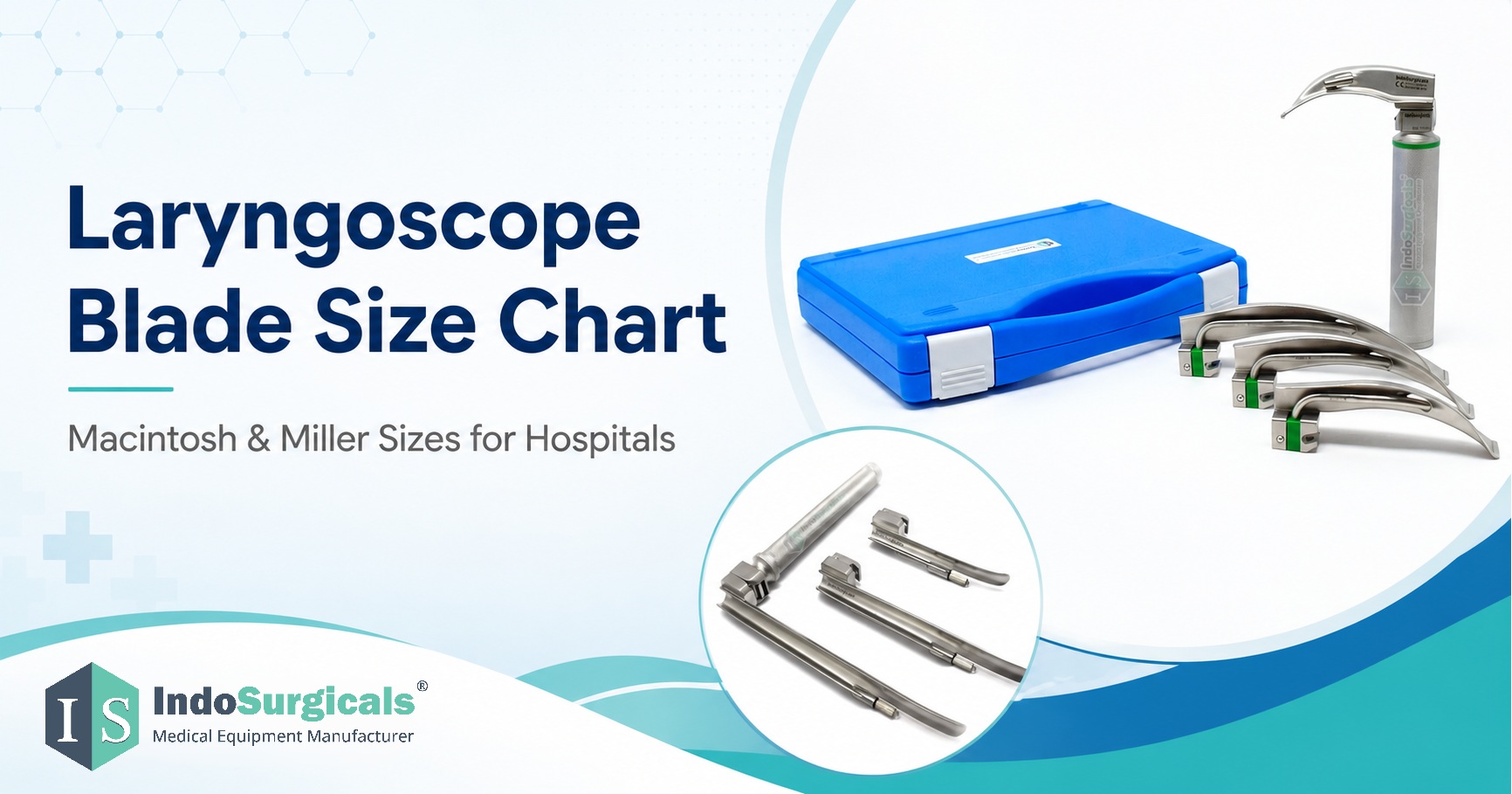
Laryngoscope Blade Sizes Explained: Macintosh and Miller Size Chart for Hospitals
Understand common Macintosh and Miller laryngoscope blade sizes for neonatal, paediatric and adult equipment planning. This practical guide explains blade numbers, key differences, IndoSurgicals size availability and important factors hospitals should consider before ordering.
Understanding Laryngoscope Blade Sizes
Laryngoscope blades are available in several patterns and numbered sizes. Understanding these numbers helps hospitals, operating theatres, emergency departments, neonatal units, medical colleges and procurement teams organise an appropriate range of airway equipment.
Important clinical note: The size associations in this guide are general equipment-planning references, not patient-specific intubation instructions. Blade selection must be made by a trained healthcare professional according to patient anatomy, clinical circumstances, device design, professional judgement and the healthcare facility’s approved airway-management protocol.
What Does a Laryngoscope Blade Size Number Mean?
A laryngoscope blade number identifies the relative size of a blade within a particular blade pattern and product range. As the number increases, the blade generally becomes longer and is intended to accommodate a larger airway or a different anatomical requirement.
The number should not be interpreted as a measurement in centimetres or millimetres. For example, “size 3” is a product-size designation rather than a statement that the blade is three centimetres long.
Exact blade length, width, curvature, flange design and distal-tip dimensions can differ between manufacturers and product systems. Hospitals should therefore verify the specifications of the exact product being ordered instead of assuming that blades carrying the same number are physically identical.
Quick Answer
Smaller blade numbers are commonly associated with neonatal and paediatric equipment, while larger numbers are commonly associated with older children and adults. However, the blade pattern, manufacturer’s dimensions, patient anatomy and clinician’s technique are just as important as the number printed on the blade.
Macintosh vs Miller Laryngoscope Blades
Macintosh and Miller blades are two widely recognised direct-laryngoscope blade patterns. They differ in shape and in the way a trained clinician uses the blade to expose the laryngeal structures.
| Feature | Macintosh Blade | Miller Blade |
|---|---|---|
| General shape | Curved blade | Straight blade with a relatively narrow profile |
| Typical placement principle | The tip is commonly positioned in the vallecula to lift the epiglottis indirectly. | The blade is commonly advanced to lift the epiglottis directly. |
| Common association | Frequently selected for adult direct laryngoscopy, with smaller sizes also available. | Frequently stocked for neonatal and paediatric use, with larger sizes also available. |
| IndoSurgicals blade-size range | Sizes 0–5 across conventional and fibre-optic ranges | Sizes 00–4 across conventional and fibre-optic ranges |
These associations are not absolute. Both curved and straight blades may be used across different patient groups when selected and operated by trained professionals according to the clinical situation.
Macintosh Laryngoscope Blade Size Chart
Macintosh blades have a curved design. The following table shows common size associations used for equipment identification and inventory planning. It should not be used as a patient-specific selection rule.
| Macintosh Size | Common Equipment Association | Planning Note |
|---|---|---|
| 0 | Smallest curved-blade requirements | A specialist small-size option. Intended application depends on the blade design, dimensions and clinician’s judgement. |
| 1 | Infant or small-paediatric equipment range | A smaller curved blade that may be stocked where clinicians use Macintosh blades for small patients. |
| 2 | Paediatric or small-patient range | Often included in paediatric or mixed-size laryngoscope sets. |
| 3 | Common adult range | A widely stocked adult Macintosh size, but it will not suit every adult patient or clinical situation. |
| 4 | Larger adult range | Provides a longer curved-blade option when required by the trained clinician. |
| 5 | Extended adult-size range | An additional long Macintosh blade option available in the IndoSurgicals fibre-optic blade range. |
Remember: Size 3 is commonly associated with adult equipment, but it is not automatically the correct blade for every adult.
Miller Laryngoscope Blade Size Chart
Miller blades have a straight design and are commonly included in neonatal and paediatric airway equipment. Larger Miller blades are also available for older children and adults.
| Miller Size | Common Equipment Association | Planning Note |
|---|---|---|
| 00 | Very small preterm-neonatal range | A specialist neonatal size commonly considered for very small preterm airway-equipment requirements. |
| 0 | Preterm or small-neonatal range | Frequently stocked in neonatal airway trolleys together with Miller sizes 00 and 1. |
| 1 | Term-neonatal or infant range | A commonly stocked straight blade for neonatal and infant airway-equipment preparation. |
| 2 | Paediatric range | Often included in paediatric and mixed-size Miller laryngoscope sets. |
| 3 | Older-paediatric or adult range | A longer straight blade whose use depends on patient anatomy, product design and clinician preference. |
| 4 | Adult or larger-airway range | An additional long Miller option available in the IndoSurgicals fibre-optic blade range. |
Neonatal departments commonly maintain more than one small straight-blade size because newborn size, gestational age, airway anatomy and clinical circumstances vary.
Why Laryngoscope Blade Selection Cannot Be Based on Age Alone
Age-group labels are useful when organising equipment, but they cannot replace professional assessment. Two patients of the same age may have different body sizes, airway anatomy, clinical conditions and procedural requirements.
Airway dimensions, tongue size, epiglottic anatomy and other anatomical factors can affect the blade selected by the responsible clinician.
A Macintosh and Miller blade with the same printed number do not have the same shape or intended handling technique.
Overall length, working length, flange, curvature and distal width may vary between brands and blade ranges.
The procedure, airway assessment, available equipment and approved airway plan influence final selection.
The blade must be selected and used only by a professional trained in the relevant airway-management technique.
Hospitals should stock and use equipment in accordance with their clinical governance, training and emergency-airway policies.
Laryngoscope Blade Sizes Available from IndoSurgicals
IndoSurgicals offers Macintosh and Miller laryngoscope blades in conventional LED and fibre-optic configurations. The available range covers individual blades and multi-blade laryngoscope sets for varied departmental requirements.
| Product System | Blade Pattern | Available Individual Sizes | View Product |
|---|---|---|---|
| Conventional LED | Macintosh | 0, 1, 2, 3 and 4 | Macintosh LED blades |
| Conventional LED | Miller | 00, 0, 1, 2 and 3 | Miller LED blades |
| Fibre Optic | Macintosh | 0, 1, 2, 3, 4 and 5 | Fibre-optic Macintosh blades |
| Fibre Optic | Miller | 00, 0, 1, 2, 3 and 4 | Fibre-optic Miller blades |
Available Macintosh Set Combinations
- Sizes 0, 1 and 2
- Sizes 1, 2 and 3
- Sizes 1, 2, 3 and 4
- Sizes 0, 1, 2 and 3
Available Miller Set Combinations
- Sizes 00, 0 and 1
- Sizes 0, 1 and 2
- Sizes 1, 2 and 3
- Selected conventional sets are also available with sizes 00, 0, 1 and 2.
Do Not Assume Conventional and Fibre-Optic Components Are Interchangeable
The blade and handle must belong to a compatible illumination and connection system. Before ordering a replacement blade or handle, confirm whether the existing equipment is conventional LED or fibre optic and verify compatibility with the exact manufacturer’s product instructions.
Planning Laryngoscope Blade Sizes for Different Hospital Departments
The appropriate inventory depends on the patients served, the department’s airway-management protocol, staff training and the type of laryngoscope system already in use.
| Department | Common Planning Requirement | Important Consideration |
|---|---|---|
| Neonatal Unit | A selection of small straight blades, commonly including Miller 00, 0 and 1. | Stock should reflect the gestational and birth-weight range managed by the unit and its neonatal-airway protocol. |
| Paediatric Department | Multiple Miller and/or Macintosh sizes for infants, children and older paediatric patients. | The selected blade patterns should match the department’s approved techniques and staff training. |
| Adult Operating Theatre | Macintosh sizes 3 and 4 are commonly stocked, with additional sizes and patterns according to policy. | A single adult blade size is not sufficient for every patient or airway plan. |
| Emergency Department and ICU | A broad, immediately accessible range appropriate to the hospital’s patient population. | Backup handles, checked illumination and alternative airway equipment should follow the facility’s emergency policy. |
| Medical College or Training Centre | Multiple Macintosh and Miller blade sizes for supervised training and equipment familiarisation. | Training equipment should clearly distinguish blade pattern, number and illumination system. |
Hospital Laryngoscope Procurement Checklist
Common Mistakes When Ordering Laryngoscope Blades
Treating the size number as a universal measurement
A numbered size is a relative product designation. Dimensions may differ between manufacturers and blade designs.
Ordering a blade without checking the handle system
A replacement blade must be compatible with the existing handle, connection and illumination configuration.
Using age as the only selection factor
Age categories help organise inventory, but final clinical selection depends on anatomy, clinical assessment and professional judgement.
Buying only one blade size for a department
Hospitals generally require a planned size range appropriate to the patient population and emergency-airway protocol.
Ignoring backup and pre-use requirements
Illumination, connection, batteries, blade condition and backup equipment should be checked according to the healthcare facility’s procedure.
Frequently Asked Questions About Laryngoscope Blade Sizes
What is the most common Macintosh blade size for adults?
Macintosh size 3 is commonly stocked for adult airway equipment, while size 4 provides a longer option. Neither size is suitable for every adult, and patient-specific selection must be made by the trained clinician.
Which Miller blade sizes are commonly stocked for neonates?
Miller sizes 00, 0 and 1 are commonly associated with neonatal airway-equipment ranges. Size 00 may be considered for very small preterm requirements, size 0 for preterm or small neonates and size 1 for term-neonatal or infant requirements. Final selection remains a clinical decision.
Is a Macintosh size 3 the same length in every brand?
Not necessarily. The number indicates a relative blade size, but exact blade length, width, curvature and other dimensions can vary between manufacturers and product systems.
What is the main difference between Macintosh and Miller blades?
The Macintosh is a curved blade generally used to lift the epiglottis indirectly from the vallecula. The Miller is a straight blade generally used to lift the epiglottis directly.
Should a hospital buy individual blades or a complete laryngoscope set?
A complete set may be suitable when establishing a new airway-equipment inventory. Individual blades may be useful for extending an existing size range or replacing a compatible blade. The existing handle and illumination system must be confirmed before ordering.
Can a fibre-optic blade be used with a conventional laryngoscope handle?
Compatibility should never be assumed. Conventional and fibre-optic systems position and transmit light differently. Use only the blade-and-handle combination approved as compatible by the manufacturer.
What laryngoscope blade sizes does IndoSurgicals offer?
IndoSurgicals offers conventional Macintosh blades in sizes 0–4, conventional Miller blades in sizes 00–3, fibre-optic Macintosh blades in sizes 0–5 and fibre-optic Miller blades in sizes 00–4.
Explore More About Laryngoscopes
For a broader explanation of laryngoscope types, illumination systems, clinical applications and purchasing considerations, read the complete IndoSurgicals laryngoscope guide.
Read the Complete Laryngoscope GuideNeed Laryngoscope Blades or Complete Sets?
IndoSurgicals supplies conventional LED and fibre-optic Macintosh and Miller laryngoscope blades and sets. Share the required blade pattern, sizes, quantity, delivery location and existing handle system for an accurate quotation.
Clinical and Editorial Disclaimer
This article is intended for general product education, equipment identification and procurement planning. It does not provide medical advice, clinical training or patient-specific instructions. Laryngoscopy and tracheal intubation must be performed only by appropriately trained healthcare professionals using approved equipment, procedures and institutional protocols.
Product availability and specifications should be confirmed with IndoSurgicals before ordering. Always review the instructions for use supplied with the exact blade and handle system.