

Direct vs Video Laryngoscope: Differences, Advantages and Selection Factors
Understand how direct and video laryngoscopes differ in airway visualisation, equipment design, learning requirements, portability, maintenance and hospital selection considerations.
Direct vs Video Laryngoscope
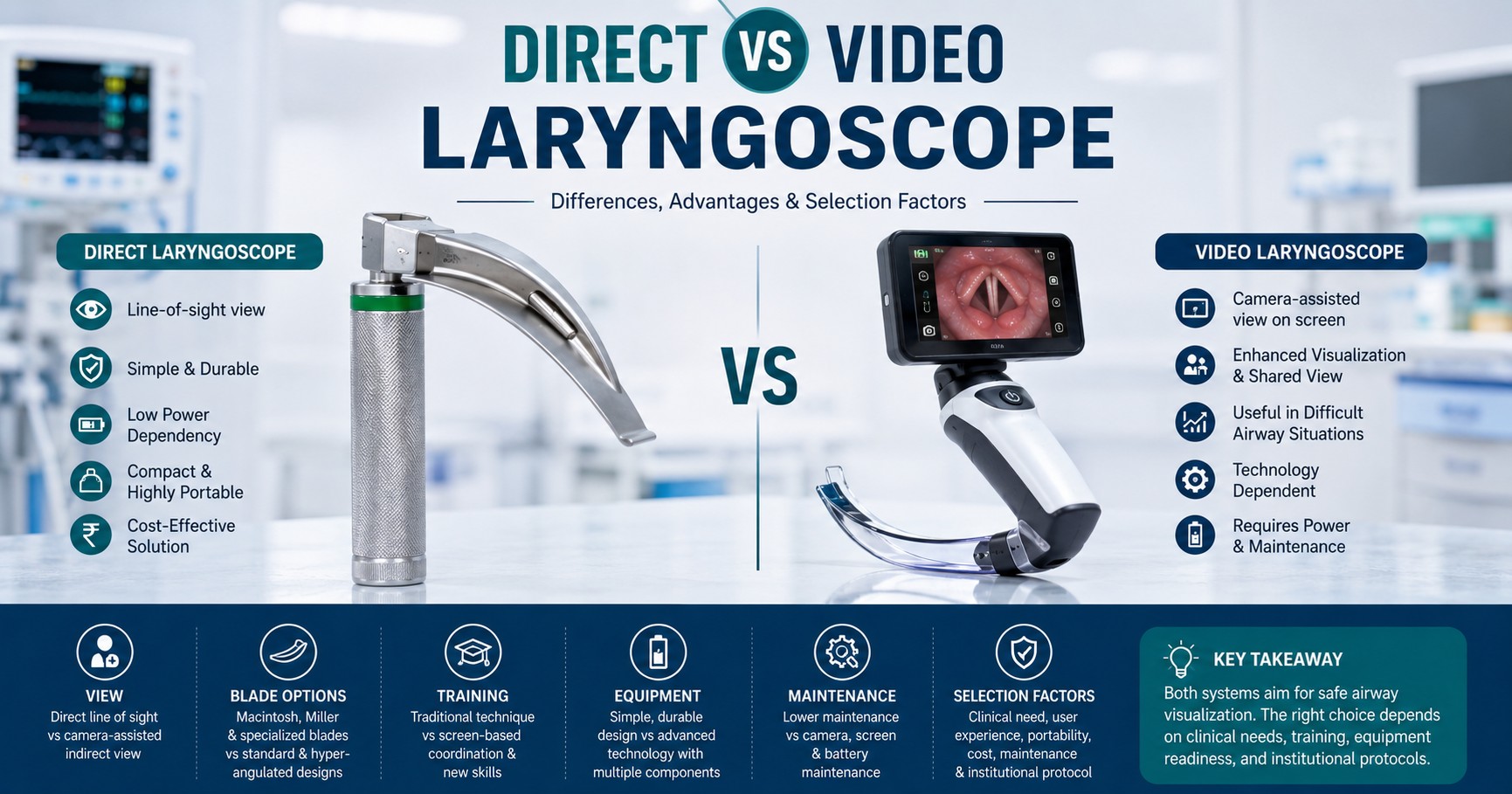
Direct and video laryngoscopes are both used to support visualisation of the larynx during airway management, but they create the view in different ways. Direct laryngoscopy depends on a line of sight through the mouth, while video laryngoscopy uses a camera near the blade tip to display an indirect image on a screen.
The clinician looks directly through the mouth toward the laryngeal structures while using the blade to create a visual pathway.
A camera positioned near the distal blade area sends an image to an integrated or external display viewed by the operator.
Important scope: This article compares equipment concepts for education and procurement planning. It does not recommend a patient-specific intubation technique. Device selection and airway management must be undertaken by appropriately trained healthcare professionals according to clinical assessment, product instructions and institutional protocols.
Direct vs Video Laryngoscope Comparison
The two systems share the general purpose of supporting visualisation during airway management, but differ in viewing method, equipment requirements and technique.
| Comparison Point | Direct Laryngoscope | Video Laryngoscope |
|---|---|---|
| View obtained | Direct visual view through the patient’s mouth. | Indirect camera image displayed on a screen. |
| Line of sight | Requires creation of a sufficiently clear optical pathway from the operator’s eye to the larynx. | Camera can provide a view without the operator’s eye being directly aligned with the larynx. |
| Image location | Observed directly at the patient. | Observed on an integrated, attached or external display. |
| Blade options | Commonly curved Macintosh, straight Miller and other specialised patterns. | May use standard-geometry, Macintosh-style, channelled or hyperangulated blades depending on the model. |
| Power dependency | Requires functioning batteries and illumination but no electronic display. | Requires functioning camera, screen, light source, cables or wireless connection where applicable, and charged batteries or power. |
| Shared view | The operator primarily sees the direct view. | The displayed image can often be viewed by the operator and other team members. |
| Tube delivery | Typically follows the direct visual pathway created by the blade. | May require a model-specific stylet, tube shape or channel, particularly with hyperangulated designs. |
| Training focus | Patient positioning, direct view, blade handling and alignment. | Blade insertion, screen coordination, camera orientation and tube advancement. |
| Maintenance focus | Blade, handle, lamp, contacts, batteries and physical condition. | Camera, screen, battery, light source, cables, connectors, software and reusable or disposable blade components. |
| IndoSurgicals current range | Conventional and fibre-optic direct laryngoscopes, blades, handles and sets. | No video laryngoscope is currently displayed in the reviewed laryngoscope category. |
Features vary significantly between video-laryngoscope models. A procurement comparison should use the specifications and instructions for the exact devices under consideration.
What Is a Direct Laryngoscope?
A direct laryngoscope is a handheld instrument that allows a trained clinician to view the laryngeal area directly through the patient’s mouth. The blade is used to displace soft tissue and create a visual pathway between the clinician’s eye and the airway structures.
Direct laryngoscopes commonly consist of a detachable blade and a battery-powered handle. Illumination may come from a blade-mounted LED lamp or from a handle-mounted light source transmitted through a fibre-optic blade.
Direct Optical Path
The operator views the airway without a camera or electronic screen between the eye and the laryngeal image.
Mechanical Simplicity
The system generally contains fewer electronic components than a video laryngoscope.
Multiple Blade Patterns
Common direct blades include curved Macintosh and straight Miller patterns in neonatal, paediatric and adult sizes.
Portable Format
A blade, compatible handle and batteries can form a compact airway device without a separate display.
Direct Does Not Mean “Without Technology”
Modern direct laryngoscopes may use LED illumination, fibre-optic light transmission, removable components and specialised blade designs. The word “direct” describes how the operator views the airway—not whether the instrument uses advanced illumination.
What Is a Video Laryngoscope?
A video laryngoscope is a laryngoscope with a camera or imaging sensor located near the distal part of the blade. The camera captures the airway image and displays it on a screen.
Because the camera is positioned closer to the laryngeal structures than the operator’s eye, the device can provide an indirect view without requiring the same straight optical pathway needed for conventional direct laryngoscopy.
A light source near the camera provides illumination within the mouth and pharynx.
The camera records the field visible from its position near the blade tip.
The image is transmitted to an integrated, attached or separate monitor.
The clinician coordinates blade movement and tube delivery while viewing the displayed image.
A good camera view does not automatically guarantee easy tube passage. Visualisation and successful delivery of the endotracheal tube are related but separate parts of the procedure. Hyperangulated systems may require a specifically shaped stylet and model-specific technique.
Standard-Geometry and Hyperangulated Video-Laryngoscope Blades
Video laryngoscopes are not one uniform device category. Their blade shape affects insertion, visualisation, tube preparation and the technique that users must learn.
| Blade Concept | General Design | Important Consideration |
|---|---|---|
| Standard-geometry video blade | Often resembles a conventional Macintosh-style blade while adding a camera and display. | Some models may allow both direct and screen-assisted viewing, but this depends on their design. |
| Hyperangulated video blade | Has a more pronounced curve designed to obtain a camera view without a direct line of sight. | Tube delivery generally requires a compatible stylet shape and specific advancement technique. |
| Channelled video blade | Contains a channel intended to guide the endotracheal tube toward the displayed airway view. | Tube compatibility, channel dimensions and removal technique vary by product. |
| Disposable video blade | A single-use blade attaches to a reusable or single-use camera and handle arrangement. | Confirm sterility status, compatibility, size range, packaging, expiry and waste requirements. |
Procurement teams should avoid comparing products only under the general term “video laryngoscope.” The selected blade geometry may materially change training, tube preparation, consumables and clinical workflow.
Potential Advantages of Direct and Video Laryngoscopes
Advantages should be considered in relation to the patient, operator, setting and exact device. Neither category performs identically in every circumstance.
- Compact equipment without a separate electronic display
- Fewer camera, monitor, cable and software dependencies
- Widely recognised Macintosh and Miller blade patterns
- Existing availability in many hospitals and emergency kits
- Reusable and disposable blade options may be available
- Potentially lower acquisition cost than advanced video systems
- Useful backup when a video device is unavailable or fails
- Camera view without requiring the same direct optical alignment
- Potentially improved laryngeal visualisation in various settings
- Displayed image can be shared with assistants and supervisors
- Can support teaching and real-time team communication
- May assist in anticipated or unanticipated difficult-airway management when used appropriately
- Some systems can record images or video where policy permits
- Different blade geometries may provide additional airway-management options
What Does Current Evidence Suggest?
Clinical trials and recent airway-management guidance have reported improved glottic views and higher first-attempt success with video laryngoscopy in many patient groups and settings. However, results depend on operator training, blade design, patient characteristics, procedural setting and the comparison device. Equipment should therefore be incorporated through a complete training and governance programme rather than purchased on the assumption that the camera alone guarantees success.
Limitations of Direct and Video Laryngoscopes
| Limitation Area | Direct Laryngoscope | Video Laryngoscope |
|---|---|---|
| Visual pathway | A difficult direct line of sight can limit the view. | The camera may see around the curve, but the image can still be obstructed by secretions, blood, fogging or tissue contact. |
| Tube advancement | The laryngeal view and tube pathway are generally aligned through the direct working space. | An excellent camera image may be obtained while tube advancement remains difficult, especially with hyperangulated blades. |
| Equipment failure | Failure may involve batteries, bulb, contacts or mechanical damage. | Failure may additionally involve the camera, display, cable, connector, software or image transmission. |
| Power requirement | Normally powered by replaceable or rechargeable handle batteries. | May require charged internal batteries, screen power and model-specific charging systems. |
| Training transfer | Skills require practice and may deteriorate if rarely used. | Technique can differ substantially across standard, channelled and hyperangulated models. |
| Cost | Usually fewer high-cost electronic components. | May involve higher purchase, consumable, repair, battery and replacement-screen costs. |
| Portability | Generally compact, although complete size ranges still require organised storage. | Portability varies from pocket-sized integrated units to systems with separate monitors and carts. |
| Reprocessing | Blade and handle require validated reusable-device processing where reusable. | Reusable camera sticks, screens, cables and blades may each have different cleaning and disinfection requirements. |
Do not compare only the airway image. A procurement assessment should also examine first-attempt performance, tube-delivery workflow, training time, device readiness, consumables, cleaning, maintenance and backup arrangements.
Training and Familiarity Matter More Than the Device Label
A hospital cannot safely introduce a video laryngoscope merely by placing it on an airway trolley. Users require structured training on the exact device, including blade choice, insertion, screen orientation, tube preparation, stylet use, troubleshooting and conversion to an alternative plan.
Direct-Laryngoscopy Skills
Include positioning, blade insertion, tissue displacement, direct laryngeal exposure, external manipulation and tube delivery.
Video-Laryngoscopy Skills
Include screen-hand coordination, camera orientation, control of insertion depth, stylet shaping, tube rotation and management of an obscured image.
Team Communication
A shared display may help the team understand the view, but roles, commands and rescue plans still require prior agreement.
Ongoing Competency
Initial training should be followed by supervised practice, competency assessment, refresher training and review of difficult or failed attempts.
Video Laryngoscopy Can Support Teaching
A shared screen can allow an experienced supervisor to see the same airway image as the learner and provide immediate guidance. This makes video laryngoscopy useful as a teaching and feedback tool, provided training remains structured and patient safety is prioritised.
Battery, Screen, Camera and Maintenance Considerations
Both devices must be checked before use, but video laryngoscopes introduce additional electronic dependencies.
| Readiness Check | Direct Laryngoscope | Video Laryngoscope |
|---|---|---|
| Power | Check batteries, cap, contacts and lamp output. | Check camera, screen and handle charge, battery indicator and charging accessories. |
| Image | Confirm bright, stable illumination. | Confirm clear image, correct orientation, brightness and absence of artefacts. |
| Physical condition | Inspect blade, handle, tip, hinge and connection. | Also inspect camera lens, display, cables, connectors, mounting points and protective covers. |
| Accessories | Confirm required blade sizes, spare handle, batteries and bulbs. | Confirm compatible blades, stylets, cables, chargers, screen mount and disposable accessories. |
| Reprocessing status | Confirm reusable blade and handle were processed and stored as required. | Confirm blade, camera stick, handle, cable and screen were processed according to their individual instructions. |
| Backup | Keep an alternative blade, handle and airway plan available. | Keep an alternative airway device available in case of camera, screen or power failure. |
Video-Laryngoscope Maintenance Questions
- How long does the battery operate between charges?
- Can the battery be replaced locally, or must the device be returned for service?
- How is the camera lens cleaned and disinfected?
- Are blades reusable, disposable or available in both forms?
- Does the system require proprietary stylets or other consumables?
- Can the screen, camera and cable be replaced separately?
- Are software or firmware updates required?
- What is the warranty and repair turnaround time?
- What backup equipment is recommended during servicing?
Emergency Department, ICU and Operating-Theatre Considerations
Operating Theatre
Consider the full range of elective and emergency cases, staff training, difficult-airway plans, turnover, cleaning and access to alternative devices.
Emergency Department
Equipment must be immediately accessible, consistently charged, available in appropriate sizes and familiar to clinicians working under time pressure.
Intensive Care Unit
Bedside space, critical illness, positioning limitations, secretions, urgency and equipment portability may affect device selection and preparation.
Ambulance and Transport
Assess portability, battery life, ruggedness, screen visibility, temperature limits, storage security, disposable supplies and ability to clean the device.
Paediatric and Neonatal Areas
Confirm that appropriate blade patterns and sizes are available and that staff have training on the exact paediatric or neonatal system.
Training Institution
A shared screen may support teaching, but learners should receive structured instruction in equipment preparation, direct and video techniques and rescue plans.
How Should a Hospital Select a Laryngoscope System?
Selection should begin with clinical and operational requirements rather than choosing a device only because it is newer or less expensive.
Hospital Selection Checklist
| Procurement Question | Why It Matters |
|---|---|
| Can the device be used by all relevant departments? | A system restricted to one location may not support emergencies elsewhere. |
| Are all required blade sizes available? | A display unit has limited value without the sizes needed for the hospital’s patient population. |
| Can users train on the exact model? | Techniques differ between standard-geometry, hyperangulated and channelled systems. |
| What happens when the screen or camera fails? | The airway trolley must include a tested alternative device and escalation plan. |
| Are replacement parts and consumables available locally? | Proprietary blades, stylets, batteries and cables can affect long-term availability and cost. |
| Can the facility clean and store the system correctly? | Screens, camera modules, handles, cables and blades may have separate reprocessing requirements. |
Why Hospitals May Maintain Both Direct and Video Laryngoscopes
Direct and video laryngoscopes should not always be treated as mutually exclusive purchases. A hospital may maintain both because each provides a different combination of viewing method, blade design, equipment dependency and backup capability.
Alternative Viewing Method
A camera-assisted view may be useful when direct visualisation is difficult, while a direct device remains available when the camera system cannot be used.
Equipment-Failure Backup
Direct laryngoscopes can provide a compact alternative during screen, cable, battery or camera failure.
Different Blade Requirements
Standard direct blades, Macintosh-style video blades and hyperangulated blades offer different equipment options.
Training and Skill Retention
Maintaining competency with more than one approved device can support a broader difficult-airway strategy.
The number and type of devices should be determined through the facility’s airway-management committee, clinical governance process, training capacity and equipment-maintenance system.
Direct Laryngoscopes Available from IndoSurgicals
IndoSurgicals currently displays conventional LED and fibre-optic direct laryngoscope sets, individual Macintosh and Miller blades, handles, replacement bulbs, McCoy-type blades and disposable direct fibre-optic laryngoscopes.
Product transparency: IndoSurgicals does not currently display a video laryngoscope in the reviewed product category. This article is therefore an educational comparison and should not imply that video-laryngoscope models are manufactured, stocked or supplied by IndoSurgicals.
| Direct-Laryngoscope Type | Blade Pattern | Product Option |
|---|---|---|
| Conventional LED | Macintosh | View Macintosh LED laryngoscope sets |
| Conventional LED | Miller | View Miller LED laryngoscope sets |
| Fibre Optic with LED Light Source | Macintosh | View fibre-optic Macintosh sets |
| Fibre Optic with LED Light Source | Miller | View fibre-optic Miller sets |
| Complete Product Category | Multiple direct blade and handle options | Explore the complete laryngoscope range |
Common Mistakes When Comparing Direct and Video Laryngoscopes
Assuming every video laryngoscope works the same way
Standard-geometry, hyperangulated and channelled blades require different techniques and accessories.
Treating a better camera view as guaranteed intubation success
Tube delivery may remain difficult even when the displayed laryngeal image is clear.
Purchasing without a training programme
Staff need supervised practice and competency assessment on the exact device and blade geometry.
Ignoring charging and battery readiness
A video laryngoscope with a discharged screen or handle cannot provide its intended benefit during an emergency.
Forgetting proprietary consumables
Blades, stylets, cables, protective covers and batteries may be specific to one system and can affect availability and cost.
Removing every direct laryngoscope after buying video equipment
Hospitals may still require direct equipment for backup, alternative techniques, specific blade requirements and equipment failure.
Publishing competitor-brand content without a business reason
A neutral educational comparison can target relevant search intent without promoting brands that IndoSurgicals does not manufacture or supply.
Frequently Asked Questions
What is the difference between direct and video laryngoscopy?
Direct laryngoscopy requires the operator to look directly through the mouth toward the larynx. Video laryngoscopy uses a camera near the blade tip and displays the airway image on a screen.
What is a video laryngoscope?
A video laryngoscope is a camera-equipped airway device that sends an image from near the blade tip to a display viewed by the clinician.
Is a video laryngoscope the same as a fibre-optic laryngoscope?
No. A fibre-optic direct laryngoscope uses optical fibres to transmit illumination from the handle to the blade tip, but the clinician still obtains a direct view. A video laryngoscope uses a camera to create an image on a screen.
Is a video laryngoscope always better than a direct laryngoscope?
No single device is automatically best for every patient, operator and setting. Video systems can improve visualisation and may improve first-attempt success in many circumstances, but safe use depends on blade choice, training, tube-delivery technique, equipment readiness and a backup plan.
What is a hyperangulated video-laryngoscope blade?
It is a video blade with a pronounced curve designed to obtain a camera view without a direct line of sight. It commonly requires a specifically shaped stylet and model-specific tube-delivery technique.
Can a video laryngoscope also provide a direct view?
Some standard-geometry video laryngoscopes may permit both direct and screen-assisted viewing. Hyperangulated models are generally designed primarily for camera-assisted viewing. The exact capability depends on the device.
Why can tube passage be difficult despite a clear video image?
The camera can see around a curved pathway that the endotracheal tube must still physically follow. Tube shape, stylet angle, blade depth, rotation and technique affect successful advancement.
What can block the camera view?
Blood, secretions, fogging, tissue contact, contamination, lens damage or incorrect blade positioning may obscure the displayed image.
Does a hospital still need direct laryngoscopes after purchasing video equipment?
Many facilities maintain direct laryngoscopes as alternative or backup equipment and for users or clinical situations in which a direct technique remains part of the approved airway plan.
Which system is more portable?
A standard direct laryngoscope is generally compact. Video systems vary from small integrated devices to larger systems with separate displays, cables and charging equipment.
Does IndoSurgicals sell video laryngoscopes?
A video laryngoscope is not currently displayed in the reviewed IndoSurgicals laryngoscope category. The current online range focuses on conventional LED and fibre-optic direct laryngoscopes, blades, handles and related components.
What information should a hospital include in a laryngoscope enquiry?
Specify the required direct-laryngoscope type, illumination system, Macintosh or Miller pattern, blade sizes, reusable or disposable preference, quantity, delivery location and any required documentation.
Authoritative Airway-Management References
Clinical policies should be based on current professional guidance, device-specific instructions, local resources and formal airway training.
Looking for Direct Laryngoscope Blades and Sets?
IndoSurgicals supplies conventional LED and fibre-optic Macintosh and Miller direct laryngoscope sets, individual blades, handles, disposable options and replacement components. Share your required blade pattern, sizes, quantity and delivery location for an accurate quotation.
Clinical and Product Disclaimer
This article is intended for general product education and hospital procurement planning. It does not provide medical advice, clinical training, a difficult-airway algorithm or patient-specific instructions.
Laryngoscopy and tracheal intubation must be performed only by appropriately trained healthcare professionals using equipment, techniques and rescue plans approved by their healthcare facility.
Product features, blade geometry, camera design, accessories, compatibility, reprocessing and maintenance requirements vary by model. Always review the manufacturer’s instructions for the exact direct or video laryngoscope before procurement, training or use.