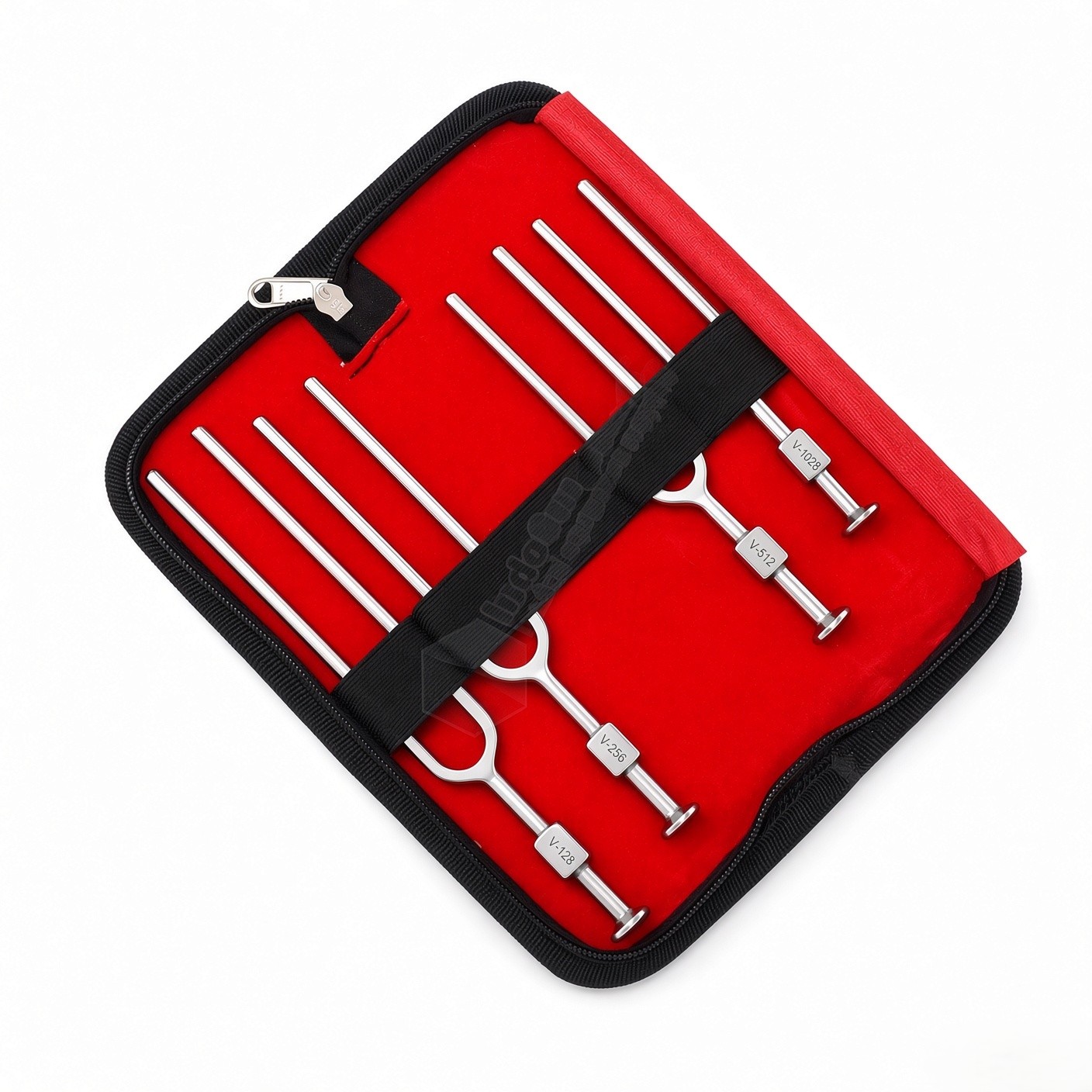
Stainless steel medical tuning fork set containing 128 Hz, 256 Hz, 512 Hz and 1024 Hz frequencies for vibration-sense examination, selected hearing and bone-conduction assessments, Rinne and Weber tests, frequency comparison and clinical teaching.
The IndoSurgicals Tuning Fork Set of 4 combines four useful medical frequencies: 128 Hz, 256 Hz, 512 Hz and 1024 Hz.
Different tuning-fork frequencies produce different combinations of audible pitch, tone duration and tactile vibration. A multi-frequency set allows healthcare professionals and medical students to select an appropriate fork according to the clinical examination or teaching requirement.
The four tuning forks are manufactured from stainless steel and supplied together in a convenient zipper bag for organised storage and transportation.
Includes 128 Hz, 256 Hz, 512 Hz and 1024 Hz tuning forks for several clinical and educational applications.
Manufactured from stainless steel for durable professional, institutional and teaching use.
Includes a 128 Hz fork particularly suitable for neurological assessment of vibration perception.
Includes a 512 Hz fork, commonly preferred for routine bedside Rinne and Weber hearing examinations.
The 1024 Hz fork provides an additional higher-pitched auditory stimulus for selected examination and teaching.
Complete four-piece set is supplied in a convenient zipper bag for organised storage and portability.
The four frequencies are not interchangeable for every examination. Each provides different acoustic and tactile characteristics.
Produces pronounced tactile vibration and is particularly useful for assessment of vibration perception over appropriate bony prominences.
Produces both an audible tone and noticeable tactile vibration and may be used for selected hearing, bone-conduction and sensory examination techniques.
Commonly preferred for bedside Rinne and Weber examinations because it provides a useful balance between audible tone duration and tactile vibration.
Produces a higher-pitched tone with less tactile vibration and may be useful for selected auditory, bone-conduction and frequency-comparison applications.
The 128 Hz tuning fork may be used during neurological assessment of vibratory sensation at suitable bony prominences.
The 512 Hz tuning fork can be used to compare air conduction and bone conduction during bedside hearing assessment.
The 512 Hz tuning fork may be used to assess whether a bone-conducted tone is perceived centrally or lateralised toward one ear.
The 128 Hz tuning fork is particularly useful during neurological sensory examination because its relatively low frequency produces a readily perceptible mechanical vibration.
The activated fork can be placed on an appropriate bony prominence while the patient reports whether vibration can be perceived.
Perception may be compared between corresponding sides or progressively more proximal sites according to the neurological examination being performed.
The 512 Hz tuning fork is the principal frequency in this set for routine bedside Rinne and Weber hearing examinations.
It provides a useful balance between audible tone duration and relatively low tactile vibration, reducing the possibility of physical vibration being mistaken for hearing.
Compares air conduction with bone conduction in an individual ear and can provide bedside information regarding a possible conductive component of hearing impairment.
Assesses lateralisation of a bone-conducted tone between the ears and is generally interpreted together with the Rinne test.
The 256 Hz tuning fork produces more tactile vibration than the 512 Hz model while also producing an audible tone.
It may be used in selected bone-conduction, hearing and sensory demonstrations and is useful in medical teaching for comparing the characteristics of lower- and higher-frequency tuning forks.
The included 1024 Hz tuning fork produces a higher-pitched tone than the 128 Hz, 256 Hz and 512 Hz forks in the set.
It can provide an additional frequency for selected auditory assessment, bone-conduction examination, frequency comparison and clinical teaching.
The 1024 Hz fork provides a substantially higher acoustic frequency than the other three forks in this set.
Higher-frequency tuning forks generally have a shorter useful tone-decay period, which is one reason the 512 Hz fork is normally preferred for routine Rinne and Weber testing.
A tuning fork consists of a handle connected to two parallel prongs or tines. When activated, the tines vibrate at their defined nominal frequency and produce both mechanical vibration and an audible tone.
Select 128 Hz, 256 Hz, 512 Hz or 1024 Hz according to the clinical examination or teaching exercise.
Hold the instrument by the handle and activate the tines using an appropriate clinical technique.
Depending on the examination, the vibrating fork may be positioned near the ear or its base may be placed against an appropriate bony landmark.
The patient's perception is assessed and interpreted according to the specific clinical test being performed.
Different tuning-fork frequencies behave differently. Lower frequencies produce stronger tactile vibration, whereas progressively higher frequencies produce higher-pitched tones with different decay characteristics.
One set provides frequency options for vibration-sense testing, bedside hearing examination, bone-conduction assessment and selected auditory comparisons.
Students can directly compare the tactile and acoustic characteristics of 128 Hz, 256 Hz, 512 Hz and 1024 Hz tuning forks during clinical-skills training.
The IndoSurgicals Tuning Fork Set of 4 is manufactured from stainless steel, providing durable medical instruments suitable for repeated professional, institutional and educational use.
Each tuning fork operates entirely through mechanical vibration and requires no battery, charging or external electrical power source.
The four-piece configuration is convenient for hospitals, clinics, examination rooms, medical colleges and clinical-skills laboratories.
The complete Tuning Fork Set of 4 is supplied in a convenient zipper bag that keeps the 128 Hz, 256 Hz, 512 Hz and 1024 Hz forks organised together.
The bag provides convenient storage and transportation for healthcare professionals, hospitals, medical colleges and clinical training institutions.
| Product Name | Tuning Fork Set of 4 (128 Hz, 256 Hz, 512 Hz, 1024 Hz) in Zipper Bag |
|---|---|
| Brand | IS IndoSurgicals® |
| Number of Tuning Forks | 4 |
| Frequencies Included | 128 Hz, 256 Hz, 512 Hz and 1024 Hz |
| Material | Stainless Steel |
| Storage | Zipper Bag |
| Power Requirement | None |
| 128 Hz Application | Vibration-sense and neurological sensory examination |
| 256 Hz Application | Selected hearing, bone-conduction and sensory examination |
| 512 Hz Application | Rinne and Weber bedside hearing tests |
| 1024 Hz Application | Selected higher-frequency auditory, bone-conduction and teaching applications |
| Suitable For | Doctors, ENT professionals, physicians, healthcare professionals, hospitals, clinics, medical colleges, students and clinical training institutions |
The four tuning-fork frequencies provide useful tools for bedside examination, neurological assessment and medical teaching, but the appropriate frequency should be selected according to the particular examination being performed.
IndoSurgicals Private Limited manufactures, supplies and exports medical tuning forks and diagnostic instruments for hospitals, healthcare professionals, medical institutions, dealers and distributors.
The IndoSurgicals Tuning Fork Set of 4 combines 128 Hz, 256 Hz, 512 Hz and 1024 Hz stainless steel tuning forks in a convenient zipper bag for sensory, hearing, bone-conduction and medical teaching requirements.
Explore the complete range of Medical Tuning Forks or browse Diagnostic Equipment from IndoSurgicals.
Contact IndoSurgicals for Tuning Fork Set of 4 product information, hospital procurement, institutional requirements, dealer and distributor enquiries, bulk quantities or international export requirements.
Contact IndoSurgicalsProduct images and specifications are provided for general reference. Product design, colour, packaging and specifications may be updated without prior notice. Please confirm current specifications, certification scope and regulatory applicability before ordering.