

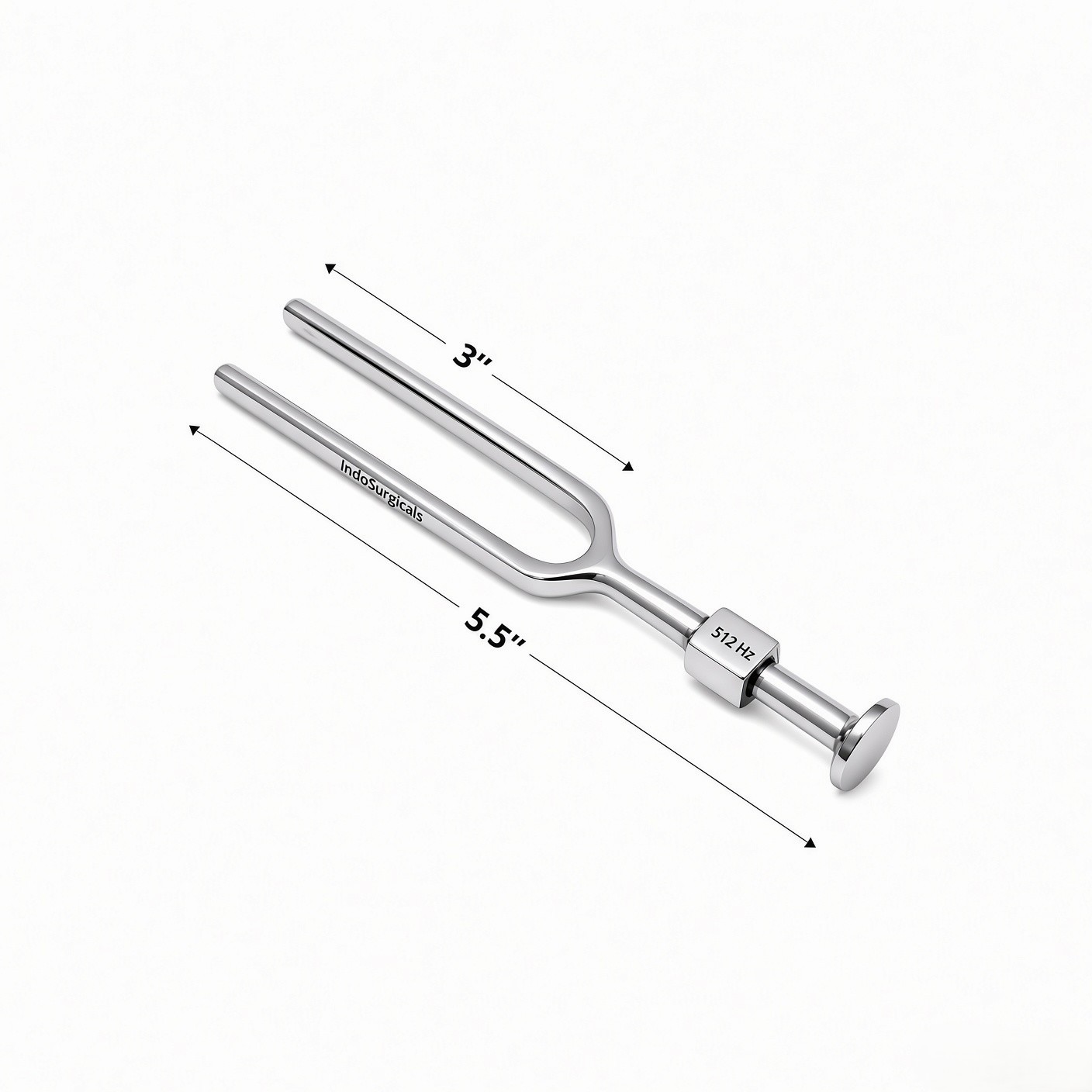
Tuning Fork 512 Hz
Medical diagnostic tuning fork designed primarily for Rinne and Weber hearing tests, air-conduction and bone-conduction comparison, and bedside hearing assessment, with durable steel construction and an extended smooth-metal handle for convenient clinical use.
512 Hz Medical Tuning Fork for Rinne & Weber Tests
The IndoSurgicals Tuning Fork 512 Hz is a medical diagnostic instrument designed for bedside assessment of hearing and is particularly suitable for performing Rinne and Weber tuning-fork tests.
The 512 Hz frequency is widely used in clinical hearing examination because it provides a useful balance between audible tone duration and relatively low tactile vibration. This helps reduce the possibility of a patient confusing physical vibration with an audible sound during bone-conduction testing.
Its durable steel construction, lightweight design and extended turned smooth-metal handle make the instrument convenient for doctors, ENT professionals, healthcare practitioners, hospitals, clinics and medical teaching institutions.
A commonly preferred tuning-fork frequency for bedside hearing assessment because it provides a clinically useful audible tone while producing less tactile vibration than lower-frequency tuning forks.
Key Features
512 Hz Frequency
A commonly preferred frequency for clinical Rinne and Weber tuning-fork hearing tests.
Rinne Test
Suitable for comparing air conduction and bone conduction during bedside assessment of hearing.
Weber Test
Suitable for assessing lateralisation of sound during clinical evaluation of asymmetric hearing impairment.
Bone-Conduction Testing
Extended smooth handle allows convenient placement against appropriate bony landmarks during examination.
Steel Construction
Manufactured from quality steel for durability and dependable mechanical performance in professional use.
One-Year Warranty
Covered by a one-year warranty against applicable manufacturing and material defects.
Clinical Uses of the 512 Hz Tuning Fork
Rinne Test
The Rinne test compares a patient's perception of sound through air conduction and bone conduction. It provides useful bedside information when assessing possible conductive hearing loss.
Weber Test
The Weber test evaluates whether a bone-conducted tone is perceived equally in both ears or lateralises toward one side, assisting clinical assessment of asymmetric hearing loss.
Hearing Examination
Rinne and Weber findings can be combined with history, otoscopy and formal audiological testing when evaluating a patient with suspected hearing impairment.
Why 512 Hz is Preferred for Rinne & Weber Testing
Selecting an appropriate tuning-fork frequency is important during hearing assessment. Lower-frequency tuning forks produce stronger tactile vibration, while very high-frequency forks have a shorter audible decay time.
Compared with 128 Hz and 256 Hz forks, a 512 Hz tuning fork produces less prominent tactile vibration, helping the patient distinguish sound from vibration.
The frequency provides sufficient audible duration for practical comparison of air and bone conduction during a Rinne examination.
The 512 Hz tuning fork is widely used for routine bedside Rinne and Weber testing in ENT and general medical examination.
Use in the Rinne Test
The Rinne test compares air conduction with bone conduction in each ear. It is a bedside screening examination that can help identify a pattern consistent with conductive hearing impairment.
Activate the Tuning Fork
Hold the tuning fork by its handle and activate the tines using an appropriate clinical technique to produce a clear audible tone.
Assess Bone Conduction
Place the base of the vibrating tuning fork on the mastoid area according to the standard examination technique and ask the patient to indicate when the tone is no longer heard.
Assess Air Conduction
Move the vibrating tines appropriately near the external auditory canal and ask whether the patient can again hear the tone.
Interpret the Response
In normal hearing and many sensorineural losses, air conduction is typically perceived better than bone conduction. A reversal of this relationship may indicate a conductive component and requires appropriate clinical interpretation.
Use in the Weber Test
The Weber test assesses lateralisation of a bone-conducted sound and is commonly performed together with the Rinne test.
Midline Placement
The base of the activated tuning fork is placed on an appropriate midline bony location, commonly the forehead or another suitable midline site according to the examiner's technique.
Assess Sound Lateralisation
The patient is asked whether the tone is heard equally in both ears or louder in one ear. Lateralisation is interpreted together with the Rinne test and other hearing findings.
Understanding Rinne & Weber Findings
Conductive Hearing Loss
Conductive hearing impairment alters transmission of sound through the external or middle ear. Rinne and Weber responses may show characteristic patterns that help the clinician decide whether further audiological evaluation is required.
Sensorineural Hearing Loss
Sensorineural hearing impairment involves the inner ear or auditory neural pathway. Weber lateralisation and Rinne findings are interpreted together when assessing possible asymmetric sensorineural loss.
Durable Steel Construction & Extended Handle
The IndoSurgicals Tuning Fork 512 Hz is constructed from quality steel and designed for repeated professional examination.
Its extra-long, turned smooth-metal handle provides a comfortable holding area and facilitates controlled placement during bone-conduction examination while helping minimise unnecessary contact with the vibrating tines.
Lightweight & Portable
The compact design makes the tuning fork convenient for outpatient clinics, bedside examination, examination kits and medical teaching.
No External Power Required
The instrument operates entirely through mechanical vibration and requires no battery, charger or external electrical power source.
Clinical Applications
Medical Tuning Fork Frequencies
Different frequencies provide different combinations of audible tone, tone duration and tactile vibration. The appropriate frequency should therefore be selected according to the clinical examination being performed.
Designed for Professional & Teaching Use
The Tuning Fork 512 Hz is a simple but valuable bedside examination instrument for ENT specialists, physicians, general practitioners, audiology professionals and other trained healthcare personnel.
It is also suitable for medical colleges and clinical-skills laboratories where students learn standard Rinne, Weber and bone-conduction examination techniques.
Product Information
| Product Name | Tuning Fork 512 Hz |
|---|---|
| Brand | IS IndoSurgicals® |
| Frequency | 512 Hz |
| Instrument Type | Medical Diagnostic Tuning Fork |
| Construction | Steel |
| Handle | Extra-long turned smooth-metal handle |
| Primary Applications | Rinne test, Weber test, air-conduction and bone-conduction hearing assessment |
| Power Requirement | None |
| Warranty | One year against applicable manufacturing and material defects |
| Other Available Frequencies | 128 Hz, 256 Hz and 1024 Hz configurations may also be available |
| Suitable For | ENT specialists, physicians, healthcare professionals, hospitals, clinics, medical colleges and clinical training institutions |
Professional Medical Examination Instrument
Rinne and Weber tests provide rapid bedside information about hearing function but should be interpreted within the context of the patient's history, otoscopic examination and other relevant findings.
Tuning Fork 512 Hz Manufacturer & Supplier in India
IndoSurgicals Private Limited manufactures, supplies and exports medical tuning forks and diagnostic instruments for hospitals, healthcare professionals, medical institutions, dealers and distributors.
The IndoSurgicals Tuning Fork 512 Hz combines durable steel construction, an extended smooth-metal handle and a clinically useful 512 Hz frequency for Rinne, Weber and bone-conduction hearing examinations.
Explore the complete range of Medical Tuning Forks or browse Diagnostic Equipment from IndoSurgicals.
Institutional, Dealer & Export Requirements
Contact IndoSurgicals for Tuning Fork 512 Hz product information, hospital procurement, institutional requirements, dealer and distributor enquiries, bulk quantities or international export requirements.
Contact IndoSurgicals