

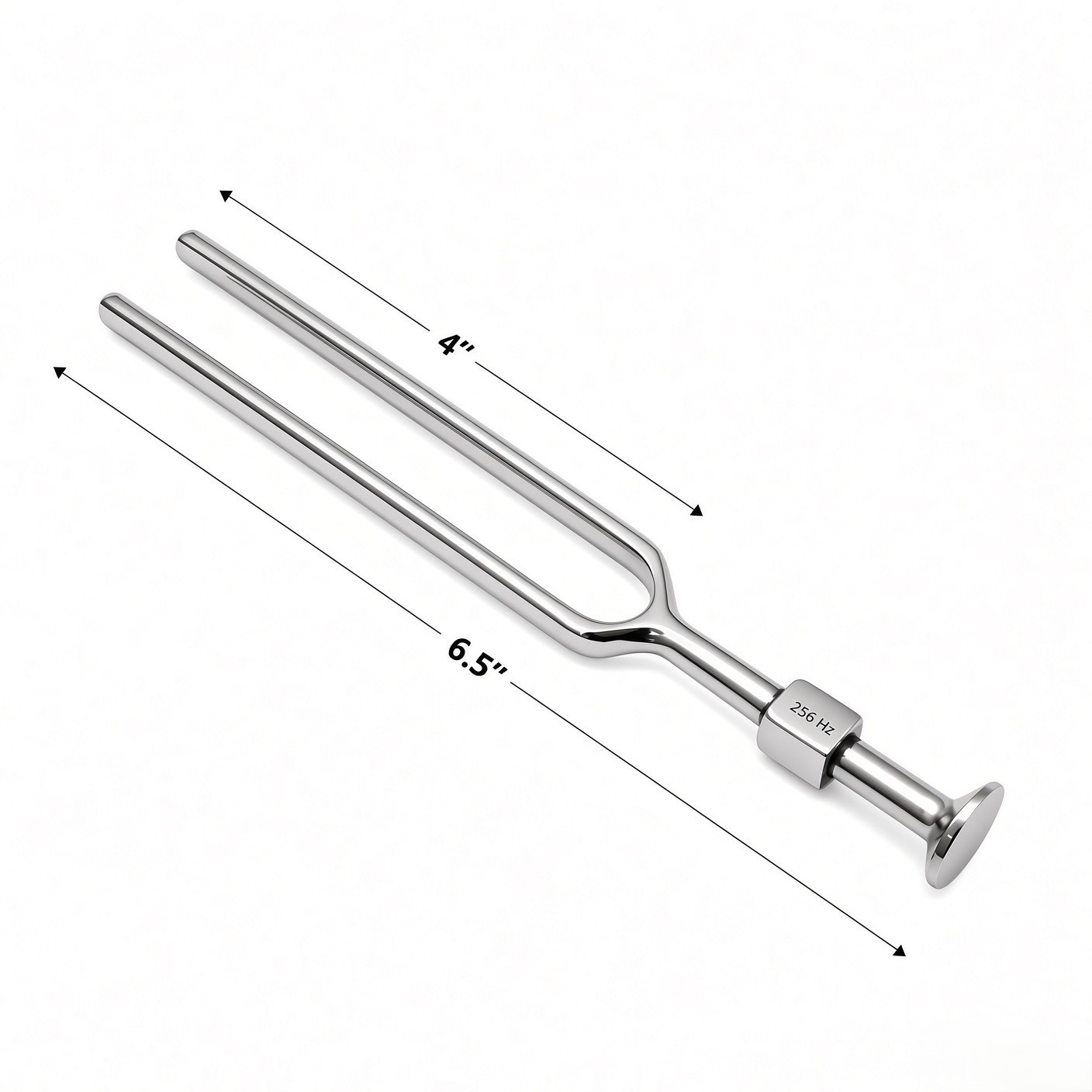
Tuning Fork 256 Hz
Medical tuning fork designed for clinical hearing assessment, bone-conduction examination and vibration-sensation testing, featuring durable steel construction, an extended smooth handle and a nominal frequency of 256 Hz.
256 Hz Medical Tuning Fork for Clinical Examination
The IndoSurgicals Tuning Fork 256 Hz is a mechanical diagnostic instrument used by healthcare professionals during selected hearing, bone-conduction and sensory examinations.
When activated, the steel tines vibrate at a nominal frequency of 256 Hz. The resulting audible tone and mechanical vibration allow the instrument to be used in appropriate bedside hearing tests as well as selected neurological vibration-sense examinations.
Its lightweight construction and extended smooth metal handle provide convenient control during testing, while the battery-free mechanical design makes the instrument suitable for hospitals, clinics, medical colleges and portable examination kits.
A traditional clinical tuning-fork frequency used for selected hearing and bone-conduction tests and also capable of producing tactile vibration for sensory examination.
Key Features
256 Hz Frequency
Produces a defined low-frequency tone and mechanical vibration suitable for selected clinical examination techniques.
Hearing Assessment
May be used for bedside tuning-fork hearing tests, including appropriate air- and bone-conduction comparisons.
Bone Conduction
Extended handle allows convenient placement of the vibrating base on appropriate bony landmarks during clinical testing.
Vibration Sensation
The pronounced tactile vibration of a 256 Hz fork also allows use in selected neurological sensory examination.
Steel Construction
Manufactured from quality steel for durability and dependable mechanical performance in professional use.
One-Year Warranty
Covered by a one-year warranty against applicable manufacturing and material defects.
Clinical Uses of a 256 Hz Tuning Fork
Rinne Test
A 256 Hz tuning fork may be used to compare air conduction and bone conduction during a Rinne test. The result contributes to bedside assessment of conductive hearing impairment.
Weber Test
During a Weber test, the vibrating fork is placed at an appropriate midline bony site and the patient reports whether the sound is perceived centrally or lateralised toward one ear.
Vibration Sense Testing
Because 256 Hz produces appreciable tactile vibration, it may also be used during selected neurological assessment of vibration perception.
Use in the Rinne Test
The Rinne test compares a patient's perception of sound through bone conduction with perception through air conduction. The result provides bedside information that may assist in distinguishing patterns associated with conductive hearing loss.
Activate the Tuning Fork
Hold the instrument by its handle and activate the tines using an appropriate clinical technique.
Assess Bone Conduction
The base of the vibrating fork is placed against the appropriate mastoid area according to the standard examination technique.
Assess Air Conduction
When the patient no longer perceives the tone by bone conduction, the vibrating tines are positioned appropriately near the external ear to assess continued perception through air conduction.
Interpret Clinically
The patient's response is interpreted together with otoscopic examination, Weber testing, audiometry and other relevant clinical findings.
Use in the Weber Test
The Weber test is a bedside bone-conduction examination used to assess lateralisation of sound between the two ears.
Midline Bone Conduction
The activated tuning fork is placed at an appropriate midline bony location such as the forehead or vertex, according to the examiner's clinical technique.
Patient Response
The patient reports whether the sound is heard equally in both ears or appears louder on one side. Lateralisation is interpreted together with the Rinne test and other hearing assessment findings.
Use for Vibration-Sensation Assessment
Lower-frequency tuning forks produce greater tactile vibration than higher-frequency forks. The 256 Hz model may therefore also be used during selected neurological examinations where perception of vibration is being assessed.
The base of the activated tuning fork may be applied to an appropriate bony prominence while the patient reports whether vibration is perceived. Findings should be interpreted within the context of the complete neurological and sensory examination.
Durable Steel Construction
The IndoSurgicals Tuning Fork 256 Hz is manufactured with a steel bar construction designed for repeated professional use.
Its extended turned smooth-metal handle allows the instrument to be held comfortably while minimising unnecessary contact with the vibrating tines. This facilitates controlled placement during bone-conduction and vibration-sense examinations.
Lightweight & Portable
Compact mechanical construction allows convenient storage in examination rooms, diagnostic kits and medical teaching laboratories.
No External Power Required
The tuning fork operates entirely through mechanical vibration and therefore requires no battery, electrical supply or charging.
Clinical Applications
Different Medical Tuning Fork Frequencies
The frequency of a tuning fork influences the balance between audible tone, tone duration and tactile vibration. Different frequencies may therefore be selected for different clinical purposes.
Suitable for Clinical & Teaching Use
The simple mechanical design of the Tuning Fork 256 Hz makes it useful for doctors, ENT professionals, audiology personnel, healthcare professionals, medical students and clinical instructors.
Its portability also makes it convenient for bedside examinations, outpatient clinics, medical teaching, screening environments and portable diagnostic kits.
Product Information
| Product Name | Tuning Fork 256 Hz |
|---|---|
| Brand | IS IndoSurgicals® |
| Frequency | 256 Hz |
| Instrument Type | Medical Diagnostic Tuning Fork |
| Construction | Steel |
| Handle | Extended turned smooth-metal handle |
| Primary Applications | Hearing assessment, bone-conduction examination and vibration-sensation testing |
| Power Requirement | None |
| Warranty | One year against applicable manufacturing and material defects |
| Available Frequencies | Tuning forks may also be available in 128 Hz, 512 Hz and 1024 Hz configurations |
| Suitable For | Doctors, ENT professionals, healthcare personnel, hospitals, clinics, medical colleges and clinical training institutions |
Professional Medical Examination Instrument
Tuning-fork tests provide useful bedside clinical information, but they are not substitutes for formal audiometry, neurological assessment or other appropriate diagnostic tests when these are clinically indicated.
Tuning Fork 256 Hz Manufacturer & Supplier in India
IndoSurgicals Private Limited manufactures, supplies and exports medical tuning forks and diagnostic instruments for hospitals, healthcare professionals, medical institutions, dealers and distributors.
The IndoSurgicals Tuning Fork 256 Hz combines durable steel construction, an extended smooth handle and a defined 256 Hz frequency for appropriate hearing, bone-conduction and sensory examination.
Explore the complete range of Medical Tuning Forks or browse Diagnostic Equipment from IndoSurgicals.
Institutional, Dealer & Export Requirements
Contact IndoSurgicals for Tuning Fork 256 Hz product information, hospital procurement, institutional requirements, dealer and distributor enquiries, bulk quantities or international export requirements.
Contact IndoSurgicals