

What Is a Stethoscope? Parts, Uses, Working Principle and Labelled Diagram
A stethoscope is one of the most familiar medical instruments, but every part of it has a specific role in carrying body sounds to the listener’s ears. This guide explains stethoscope anatomy, its working principle, common uses, the difference between the bell and diaphragm, and the limitations of acoustic listening.
A stethoscope is a medical instrument used to listen to sounds produced inside the human body. Doctors, nurses, medical students and other trained healthcare professionals commonly use it to assess heart sounds, breathing sounds, bowel activity and blood flow. The clinical process of listening to these internal sounds is called auscultation.
A conventional acoustic stethoscope may look simple, but every component has a specific function. Its diaphragm or bell receives vibrations from the patient’s body, the tubing carries acoustic pressure waves, and the headset delivers those sounds to the listener’s ears.
A stethoscope supports clinical examination, but it does not diagnose a disease by itself. Correct interpretation of heart, lung and other body sounds requires appropriate medical education, supervised training and consideration of the patient’s complete clinical condition.
Video Guide
Parts and Details of a Stethoscope
Watch this detailed explanation of the ear tips, binaural tubes, binaural spring, flexible tubing, stem, chest piece, diaphragm, bell and other important parts of an acoustic stethoscope.
Continue below for a detailed explanation of each stethoscope component.
What Is a Stethoscope in Simple Words?
A stethoscope is a listening instrument designed to transmit sounds and vibrations from a patient’s body to the ears of a healthcare professional. It is most frequently associated with examination of the chest, but it is also used while assessing the abdomen and certain blood vessels.
Most commonly used models are acoustic stethoscopes. They work without batteries or electronic amplification. Digital or electronic stethoscopes convert acoustic vibrations into electronic signals and may provide amplification, recording, filtering or wireless transmission.
What Is Auscultation?
Auscultation is the clinical process of listening to sounds generated within the body. A trained healthcare professional may evaluate their frequency, rhythm, pitch, intensity, duration and quality.
Auscultation is one part of a broader clinical examination. Findings must be considered with the patient’s symptoms, history, vital signs and any other investigations required by a qualified healthcare professional.
Main Parts of a Stethoscope and Their Functions
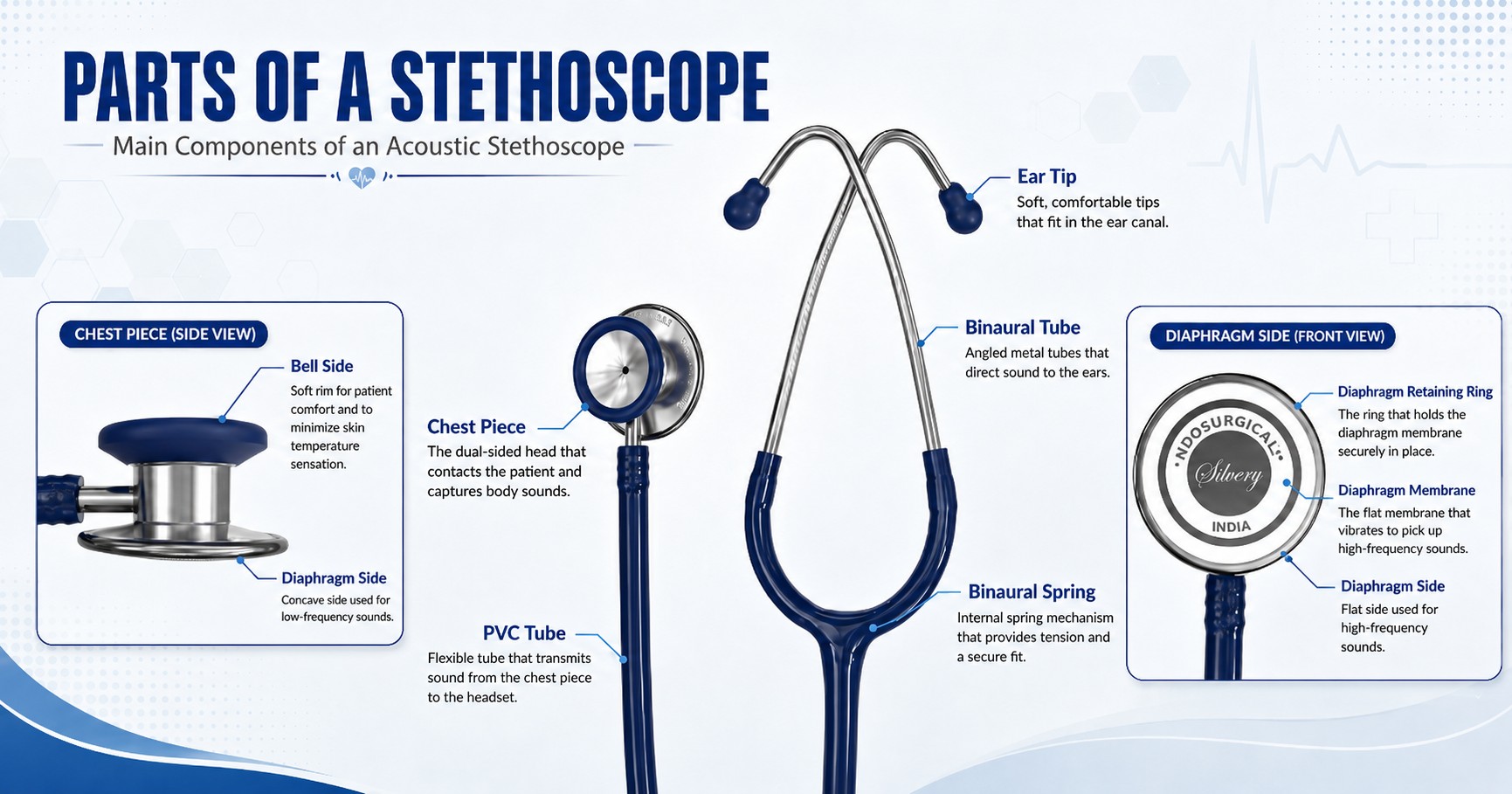
A conventional acoustic stethoscope consists of three main assemblies: the headset, flexible tubing and chest piece. These assemblies contain several components that form a continuous acoustic pathway.
Ear Tips
Ear tips, also called earpieces, fit inside the listener’s ears. They help create a comfortable acoustic seal, reduce interference from surrounding noise and direct sound into the ear canals. They should normally point slightly forward to follow the natural direction of the ear canals.
Binaural Tubes
The binaural tubes are the two rigid or semi-rigid metal tubes attached to the ear tips. They divide the acoustic pathway so that sound reaches both ears and also help position the headset correctly.
Binaural Spring
The spring or tension mechanism provides gentle inward pressure to maintain a seal between the ear tips and ear canals. Excessive tension can cause discomfort, while insufficient tension can permit sound leakage.
Flexible Tubing
The tubing carries acoustic pressure waves from the chest piece to the headset. It must remain flexible and maintain a substantially airtight pathway. Cracked, loose, hardened or punctured tubing can reduce sound quality.
Stem
The stem connects the chest piece to the tubing. In many dual-head models, rotating the chest piece opens the sound pathway to either the diaphragm or bell while closing the other side.
Chest Piece
The chest piece is placed against the patient’s body. It receives vibrations from the skin and directs them into the internal acoustic channel. It may be single-sided, dual-sided, adult, pediatric or neonatal in size.
Diaphragm
The diaphragm is the broad, flat listening surface. Its thin circular membrane vibrates in response to body movement and is generally used for relatively higher-frequency sounds in a traditional design.
Bell
The bell is the smaller, cup-shaped side of a traditional dual-head chest piece. It is generally used for relatively lower-frequency sounds and should usually be placed lightly against the skin.
Non-Chill Ring
The non-chill ring surrounds the edge of the bell or diaphragm and reduces direct contact between the patient’s skin and the colder metal edge of the chest piece.
Diaphragm Retaining Ring
The retaining ring secures the diaphragm membrane to the chest piece. A loose or damaged ring may create unwanted vibration, leakage or reduced sound transmission.
| Stethoscope part | Main function |
|---|---|
| Ear tips | Create a seal and direct sound into the ears. |
| Binaural tubes | Carry sound to both ears and position the headset. |
| Binaural spring | Maintains suitable pressure between the headset and ears. |
| Flexible tubing | Transmits acoustic pressure waves from the chest piece. |
| Stem | Connects the tubing and may select the active side. |
| Chest piece | Receives vibrations from the patient’s body. |
| Diaphragm | Commonly used for relatively higher-frequency sounds. |
| Bell | Commonly used for relatively lower-frequency sounds. |
| Non-chill ring | Improves patient comfort around the metal edge. |
How Does a Stethoscope Work?
An acoustic stethoscope works through the capture and transmission of mechanical vibrations. It does not require a battery or an electronic amplifier.
Step 1: The body produces vibrations
Heart-valve movement, blood flow, breathing and intestinal activity create small vibrations that travel through tissues to the skin.
Step 2: The chest piece receives the vibrations
The diaphragm membrane or traditional bell receives vibrations when placed against the patient’s body.
Step 3: Pressure waves are created
Movement at the chest piece produces small changes in air pressure within its acoustic chamber.
Step 4: The tubing carries the sound
The enclosed tubing directs the pressure waves towards the headset. Its dimensions, flexibility and airtightness influence sound transmission.
Step 5: Sound reaches both ears
The pathway divides into the binaural tubes, and correctly fitted ear tips deliver the sound to the listener’s ear canals.
What Is the Working Principle of a Stethoscope?
The working principle of an acoustic stethoscope is the capture and transmission of mechanical body vibrations as acoustic pressure waves.
The chest piece, diaphragm or bell, enclosed air chamber, tubing, binaural tubes and ear tips form a connected acoustic system. Its performance depends on:
- Contact between the chest piece and the patient’s skin
- Diaphragm material, tension and movement
- Shape of the internal acoustic chamber
- Frequency response of the diaphragm or bell
- Length and internal diameter of the tubing
- Airtightness of every connection
- Correct orientation and fit of the ear tips
- Background noise and examination technique
That explanation is incomplete. Stethoscope performance also involves vibration of the diaphragm, acoustic coupling, resonance, pressure-wave transmission, frequency response and the seal of the complete sound pathway.
Bell vs Diaphragm of a Stethoscope
A traditional dual-head stethoscope normally provides a diaphragm on one side and a bell on the other. These surfaces are intended to emphasise different frequency ranges.
| Feature | Diaphragm | Traditional bell |
|---|---|---|
| Shape | Broad and flat | Smaller and cup-shaped |
| Contact pressure | Usually firm but comfortable | Usually light pressure |
| Frequency range | Relatively higher-frequency sounds | Relatively lower-frequency sounds |
| Common applications | Breath sounds, bowel sounds, normal heart sounds and Korotkoff sounds | Certain low-pitched heart sounds, murmurs and vascular sounds |
Some modern stethoscopes use a tunable diaphragm. With these designs, changing the pressure applied to the chest piece may change the frequency range emphasised. Users should follow the instructions supplied with the particular model.
What Is a Stethoscope Used For?
A stethoscope is used in several forms of clinical examination. Its usefulness depends on correct placement, suitable surroundings and the examiner’s training.
Listening to Heart Sounds
A trained professional may assess heart rate, rhythm, normal heart sounds, additional sounds and certain murmurs.
Listening to Lung Sounds
The chest and back are examined to compare air entry and identify sounds such as wheezes, crackles or reduced breath sounds.
Manual Blood-Pressure Measurement
The stethoscope is used with a sphygmomanometer to hear Korotkoff sounds over the brachial artery.
Listening to Bowel Sounds
The diaphragm may be placed over the abdomen to listen to sounds caused by gastrointestinal movement.
Listening to Blood Flow
A clinician may listen for a bruit, a sound associated with turbulent blood flow in a vessel.
Routine and Emergency Examination
Stethoscopes are used in hospitals, clinics, ambulances, emergency departments, medical colleges and community healthcare.
Who Uses a Stethoscope?
Types of Stethoscopes at a Glance
| Stethoscope type | Basic description |
|---|---|
| Acoustic | Transmits sound mechanically without electronic amplification. |
| Single-head | Has one listening surface, often a standard or tunable diaphragm. |
| Dual-head | Usually provides a diaphragm and bell or a second diaphragm. |
| Cardiology | Designed for users who require greater acoustic sensitivity. |
| Pediatric | Uses a smaller chest piece for more precise positioning on children. |
| Neonatal | Uses a very small chest piece designed for newborns and small infants. |
| Teaching | Provides multiple headsets so two or more people can listen together. |
| Fetal or Pinard | A specialised instrument used for fetal auscultation under appropriate clinical conditions. |
| Digital or electronic | Converts acoustic vibration into an electronic signal and may amplify, filter, record or transmit sounds. |
Basic Steps for Using a Stethoscope
Detailed auscultation techniques should be learned under qualified clinical supervision. The following basic steps apply to many acoustic stethoscopes:
- Inspect the ear tips, tubing, diaphragm and connections for visible damage.
- Clean the patient-contact surface according to the applicable procedure.
- Insert the ear tips so they point slightly forward.
- Confirm that the required side of a dual-head chest piece is open.
- Place the chest piece directly against the patient’s skin whenever practical.
- Hold it steadily and avoid rubbing or touching the tubing unnecessarily.
- Listen in a quiet environment and compare sounds systematically.
- Clean the chest piece after completing the examination.
Clothing can create friction noise and weaken subtle sounds. Direct contact with the skin usually provides more effective acoustic transmission.
Why Can’t I Hear Clearly Through My Stethoscope?
Poor or absent sound does not always mean the instrument is defective. Common causes include:
As an initial check, insert the ear tips correctly, select the diaphragm and gently rub its surface. Sound should reach both ears. Avoid repeated hard tapping because it can be uncomfortable for the listener.
What Determines Stethoscope Sound Quality?
Acoustic performance depends on the complete instrument, not on one component alone. Important factors include:
- Chest-piece material, construction and internal design
- Diaphragm material and tension
- Accuracy of the internal acoustic channel
- Tubing length, internal diameter and flexibility
- Airtight connections throughout the sound pathway
- Ear-tip material, fit and seal
- Headset alignment and tension
- Background noise and examination technique
- The hearing ability and experience of the listener
How to Clean and Maintain a Stethoscope
Healthcare institutions may have specific cleaning and disinfection requirements. Those procedures and the instructions supplied with the stethoscope should take priority over general guidance.
Limitations of an Acoustic Stethoscope
Interpretation requires training
Internal sounds can be subtle or similar. Correct interpretation requires clinical knowledge and supervised practice.
Background noise can interfere
Conversation, equipment, traffic and other environmental sounds can make auscultation difficult.
Clothing creates unwanted noise
Fabric can weaken sound and produce rubbing noise between the chest piece and patient.
Some sounds may be too faint
Certain abnormalities may not be reliably detected with a conventional acoustic instrument.
Findings are not always specific
An unusual sound can have more than one possible cause and may require further assessment.
It does not replace diagnostic tests
A clinician may also require ECG, echocardiography, imaging, ultrasound, laboratory tests or other investigations.
Frequently Asked Questions
What is a stethoscope in simple words?
It is a medical instrument used to listen to sounds produced inside the body, especially sounds from the heart, lungs, intestines and blood vessels.
What are the main parts of a stethoscope?
The main parts are the ear tips, binaural tubes, Binaural spring, flexible tubing, stem, chest piece, diaphragm, bell and non-chill ring.
What is the function of the diaphragm?
The diaphragm receives vibrations through a flexible membrane and is generally used for relatively higher-frequency sounds in a traditional design.
What is the function of the bell?
A traditional bell is mainly used for relatively lower-frequency sounds and should usually be placed lightly against the skin.
On which principle does a stethoscope work?
It works through mechanical vibration and acoustic transmission. The chest piece receives body vibration, and pressure waves travel through the enclosed tubing to the ears.
Does an acoustic stethoscope amplify sound?
A conventional acoustic model does not use electronic amplification. Its physical design transfers and selectively emphasises body sounds through an enclosed acoustic pathway.
Can a stethoscope diagnose heart or lung disease?
No. It provides sounds that may support clinical assessment, but they must be interpreted by a trained professional with the patient’s history, examination and any required tests.
Can a stethoscope be used over clothing?
Some louder sounds may be heard through thin clothing, but fabric can weaken the signal and create friction noise. Direct skin contact generally provides clearer sound.
Why are the ear tips angled forward?
They are angled forward to follow the natural direction of the ear canals, improving comfort, sealing and sound transmission.
What is the difference between a stethoscope and a sphygmomanometer?
A stethoscope is used to listen to sounds. A sphygmomanometer uses an inflatable cuff and pressure gauge to measure blood pressure. Both are used together during manual measurement.
Can an ordinary stethoscope hear a baby’s heartbeat during pregnancy?
Listening depends on the stage of pregnancy, fetal position, instrument and examiner’s training. A specialised fetal stethoscope or Doppler may be used by trained professionals. Home listening must not be used to judge fetal health or delay medical care.
Conclusion
A stethoscope is a carefully designed medical instrument that allows healthcare professionals to listen to sounds generated inside the body. Its chest piece captures vibrations, the diaphragm or bell influences the frequencies received, the tubing carries acoustic pressure waves, and the headset delivers sound to both ears.
Understanding its parts and working principle helps users operate the instrument correctly, identify common performance problems and select an appropriate design for their clinical requirements.
Hearing a body sound and interpreting its medical significance are different skills. Auscultation findings should always be evaluated by a properly trained healthcare professional as part of a complete clinical assessment.
Explore IndoSurgicals Stethoscopes
Discover acoustic stethoscopes designed for doctors, medical students, nurses, healthcare institutions and different patient groups.
View Stethoscope Range