

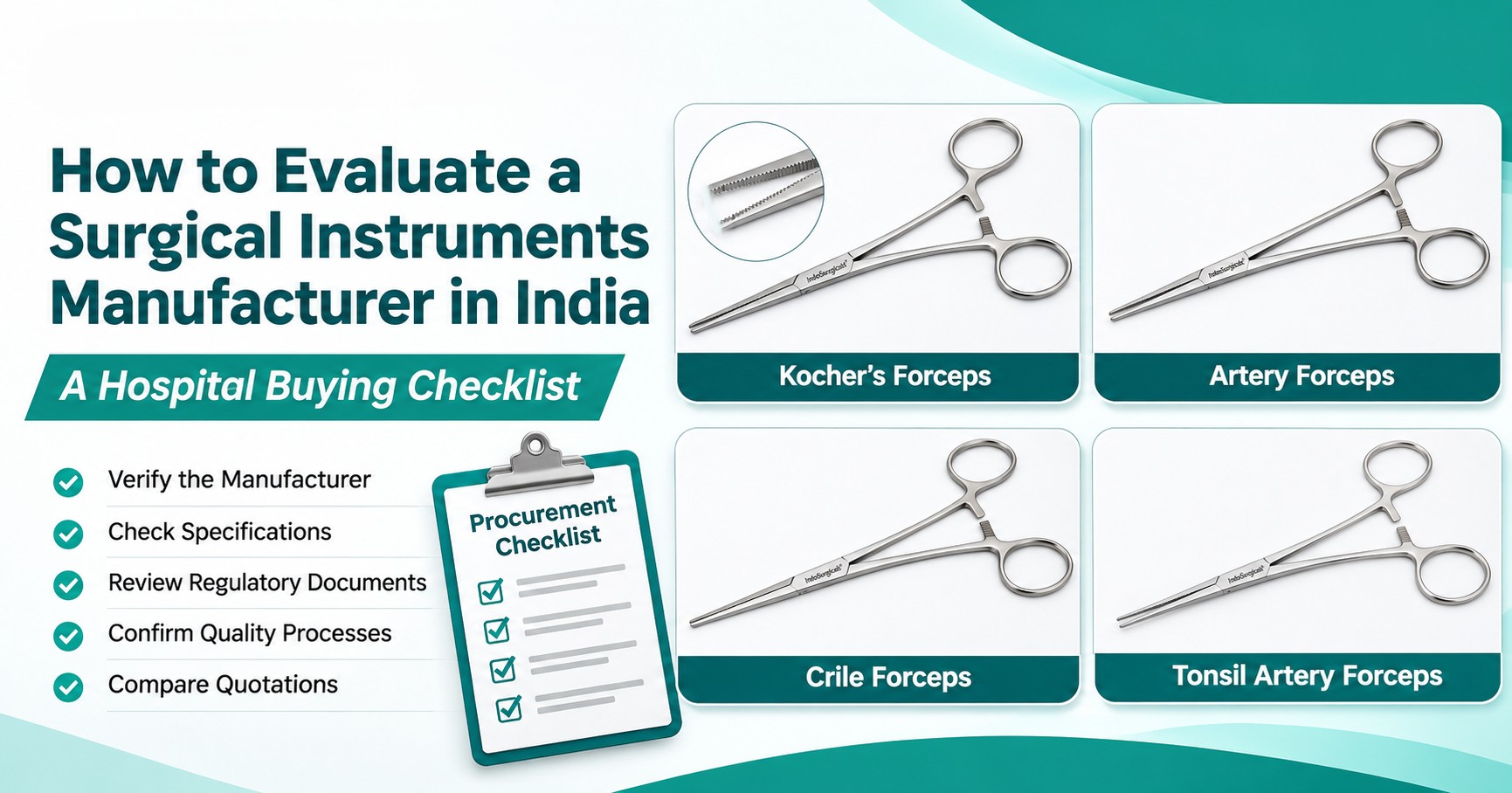
How to Evaluate a Surgical Instruments Manufacturer in India: A Hospital Buying Checklist
Choosing a surgical instrument manufacturer in India? Use this hospital buying checklist to compare exact specifications, quality documentation, regulatory requirements, instrument kits and quotations. Copy excerpt
Hospital Procurement Guide | India
Choosing surgical instruments is not simply a matter of finding a supplier with a long catalogue or a low quotation. Hospitals, medical colleges, procurement departments and distributors need to confirm that each proposed instrument matches the required pattern, dimensions, documentation and intended use.
A practical supplier evaluation starts with the exact instrument list, then checks the manufacturer's or supplier's role, the product-specific documentation, quality controls and the commercial terms.
This guide offers a step-by-step purchasing framework for surgical instruments sourced in India. It is a procurement guide, not a substitute for clinical selection or regulatory advice.
In This Guide
10-Point Checklist Specifications Regulatory Documents Quality and Processing Instrument Kits Buyer FAQs
Quick Checklist: What Should a Hospital Verify?
Before approving a surgical instrument quotation, confirm:
- The legal business identity and whether the company manufactures, sources or distributes each item.
- The exact instrument name, model or SKU, pattern, length and working-end design.
- The manufacturer and product-specific regulatory evidence applicable to the device.
- Any quality-system certificate, including its validity, issuing body and stated scope.
- Material and finish details where they are specified or required by the tender.
- Reprocessing information and instructions for use appropriate to the exact device.
- Any kit's complete item-by-item composition and permitted substitutions.
- Sample evaluation, inspection criteria and a clear process for handling discrepancies.
- Packing, traceability, delivery, warranty and after-sales arrangements.
- A quotation that identifies all included and excluded costs.
1. Establish Who Is Responsible for the Supplied Instruments
The terms manufacturer, supplier, distributor and exporter are not interchangeable.
A company may manufacture some products and obtain others from external sources. For a buyer, the important question is who is legally and operationally responsible for the exact product being quoted.
Ask for the legal company name, relevant business details, manufacturing or sourcing role, product origin where applicable, and the entity identified on the supplied product documentation.
If your tender requires an original manufacturer, determine what evidence the bidder must provide under that tender's rules.
For repeat or institutional purchasing, confirm who will handle specification queries, replacement requests, complaints and documentation after delivery.
A convincing product photograph or a general brochure cannot answer those questions.
2. Compare Exact Specifications, Not Just Instrument Names
Two quotations may both mention "artery forceps" or "surgical scissors" yet describe different configurations. The instrument name alone does not establish equivalence.
Create a comparison sheet that captures the following for every line item:
| Specification | What to Record |
|---|---|
| Name and Pattern | Exact published or tender description |
| Reference | Manufacturer model, catalogue number or SKU |
| Size | Length and other relevant dimensions, with units |
| Working End | Straight or curved, toothed or non-toothed, jaw or tip design as relevant |
| Material and Finish | Only where specified or supported by product documentation |
| Supplied Configuration | Single instrument, set, accessories and quantities |
| Use and Processing Status | Reusable, single-use, sterile supply or other device-specific status, if documented |
For example, a 16 cm curved forceps should not be treated as a substitute for an 18 cm straight pattern solely because both quotations use the same general product-family name.
The responsible clinical department should approve alternatives before purchase.

Example product image: Kocher straight forceps. Product photographs assist identification; always verify the exact SKU, pattern and dimensions.
For a reference to published instrument families, see the IndoSurgicals Surgical Instruments catalogue .
The existing guide to surgical instrument names and types explains the general categories; this article focuses instead on supplier assessment and procurement evidence.
3. Check the Applicable Regulatory Pathway in India
Do not assume that every surgical instrument follows one identical licensing route.
Indian medical devices are regulated under the Medical Devices Rules, 2017, as amended, with requirements depending on the specific device and its classification.
For example, CDSCO's October 2025 notice describes an exemption from licensing for qualifying Class A non-sterile, non-measuring devices, while requiring the applicable online registration.
A sterile version or a device with a measuring function cannot automatically be placed in that same exempt group.
For the exact item being purchased, request the relevant manufacturer or importer details and licence or registration evidence as applicable.
The purchasing team should confirm classification and current requirements using CDSCO's Medical Devices Rules resources and, where needed, specialist regulatory advice.
Practical Rule: Never accept an unrelated registration number, a generic certification statement or a marketing claim as proof that a particular instrument meets its applicable requirements.
4. Review Quality-System Evidence Carefully
ISO 13485 is an international standard for medical-device quality management systems.
It can be a valuable supplier-assessment indicator, but a quality-system certificate is not itself a product approval or proof that every item in a catalogue has a particular specification.
When a supplier presents an ISO certificate, check:
- The name and site listed on the certificate.
- The validity period and the issuing certification body.
- The activities and products included in the certification scope.
- Whether the certificate actually covers the relevant organization and operations.
Then ask what product-level controls and documentation are available for the requested instruments.
Depending on the purchasing specification, those may include incoming inspection, dimensional checks, finish verification, product identification and handling of nonconforming items.
Require evidence rather than assuming that every supplier uses the same testing process.
Reference: ISO 13485:2016
5. Confirm Material, Finish and Reprocessing Information
Hospitals may need to compare material grades, surface finish, corrosion-related requirements and cleaning compatibility.
Those details should come from the specific manufacturer's product documentation, not a general assertion that all surgical instruments are made from a single steel grade.
Where reusable instruments are requested, obtain the relevant instructions for use and validated processing information applicable to the exact device.
ISO 17664-1:2021 addresses information manufacturers provide for processing critical and semi-critical medical devices and devices intended to be sterilized.
It does not mean that every instrument in a mixed catalogue has identical cleaning or sterilization instructions.
Confirm whether an item is supplied sterile or non-sterile. Never infer that a product is ready for clinical use merely because it appears in a surgical instrument set.
Facility staff should follow the applicable manufacturer's instructions and local infection-prevention procedures.
Reference: ISO 17664-1:2021
6. Evaluate Instrument Sets Item by Item
Procedure kits are especially vulnerable to specification mismatches.
A product called "minor surgery set" or "dressing set" does not have a universal composition across all suppliers.
Ask for a numbered contents list showing each instrument's name, pattern, size and quantity.
Confirm which components are included, whether accessories or cases are supplied and whether any substitutions are proposed.
Separate clinical-use instruments from training or practice items.
For an example of how published kits can differ, browse the IndoSurgicals Instrument Kit collection , where individual procedure sets have their own compositions.
The correct purchasing decision depends on the exact item list, not the kit name alone.
7. Compare Quotations on the Same Basis
A lower quoted unit price may not be the lower procurement cost once differences in specification, packing, delivery, taxes, freight, documentation or replacement terms are considered.
Ask each bidder to quote against the same approved schedule.
The quotation should identify the supplier reference, agreed quantity and configuration, expected delivery time, place of delivery, packing terms, taxes and shipping where applicable, validity period and the process for handling discrepancies.
For distributors and export purchasers, confirm destination-country documentation requirements and shipment responsibilities before finalizing the order.
Do not assume that documentation suitable for an Indian domestic order is automatically sufficient for every export market.
8. Agree on Inspection and After-Sales Procedures
Before placing a substantial or repeat order, establish what the receiving department will inspect.
Depending on the instrument, this may include product identity, dimensions, physical condition, finish, supplied accessories, counts, labels and accompanying documents.
Define the process for reporting damaged, short-supplied or incorrectly specified products.
Where sampling is practical and permitted by the procurement process, use the approved sample as a comparison reference without treating the sample as a replacement for appropriate documentation.
A Ready-to-Use Surgical Instrument Enquiry Format
A structured request helps purchasers compare offers without repeatedly asking for missing information.
| Field | What the Buyer Should Provide |
|---|---|
| Buyer | Hospital, medical college, distributor or purchasing organization |
| Requirement | Exact instrument list or tender schedule |
| Product Reference | SKU or model, if already selected |
| Configuration | Pattern, dimensions, working end, material or finish if required |
| Quantity | Units per line and number of complete sets |
| Documentation | Specific regulatory, quality and processing records requested |
| Delivery | City, country, required date and commercial terms |
| Clarifications | Whether alternatives are allowed and who approves them |
Suggested Enquiry Wording
"Please quote against the attached line-item schedule. Identify each proposed model/SKU, specification differences, available documentation, delivery period and any substitutions separately. Do not treat alternatives as approved unless confirmed in writing."
Frequently Asked Questions
Is ISO 13485 certification enough to approve a surgical instrument supplier?
No. It concerns the organization's quality management system and its specified scope. Buyers still need to verify the exact instrument, applicable regulatory pathway, technical specifications and procurement requirements.
Are all surgical instruments sold in India subject to the same licence?
No. The applicable requirements depend on the device's classification and characteristics. Qualifying Class A non-sterile, non-measuring devices have a distinct registration-based arrangement; buyers should verify the exact product and current CDSCO requirements.
Can different suppliers' instrument kits be compared by the kit name alone?
No. Compare each listed component, quantity, dimensions and pattern, and document any proposed substitutions.
Should a hospital choose the lowest quotation?
Price matters, but the bids must first be technically comparable. Product specification, documentation, processing suitability, delivery and discrepancy handling are also relevant to procurement decisions.
A Better Buying Decision Begins with a Better Specification
The most reliable way to evaluate a surgical instruments manufacturer or supplier in India is to begin with the hospital's clinical and purchasing requirements, ask for evidence specific to the proposed devices, and compare offers against the same itemized schedule.
Looking for Surgical Instruments for Hospital or Institutional Procurement?
Explore the IndoSurgicals Surgical Instruments range and submit the required instrument names, exact patterns or SKUs, quantities and delivery destination to request a consolidated quotation.
Any certification, compatibility or supplied configuration should be confirmed for the relevant product before ordering.
Sources and Further Reading
- World Health Organization - Procurement and Technical Specifications for Medical Devices
- Central Drugs Standard Control Organization - Medical Devices Rules, 2017 and Amendments
- CDSCO - Class A Non-Sterile and Non-Measuring Medical Device Classification Notice
- ISO 13485:2016 - Quality Management Systems for Medical Devices
- ISO 17664-1:2021 - Manufacturer-Provided Processing Information
Editorial Note: This article offers general procurement guidance. Product selection, reprocessing and regulatory compliance must be assessed for the specific device and intended use by qualified professionals.