

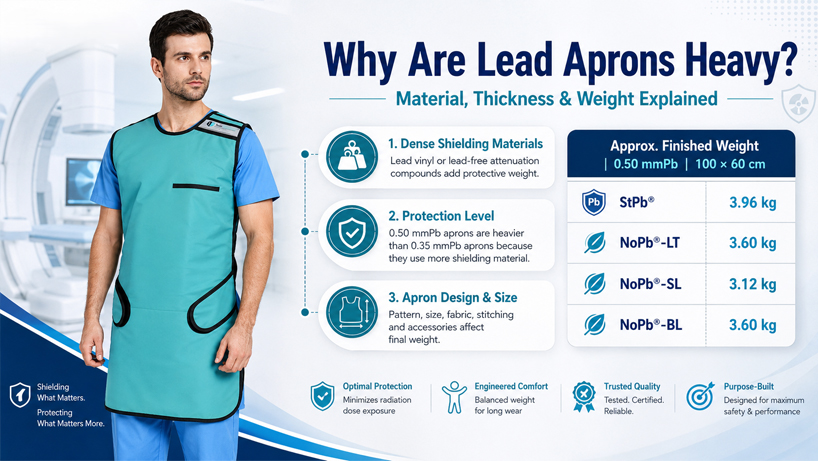
Lead aprons are heavy because they are designed to protect the body from scattered X-ray radiation during medical procedures. Unlike normal clothing, a radiation protection apron contains a special shielding core material that reduces radiation exposure to the wearer.
Doctors, radiologists, technicians, dentists, cath lab staff, C-arm users and other healthcare professionals often ask: Why are lead aprons so heavy? The answer mainly depends on three factors: radiation shielding material, lead equivalent thickness, and apron design.
IndoSurgicals manufactures lead and lead-free radiation protection aprons using different core material options such as StPb®, NoPb®-LT, NoPb®-SL and NoPb®-BL, allowing users to choose the right balance of protection, comfort, weight and budget.
Why Are Lead Aprons Heavy?
Lead aprons are heavy because radiation shielding requires dense materials. X-ray radiation cannot be blocked effectively by ordinary fabric. To reduce radiation exposure, the apron must contain a protective core made from high-density shielding materials.
Traditional lead aprons use lead-based shielding material, while modern lead-free aprons use special radiation attenuation materials such as bismuth oxide, antimony oxide, barium sulfate, samarium oxide, cerium oxide and other shielding compounds.
These materials add weight, but they are necessary for protection. The higher the protection level, the more shielding material is required.
What Makes a Lead Apron Heavy?
The weight of a lead apron depends on:
| Factor | Effect on Weight |
|---|---|
| Lead equivalent thickness | Higher protection level increases weight |
| Core material type | Different materials have different kg/m² weight |
| Apron size | Larger aprons require more material |
| Apron pattern | Frontal, full-overlap and partial-overlap designs have different material usage |
| Outer covering and accessories | Fabric, stitching, binding, hook and loop closure, pockets and buckles add weight |
| Cut and shape | Neck cut, armhole cut and rounded bottom reduce some core material weight |
In practical apron manufacturing, the core material is cut around the neck, armhole and bottom areas, which reduces some core weight. At the same time, outer fabric, stitching, binding, hook and loop fasteners, pockets and accessories add weight. Because these two factors often balance each other, the finished apron weight is usually approximately close to the calculated core material weight.
Lead Apron Thickness and Weight
Lead apron thickness is commonly described as lead equivalency, written as mmPb. This does not always mean the apron contains pure lead of that thickness. It means the apron provides radiation protection equivalent to that thickness of lead.
IndoSurgicals supplies radiation protection aprons mainly in two protection levels:
| Protection Level | Meaning | Common Use |
|---|---|---|
| 0.35 mmPb | Standard radiation protection level | Routine X-ray, diagnostic, dental, veterinary and general radiology use |
| 0.50 mmPb | Higher protection level | Cath lab, C-arm, fluoroscopy and interventional procedures |
A 0.50 mmPb lead apron is usually heavier than a 0.35 mmPb lead apron because it requires more shielding material.
How IndoSurgicals Apron Construction Affects Weight
IndoSurgicals uses specific sheet combinations for apron construction:
| Apron Protection Level | Sheet Construction Used |
|---|---|
| 0.35 mmPb Lead Equivalent | 2 sheets of 0.175 mmPb |
| 0.50 mmPb Lead Equivalent | 2 sheets of 0.25 mmPb |
For frontal protection aprons, the core material is used on the front side of the apron.
For full protection aprons, the back panel is always made with one 0.25 mmPb sheet.
In partial-overlap full protection aprons, both front panels are made with the full claimed lead equivalent protection. Therefore, the overlapped front area provides doubled lead equivalency: 0.35 mmPb becomes approximately 0.70 mmPb, and 0.50 mmPb becomes approximately 1.00 mmPb in the overlapped area.
Material-Wise Lead Apron Weight Comparison
The weight of a lead apron depends strongly on the selected core material. Below is a practical comparison of IndoSurgicals core materials.
Approximate Finished Weight of 0.50 mmPb Frontal Protection Lead Apron
Size considered: 100 cm × 60 cm
| Core Material | Core Weight / Area | Approx. Finished Weight |
|---|---|---|
| StPb® | 6.60 kg/m² | Approx. 3.96 kg |
| NoPb®-LT | 6.00 kg/m² | Approx. 3.60 kg |
| NoPb®-SL | 5.20 kg/m² | Approx. 3.12 kg |
| NoPb®-BL | 6.00 kg/m² | Approx. 3.60 kg |
Approximate Finished Weight of 0.35 mmPb Frontal Protection Lead Apron
Size considered: 100 cm × 60 cm
| Core Material | Core Weight / Area | Approx. Finished Weight |
|---|---|---|
| StPb® | 4.62 kg/m² | Approx. 2.77 kg |
| NoPb®-LT | 4.50 kg/m² | Approx. 2.70 kg |
| NoPb®-SL | 3.90 kg/m² | Approx. 2.34 kg |
| NoPb®-BL | Approx. 4.29 kg/m² | Approx. 2.57 kg |
From this comparison, NoPb®-SL is the lightest option among IndoSurgicals core materials.
Short Description of Each Core Material
StPb® Lead Vinyl Core Material
StPb® is a traditional lead-vinyl radiation protection core material. It is suitable for users who prefer conventional lead-based shielding and a cost-effective radiation protection apron. StPb® provides dependable protection for standard X-ray, diagnostic and radiology applications.
NoPb®-LT Lead-Free Lightweight Core Material
NoPb®-LT is a lead-free lightweight radiation protection core material designed for reliable X-ray shielding with good flexibility, durability and reduced weight. It is suitable for users who want a lead-free apron with balanced protection and comfort.
NoPb®-SL Lead-Free Super Lightweight Core Material
NoPb®-SL is a super lightweight lead-free radiation protection core material designed for better wearing comfort during long procedures. It is especially suitable for cath lab users, radiologists, technicians and healthcare professionals who wear aprons for extended periods.
NoPb®-BL Lead-Free Broad Beam Tested Core Material
NoPb®-BL is a premium lead-free radiation protection core material tested under broad beam geometry conditions. It is suitable for users who require professional-grade shielding performance and strong technical documentation.
Why Are Cath Lab Lead Aprons Often Heavy?
Cath lab lead aprons are often heavier because cath lab procedures may involve longer exposure times and frequent use of fluoroscopy. Many users prefer 0.50 mmPb lead equivalent protection for higher protection requirements.
However, because cath lab staff often wear aprons for long periods, material selection becomes very important. A lighter lead-free material such as NoPb®-SL can help improve wearing comfort while still providing radiation protection.
Are Lead-Free Aprons Always Lighter?
Not always. A lead-free apron is not automatically lighter than a lead apron. The weight depends on the formulation and area density of the core material.
Some lead-free materials may be heavier than lead vinyl, while well-designed lightweight lead-free materials can reduce apron weight. That is why IndoSurgicals offers multiple material options:
| Requirement | Suggested Material |
|---|---|
| Conventional and economical option | StPb® |
| Balanced lead-free lightweight option | NoPb®-LT |
| Lightest lead-free option | NoPb®-SL |
| Premium broad beam tested option | NoPb®-BL |
How to Choose the Right Lead Apron Weight
Choose the apron material based on your working environment:
| User Requirement | Recommended Choice |
|---|---|
| Routine diagnostic use | 0.35 mmPb StPb® or NoPb®-LT |
| Long wearing comfort | NoPb®-SL |
| Cath lab or C-arm use | 0.50 mmPb NoPb®-SL or NoPb®-BL |
| Conventional lead-based protection | StPb® |
| Premium lead-free tested protection | NoPb®-BL |
For long procedures, a small difference in apron weight can make a big difference in comfort. Even a few hundred grams may matter when the apron is worn daily for extended hours.
Frequently Asked Questions
How much do lead aprons weigh?
Lead apron weight depends on size, protection level, design and core material. For a 0.50 mmPb frontal protection apron in 100 cm × 60 cm size, IndoSurgicals apron weight ranges from approximately 3.12 kg to 3.96 kg, depending on the selected core material.
Why are lead aprons heavy?
Lead aprons are heavy because they contain high-density shielding materials that reduce X-ray radiation exposure. These materials may include lead vinyl or lead-free attenuation compounds.
Does 0.50 mmPb apron weigh more than 0.35 mmPb apron?
Yes. A 0.50 mmPb apron generally weighs more than a 0.35 mmPb apron because it uses more shielding material and provides higher radiation protection.
Which IndoSurgicals lead apron material is the lightest?
Among IndoSurgicals core materials, NoPb®-SL is the lightest option. It is designed for better wearing comfort during long procedures.
Are lead-free aprons lighter than lead aprons?
Lead-free aprons can be lighter, but it depends on the material formulation. IndoSurgicals NoPb®-SL and NoPb®-LT are designed to provide lighter lead-free alternatives compared with conventional lead vinyl options.
Conclusion
Lead aprons are heavy because they contain dense radiation protection materials that help reduce X-ray exposure. The final weight depends on the core material, apron size, protection level, pattern and construction.
For users who prefer a conventional and economical option, StPb® is suitable. For users who want a lead-free lightweight apron, NoPb®-LT is a balanced option. For maximum comfort and lower weight, NoPb®-SL is the lightest option. For premium broad beam tested lead-free protection, NoPb®-BL is a strong choice.
IndoSurgicals offers multiple apron core materials so healthcare professionals can select the right radiation protection apron according to their procedure type, comfort requirement and protection level.
Explore the Complete IndoSurgicals Product Range
View Lead Aprons