

A radiology lead apron is a wearable radiation-protection garment used to reduce exposure to scattered X-ray radiation during diagnostic imaging, fluoroscopy, dental radiography, C-arm procedures, cath-lab work and other X-ray-based medical procedures.
IndoSurgicals manufactures radiology lead aprons in multiple patterns, protection levels and core-material options so hospitals and healthcare professionals can select a configuration according to procedure type, working position, wearing duration and institutional radiation-safety requirements.

What Is a Radiology Lead Apron?
A radiology lead apron is a protective garment containing lead-based or lead-equivalent radiation-shielding core material. The core attenuates scattered X-ray radiation before it reaches the wearer’s body.
A lead apron is only one part of a complete radiation-protection programme. It does not replace appropriate working distance, shielding barriers, positioning, dosimetry, equipment settings or institutional radiation-safety procedures.
Lead Apron Patterns: Choose the Required Coverage
Different clinical environments require different apron patterns. The six current IndoSurgicals product photographs below show the main frontal, full-overlap and partial-overlap choices in both one-piece and two-piece configurations.
Frontal Protection Lead Apron
Front-side protection for users who generally remain positioned facing the X-ray source.
View exact product →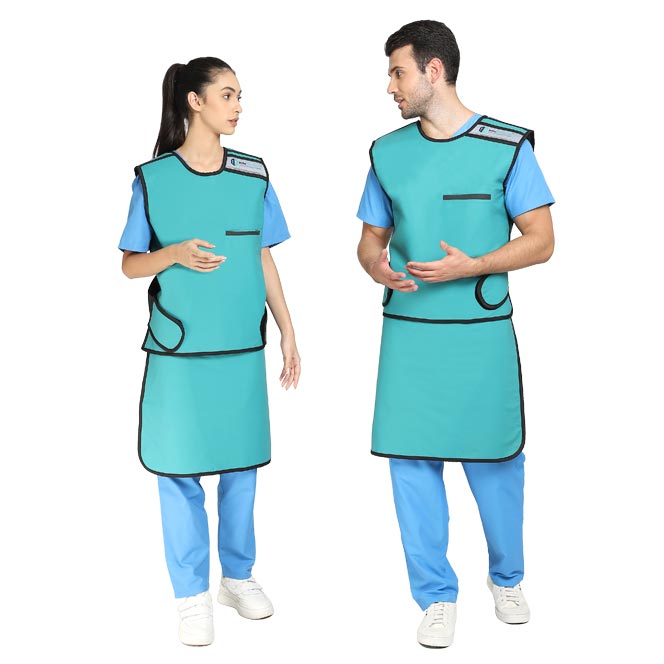
Frontal Protection Lead Vest & Skirt
Front-side protection in a two-piece format that distributes weight between shoulders and waist.
View exact product →
Full Protection Full-Overlap Lead Apron
Wrap-around one-piece protection with front and back coverage; the required front protection is achieved through overlap.
View exact product →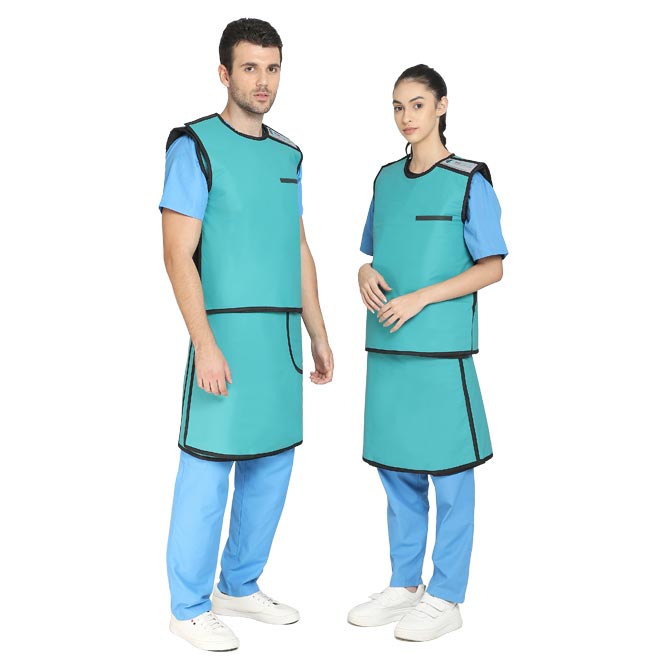
Full Protection Full-Overlap Vest & Skirt
Wrap-around two-piece protection for users who need broad coverage with improved weight distribution.
View exact product →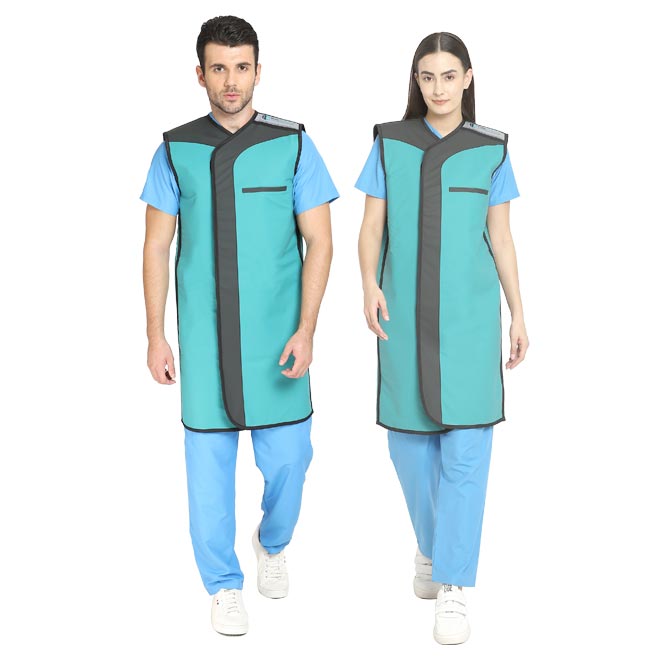
Full Protection Partial-Overlap Lead Apron
Each front panel carries the full claimed protection, creating additional shielding in the central overlap area.
View exact product →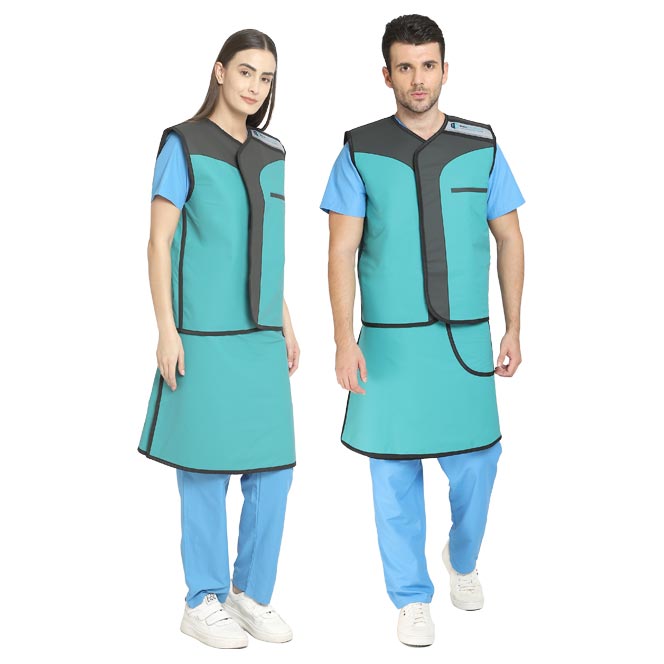
Full Protection Partial-Overlap Vest & Skirt
Partial-overlap protection in a two-piece vest-and-skirt format for mobility and weight distribution.
View exact product →Why Lead Aprons Are Important in Radiology
During X-ray and fluoroscopy procedures, scattered radiation may be produced when the primary X-ray beam interacts with the patient or surrounding surfaces. Healthcare professionals standing near the procedure area may receive repeated occupational exposure if suitable protection is not used.
A correctly selected radiology lead apron helps reduce occupational exposure and supports safer working conditions for healthcare professionals working around X-ray equipment.
0.35 mmPb and 0.50 mmPb Protection Options
Lead-apron protection is commonly described in mmPb, meaning millimetres of lead equivalence. This expresses shielding performance relative to a stated thickness of lead rather than simply describing the physical thickness of the finished garment.
Routine and Moderate-Protection Applications
Commonly considered for routine X-ray, dental, veterinary and general radiology applications where the facility protocol permits 0.35 mmPb protection and lower core weight is desirable.
Higher Nominal Protection
Commonly considered for fluoroscopy, C-arm, cath-lab, urology and interventional environments where the approved departmental protocol requires a higher nominal lead-equivalent rating.
How IndoSurgicals Builds the Required Lead Equivalency
0.35 mmPb Construction
Total claimed protection: 0.35 mmPb lead equivalent.
0.50 mmPb Construction
Total claimed protection: 0.50 mmPb lead equivalent.
Core Material Options in IndoSurgicals Lead Aprons
IndoSurgicals offers a conventional lead-vinyl option and three lead-free core-material families. Core-material choice affects approximate area density, flexibility, wearing comfort, material composition and the type of technical documentation required by the buyer.
StPb®
Traditional lead-vinyl radiation-protection core material for buyers who prefer conventional lead-based shielding and economical construction.
0.50 mmPb: approx. 6.60 kg/m²
NoPb®-LT
Lead-free lightweight core option designed to balance non-lead construction, practical weight and shielding performance.
0.50 mmPb: approx. 6.00 kg/m²
NoPb®-SL
Super-lightweight lead-free option with the lowest listed core area density in the current IndoSurgicals comparison.
0.50 mmPb: approx. 5.20 kg/m²
NoPb®-BL
Premium lead-free core material for buyers who specifically require broad-beam test data and associated technical documentation.
0.50 mmPb: approx. 6.00 kg/m²
Types of Radiology Lead Aprons Offered by IndoSurgicals
| Apron Type | Protection Style | Best Suitable For |
|---|---|---|
| Frontal Protection Lead Apron | Front-side protection | Routine X-ray rooms, dental imaging, diagnostic radiology and applications where the wearer normally faces the radiation source. |
| Frontal Protection Lead Vest & Skirt | Front-side protection with two-piece weight distribution | Users who want frontal coverage with weight divided between shoulders and waist. |
| Full Protection Full-Overlap Lead Apron | Front and back coverage; required front protection achieved through overlap | Radiology, fluoroscopy, C-arm and procedures requiring broader wrap-around coverage. |
| Full Protection Full-Overlap Vest & Skirt | Wrap-around full protection in a two-piece design | Longer procedures where both broad coverage and weight distribution are important. |
| Full Protection Partial-Overlap Lead Apron | Full protection on each front panel with additional shielding in the overlap area | Cath-lab, interventional radiology and users preferring additional central front overlap shielding. |
| Full Protection Partial-Overlap Vest & Skirt | Partial-overlap protection with two-piece weight distribution | Doctors and radiology professionals needing full-protection coverage, mobility and better weight distribution. |
How to Choose the Right Radiology Lead Apron
Define the Procedure
Confirm whether the apron is for routine X-ray, fluoroscopy, C-arm, cath-lab, dental, veterinary or another imaging application.
Choose Coverage
Select frontal or full-protection coverage according to working position, staff movement and the approved facility protocol.
Select mmPb Level
Specify 0.35 mmPb or 0.50 mmPb according to the protection requirement approved for the intended procedure.
Choose Core Material
Compare conventional lead, lead-free construction, approximate area density, comfort and documentation requirements.
Ergonomic Considerations for Long Procedures
Radiation protection should not come at the cost of unnecessary user strain. A heavy or poorly fitted apron can increase shoulder, neck and back load during long procedures.
Vest-and-skirt designs distribute weight between the shoulders and waist. Proper sizing, suitable closures and lower-area-density core material can also improve wearing comfort. The most comfortable option is not automatically the correct protection option, so comfort and radiation-safety requirements should be considered together.
Outer Covering, Cleaning and Storage
Basic Cleaning Guidance
- Wipe the surface with a soft damp cloth.
- Use a mild cleaning solution when required and compatible with the outer covering.
- Do not use harsh chemicals unless approved for the product.
- Do not machine wash, dry clean, iron or autoclave the apron.
- Allow the apron to dry completely before storage.
- Inspect the apron regularly for visible surface damage.
Best Storage Practices
- Hang the apron on a suitable radiation-protection apron hanger.
- Use a dedicated apron rack or store flat where appropriate.
- Avoid folding, sharp creasing or crushing the protective core.
- Keep the apron away from excessive heat and direct sunlight.
- Do not place heavy objects over the apron.
- Store the apron clean and dry.
Lead Apron Inspection and Maintenance
Every lead apron should be inspected regularly to confirm that it remains suitable for clinical use. Visual and physical inspection can help identify outer damage, cracks, tears, loose stitching, peeling, deformity or suspected internal core failure.
Why Choose IndoSurgicals Radiology Lead Aprons?
IndoSurgicals manufactures radiation-protection apparel for professional healthcare environments and offers multiple protection levels, core materials, apron patterns, sizes and customization options for hospitals, clinics, diagnostic centres, distributors and institutional buyers.
FAQs About Radiology Lead Aprons
1. What is a lead apron used for?
A lead apron is used to reduce exposure to scattered X-ray radiation during diagnostic imaging, fluoroscopy, dental radiography, C-arm procedures and other X-ray-based medical procedures.
2. Who should wear a lead apron?
Doctors, radiographers, technicians, dentists, surgeons, nurses, veterinary professionals and patients may wear lead aprons when radiation protection is required during X-ray or fluoroscopy procedures.
3. What does mmPb mean in a lead apron?
mmPb means millimetre lead equivalence. It indicates the radiation shielding performance of the apron compared with a sheet of lead of the same stated thickness.
4. Which is better: 0.35 mmPb or 0.50 mmPb lead apron?
A 0.35 mmPb apron is lighter and suitable for many routine applications. A 0.50 mmPb apron provides higher nominal protection and is generally preferred for fluoroscopy, C-arm and interventional procedures. The final choice should follow procedure-specific and institutional radiation-safety requirements.
5. Is a lead-free apron safe?
A lead-free apron can be safe when it is properly tested and provides the required lead equivalency. Lead-free aprons use alternative radiation-shielding materials and are often selected where reduced weight or non-lead construction is preferred.
6. What is the difference between lead and lead-free aprons?
Traditional lead aprons use lead-based core material. Lead-free aprons use non-lead shielding materials designed to provide the required lead-equivalent protection.
7. Which lead apron is best for doctors?
For doctors who wear aprons for long procedures, a vest-and-skirt design or a lightweight lead-free material may improve comfort. The protection level and apron pattern should be selected according to the procedure and institutional radiation-safety policy.
8. Which lead apron is best for C-arm use?
For C-arm and fluoroscopy use, a 0.50 mmPb full-protection apron or vest-and-skirt is commonly considered where the facility protocol requires that level of protection. Selection depends on working position, scatter conditions and institutional policy.
9. Can lead aprons protect from all radiation?
No. Lead aprons are mainly used for X-ray and scattered-radiation protection. They are not a complete solution for every radiation type or exposure situation. Appropriate distance, barriers, positioning, dosimetry and institutional safety procedures remain necessary.
10. How long does a lead apron last?
A lead apron can last for several years if it is properly used, cleaned, inspected and stored. It should be removed from use if cracks, tears, core damage or shielding defects are found.
11. Do lead aprons expire?
Lead aprons usually do not have a fixed expiry like medicines, but the protective core can become damaged over time. Periodic inspection is required to determine whether an apron remains fit for use.
12. How often should lead aprons be inspected?
Lead aprons should be visually checked before use and inspected periodically according to the facility’s radiation-safety and quality-assurance policy. Inspection records should be maintained where required.
13. Can lead aprons be folded?
Lead aprons should not be folded sharply because folding can damage the protective core. Store them on a suitable lead-apron hanger or rack, or flat where appropriate.
14. How should lead aprons be cleaned?
Lead aprons should be wiped with a soft damp cloth and a mild cleaning solution when needed. They should not be machine washed, dry cleaned, ironed or autoclaved unless the specific product instructions explicitly allow it.
15. What size lead apron should I choose?
The apron should cover the required body area without unnecessarily restricting movement. Select size according to wearer height, body dimensions, intended procedure and the specific apron pattern.
16. Is vest and skirt better than a one-piece apron?
A vest-and-skirt design distributes weight between the shoulders and waist, which can improve comfort during long procedures. A one-piece design may be suitable where its protection pattern, fit and wearing duration meet the user’s clinical requirement.
17. What is a wrap-around lead apron?
A wrap-around lead apron provides front and back coverage. It is useful where the wearer may turn relative to the radiation source or where full-protection coverage is required by the procedure or facility protocol.
18. Where can I buy radiology lead aprons in India?
IndoSurgicals Private Limited manufactures and supplies radiology lead aprons in multiple protection levels, core materials, patterns and sizes. Institutional buyers can use the product pages or enquiry system to specify the exact configuration required.
Choosing the Correct Radiology Lead Apron
A radiology lead apron is an important radiation-protection garment for X-ray, fluoroscopy, C-arm, cath-lab, dental imaging and interventional procedures. The correct apron should be selected according to protection level, procedure type, exposure direction, working position, wearing duration and user comfort.
IndoSurgicals offers frontal, wrap-around, full-overlap, partial-overlap and vest-and-skirt designs with 0.35 mmPb and 0.50 mmPb protection options and multiple conventional or lead-free core materials.
Explore IndoSurgicals Radiology Lead Aprons
Compare actual frontal, full-overlap, partial-overlap, one-piece and vest-and-skirt products, then specify the required lead equivalency, core material, sizes, colours and quantity for quotation.