

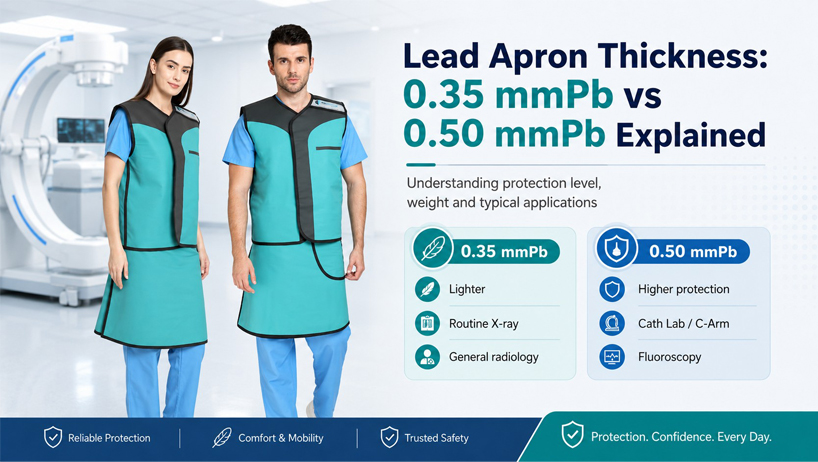
0.35 mmPb vs 0.50 mmPb Explained
Lead apron thickness is one of the most important factors when selecting a radiation protection apron. Many users search for lead apron thickness, but in medical radiation protection, the correct term is usually lead equivalency, written as mmPb.
A lead apron may not physically contain a solid sheet of pure lead with the same thickness. Instead, it is designed to provide radiation protection equivalent to a specific thickness of lead. That is why aprons are commonly described as 0.35 mmPb lead equivalent or 0.50 mmPb lead equivalent.
IndoSurgicals supplies radiation protection aprons mainly in two protection levels: 0.35 mmPb and 0.50 mmPb, depending on the application, exposure level and user requirement.
What Does mmPb Mean in Lead Aprons?
mmPb means millimetre lead equivalent.
It indicates how much radiation shielding the apron provides compared with a certain thickness of lead. For example:
| Lead Equivalent | Meaning |
|---|---|
| 0.35 mmPb | Protection equivalent to 0.35 mm thickness of lead |
| 0.50 mmPb | Protection equivalent to 0.50 mm thickness of lead |
This does not always mean the apron contains pure lead of that exact physical thickness. Modern radiation protection aprons may use lead vinyl or lead-free shielding materials that provide equivalent protection.
0.35 mmPb Lead Apron Thickness
A 0.35 mmPb lead apron is commonly used for routine diagnostic and general X-ray protection applications. It provides reliable radiation protection while keeping the apron lighter than a 0.50 mmPb apron.
At IndoSurgicals, 0.35 mmPb lead equivalent apron construction is made using:
0.35 mmPb
Construction: 2 sheets of 0.175 mmPb
| Claimed Protection | Sheet Construction |
|---|---|
| 0.35 mmPb | 2 sheets of 0.175 mmPb |
This construction is used to achieve the required 0.35 mmPb lead equivalent protection.
Common Uses of 0.35 mmPb Aprons
0.35 mmPb aprons are suitable for many routine medical radiation protection applications such as:
- General X-ray rooms
- Diagnostic radiology
- Dental X-ray procedures
- Veterinary X-ray procedures
- Routine imaging support
- Patient protection shields
- General radiology departments
Best suited for: Users who need a balance between radiation protection and lower apron weight.
0.50 mmPb Lead Apron Thickness
A 0.50 mmPb lead apron provides a higher level of radiation protection compared with 0.35 mmPb. It generally uses more shielding material and therefore weighs more.
At IndoSurgicals, 0.50 mmPb lead equivalent apron construction is made using:
0.50 mmPb
Construction: 2 sheets of 0.25 mmPb
| Claimed Protection | Sheet Construction |
|---|---|
| 0.50 mmPb | 2 sheets of 0.25 mmPb |
This construction is used for higher protection requirements.
Common Uses of 0.50 mmPb Aprons
0.50 mmPb aprons are commonly preferred for applications where higher radiation protection may be required, such as:
- Cath lab procedures
- C-arm procedures
- Fluoroscopy
- Interventional radiology
- Urology procedures
- Operation theatres using imaging
- Longer exposure or higher scatter radiation environments
Best suited for: Applications where higher radiation protection is the main priority.
0.35 mmPb vs 0.50 mmPb Lead Apron: Main Difference
The main difference between 0.35 mmPb and 0.50 mmPb aprons is the level of radiation protection and the amount of shielding material used.
| Feature | 0.35 mmPb Lead Apron | 0.50 mmPb Lead Apron |
|---|---|---|
| Protection Level | Standard protection | Higher protection |
| Weight | Lighter | Heavier |
| Construction | 2 × 0.175 mmPb sheets | 2 × 0.25 mmPb sheets |
| Comfort | Easier for longer routine use | Heavier during long use |
| Common Use | General X-ray, dental, diagnostic, veterinary | Cath lab, C-arm, fluoroscopy, interventional use |
| Best For | Balance of protection and comfort | Higher protection requirement |
How Thickness Affects Lead Apron Weight
Higher lead equivalency usually means more shielding material, which increases apron weight. This is why a 0.50 mmPb apron is generally heavier than a 0.35 mmPb apron.
For example, in a frontal protection apron of 100 cm × 60 cm size, approximate finished weights may be:
| Core Material | 0.35 mmPb Approx. Weight | 0.50 mmPb Approx. Weight |
|---|---|---|
| StPb® | Approx. 2.77 kg | Approx. 3.96 kg |
| NoPb®-LT | Approx. 2.70 kg | Approx. 3.60 kg |
| NoPb®-SL | Approx. 2.34 kg | Approx. 3.12 kg |
| NoPb®-BL | Approx. 2.57 kg | Approx. 3.60 kg |
These weights are approximate finished weight estimates for 100 cm × 60 cm frontal protection aprons. Actual weight may vary slightly depending on design, fabric, stitching, closures, pockets and accessories.
Does Higher Thickness Always Mean Better Apron?
Not always. A higher lead equivalency provides higher radiation protection, but it also increases weight. The best apron depends on the user’s procedure type and wearing duration.
| User Requirement | Better Choice |
|---|---|
| Routine diagnostic use | 0.35 mmPb |
| Lightweight comfort | 0.35 mmPb or NoPb®-SL material |
| Cath lab / fluoroscopy | 0.50 mmPb |
| Higher scatter radiation environment | 0.50 mmPb |
| Long-duration wearing | Lighter core material such as NoPb®-SL |
The goal is not only to choose the thickest apron, but to choose the right apron for the actual radiation exposure and working environment.
Material Options Available in 0.35 mmPb and 0.50 mmPb
IndoSurgicals offers multiple core material options in 0.35 mmPb and 0.50 mmPb lead equivalent apron constructions.
StPb® Lead Vinyl Core Material
StPb® is a traditional lead-vinyl radiation protection core material. It is suitable for users who prefer conventional lead-based shielding and cost-effective radiation protection.
NoPb®-LT Lead-Free Lightweight Core Material
NoPb®-LT is a lead-free lightweight radiation protection core material designed for reliable shielding with good flexibility, durability and reduced weight.
NoPb®-SL Lead-Free Super Lightweight Core Material
NoPb®-SL is a super lightweight lead-free radiation protection core material designed for better wearing comfort during long medical procedures.
NoPb®-BL Lead-Free Broad Beam Tested Core Material
NoPb®-BL is a premium lead-free radiation protection core material tested under broad beam geometry conditions for users who require professional-grade technical documentation.
Thickness in Different Lead Apron Patterns
Lead apron thickness and protection arrangement also depend on the apron pattern.
 Frontal Protection Lead Apron • SKU 91161
Frontal Protection
Shielding core is mainly placed on the front side.
 Full-Overlap Full Protection Lead Apron • SKU 91581
Full-Overlap
Front protection is achieved when both front panels overlap.
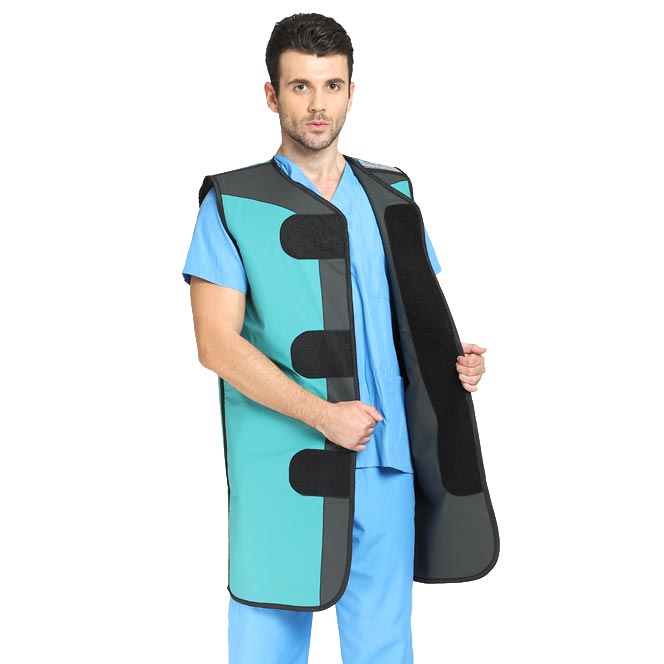 Partial-Overlap Full Protection Lead Apron • SKU 91641
Partial-Overlap
Both front panels are made with full claimed protection.
Frontal Protection Lead Apron
In a frontal protection apron, the shielding core is mainly placed on the front side.
| Protection Level | Construction |
|---|---|
| 0.35 mmPb | 2 × 0.175 mmPb |
| 0.50 mmPb | 2 × 0.25 mmPb |
This design is suitable when the user mainly faces the radiation source.
Full-Overlap Full Protection Lead Apron
In a full-overlap full protection apron, the required front protection is achieved when both front panels overlap each other. The back panel is always made with one 0.25 mmPb sheet.
| Claimed Protection | Front Panel 1 | Front Panel 2 | Back Panel | Front Overlapped Area |
|---|---|---|---|---|
| 0.35 mmPb | 0.175 mmPb | 0.175 mmPb | 0.25 mmPb | 0.35 mmPb |
| 0.50 mmPb | 0.25 mmPb | 0.25 mmPb | 0.25 mmPb | 0.50 mmPb |
Partial-Overlap Full Protection Lead Apron
In a partial-overlap full protection apron, both front panels are made with the full claimed lead equivalent protection.
| Claimed Protection | Each Front Panel | Back Panel | Overlapped Front Area |
|---|---|---|---|
| 0.35 mmPb | 0.35 mmPb | 0.25 mmPb | Approx. 0.70 mmPb |
| 0.50 mmPb | 0.50 mmPb | 0.25 mmPb | Approx. 1.00 mmPb |
In the overlapped front portion, the protection effectively doubles. This means 0.35 mmPb becomes approximately 0.70 mmPb, and 0.50 mmPb becomes approximately 1.00 mmPb in the overlap area.
Which Lead Apron Thickness Should You Choose?
The correct lead apron thickness depends on your procedure type, exposure level and comfort requirement.
| Application | Suggested Protection Level |
|---|---|
| General radiology | 0.35 mmPb |
| Dental X-ray | 0.35 mmPb |
| Veterinary X-ray | 0.35 mmPb |
| Routine diagnostic imaging | 0.35 mmPb |
| C-arm procedures | 0.50 mmPb |
| Cath lab procedures | 0.50 mmPb |
| Fluoroscopy | 0.50 mmPb |
| Interventional radiology | 0.50 mmPb |
The final choice should always follow your institutional radiation safety policy and procedure requirement.
Frequently Asked Questions
What is the standard thickness of a lead apron?
Common lead apron protection levels are 0.35 mmPb and 0.50 mmPb. IndoSurgicals supplies aprons mainly in these two lead equivalent protection levels.
What does 0.35 mmPb mean?
0.35 mmPb means the apron provides radiation protection equivalent to 0.35 mm thickness of lead. At IndoSurgicals, 0.35 mmPb apron construction uses two 0.175 mmPb sheets.
What does 0.50 mmPb mean?
0.50 mmPb means the apron provides radiation protection equivalent to 0.50 mm thickness of lead. At IndoSurgicals, 0.50 mmPb apron construction uses two 0.25 mmPb sheets.
Is 0.50 mmPb better than 0.35 mmPb?
0.50 mmPb provides higher protection than 0.35 mmPb, but it is also heavier. The better option depends on the procedure type, exposure level and wearing comfort requirement.
Which lead apron is lighter: 0.35 mmPb or 0.50 mmPb?
A 0.35 mmPb apron is generally lighter because it uses less shielding material than a 0.50 mmPb apron.
Which lead apron thickness is best for cath lab?
For cath lab and fluoroscopy procedures, 0.50 mmPb is commonly preferred because it provides higher protection in higher exposure environments.
Conclusion
Lead apron thickness is better understood as lead equivalency, written as mmPb. A 0.35 mmPb apron provides standard protection and lower weight, while a 0.50 mmPb apron provides higher protection with increased weight.
IndoSurgicals supplies aprons in both 0.35 mmPb and 0.50 mmPb protection levels using high-quality core materials such as StPb®, NoPb®-LT, NoPb®-SL and NoPb®-BL.
For routine diagnostic use, 0.35 mmPb may be suitable. For cath lab, C-arm, fluoroscopy and interventional procedures, 0.50 mmPb is commonly preferred. The best choice depends on the required radiation protection level, comfort and duration of use.
Explore IndoSurgicals Lead Aprons
View radiation protection aprons designed for hospitals, diagnostic centres, cath labs, radiology departments and healthcare professionals.
Explore the Complete Product Range