

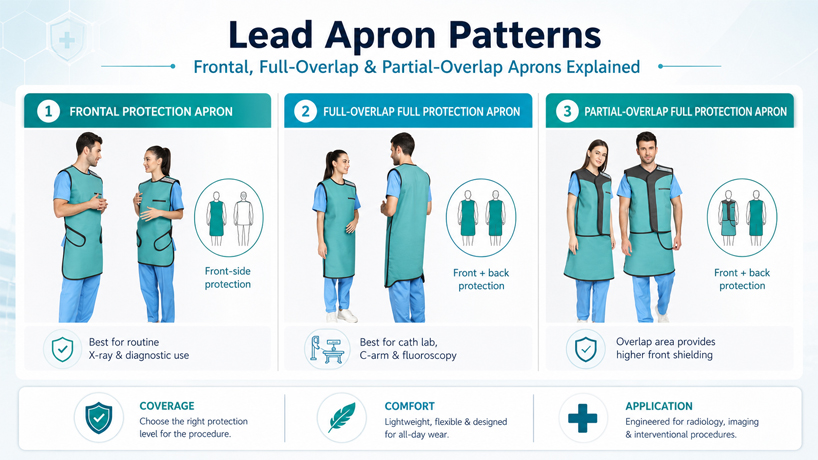
Lead aprons are available in different patterns depending on the type of radiation protection required. The correct lead apron pattern depends on procedure type, radiation exposure direction, wearing duration, comfort requirement and required protection level.
The most common lead apron patterns include Frontal Protection Lead Aprons, Full-Overlap Full Protection Lead Aprons and Partial-Overlap Full Protection Lead Aprons.
What Is a Lead Apron Pattern?
A lead apron pattern refers to the design and coverage style of the apron. It decides how the radiation protection core material is arranged around the body.
Choosing the correct lead apron pattern is as important as choosing the correct protection level. A routine X-ray user may need a different design from a cath lab doctor, C-arm technician or interventional radiology professional.
| Factor | Impact on Apron Selection |
|---|---|
| Protection Coverage | Decides whether the apron provides front-only protection or front-and-back protection. |
| Weight Distribution | Affects how the apron load is carried on the shoulders, back and body. |
| Comfort | Very important during long procedures such as cath lab, fluoroscopy and C-arm work. |
| Mobility | Influences movement, bending and rotation during clinical work. |
| Application | Different patterns are preferred for radiology, dental, cath lab, C-arm and interventional procedures. |
 Frontal Protection Lead Apron • SKU 91161
Frontal Protection Apron
Best for routine X-ray, dental imaging, veterinary X-ray and situations where front-side exposure is the main concern.
 Full-Overlap Full Protection Lead Apron • SKU 91581
Full-Overlap Apron
Provides front and back protection. Front protection is achieved when both front panels overlap.
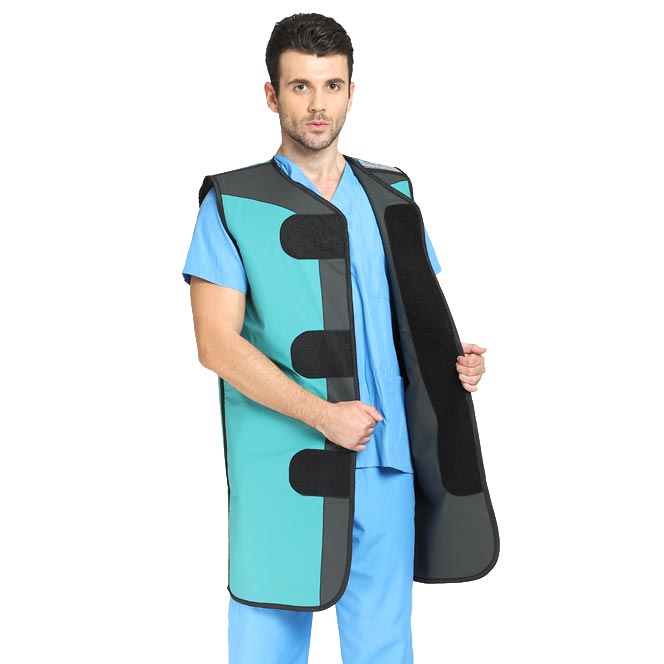 Partial-Overlap Full Protection Lead Apron • SKU 91641
Partial-Overlap Apron
Both front panels have full claimed protection, giving additional shielding in the overlapped area.
Frontal Protection Lead Apron
A Frontal Protection Lead Apron provides radiation protection mainly on the front side of the body. It is suitable when the user generally faces the radiation source and back-side exposure is not a major concern.
Where Frontal Protection Aprons Are Used
- General radiology
- Diagnostic X-ray rooms
- Dental X-ray procedures
- Veterinary X-ray imaging
- Patient protection
- Routine imaging support
- Selected C-arm procedures where front exposure is the main concern
Frontal Protection Apron Construction
| Claimed Protection | Core Sheet Construction |
|---|---|
| 0.35 mmPb | 2 sheets of 0.175 mmPb |
| 0.50 mmPb | 2 sheets of 0.25 mmPb |
Best For
| Requirement | Suitability |
|---|---|
| Front-side protection | Excellent |
| Back-side protection | Not intended as primary back-side protection |
| Routine X-ray use | Suitable |
| Long-duration cath lab use | Full protection apron may be preferred |
| Weight comfort | Generally lighter than full protection designs |
Full-Overlap Full Protection Lead Apron
A Full-Overlap Full Protection Lead Apron provides front and back protection. In this pattern, the required front protection is achieved when the two front panels overlap each other.
This pattern is commonly used where the wearer needs broader body coverage, especially in procedures where the user may move, turn or remain near the radiation source for longer periods.
Where Full-Overlap Aprons Are Used
- Cath lab procedures
- C-arm procedures
- Fluoroscopy
- Interventional radiology
- Urology procedures
- Operation theatres using imaging
- Medical staff requiring front and back coverage
Full-Overlap Apron Construction
In Full-Overlap Full Protection Lead Aprons, front protection is achieved in the overlapped front area. The back panel is made with 0.25 mmPb lead equivalent protection.
| Claimed Apron Protection | Front Panel 1 | Front Panel 2 | Back Panel | Front Overlapped Area |
|---|---|---|---|---|
| 0.35 mmPb | 0.175 mmPb | 0.175 mmPb | 0.25 mmPb | 0.35 mmPb |
| 0.50 mmPb | 0.25 mmPb | 0.25 mmPb | 0.25 mmPb | 0.50 mmPb |
Best For
| Requirement | Suitability |
|---|---|
| Front and back protection | Excellent |
| Cath lab use | Suitable |
| C-arm / fluoroscopy use | Suitable |
| Weight distribution | Better than simple front-heavy designs |
| Long procedures | Suitable with lightweight core material |
Partial-Overlap Full Protection Lead Apron
A Partial-Overlap Full Protection Lead Apron also provides front and back coverage, but its front-panel construction is different from full-overlap aprons.
In this design, both front panels are made with the full claimed lead equivalent protection. Therefore, wherever both front panels overlap, the protection in the overlapped area becomes effectively doubled.
Where Partial-Overlap Aprons Are Used
- Cath lab procedures
- Interventional radiology
- C-arm procedures
- Fluoroscopy-guided procedures
- Urology procedures
- Doctors and technicians needing full protection
- Users who prefer enhanced overlap-area shielding
Partial-Overlap Apron Construction
| Claimed Apron Protection | Each Front Panel | Back Panel | Overlapped Front Area |
|---|---|---|---|
| 0.35 mmPb | 0.35 mmPb | 0.25 mmPb | Approx. 0.70 mmPb |
| 0.50 mmPb | 0.50 mmPb | 0.25 mmPb | Approx. 1.00 mmPb |
In 0.35 mmPb partial-overlap aprons, each front panel is 0.35 mmPb lead equivalent, and the overlapped front area becomes approximately 0.70 mmPb lead equivalent.
In 0.50 mmPb partial-overlap aprons, each front panel is 0.50 mmPb lead equivalent, and the overlapped front area becomes approximately 1.00 mmPb lead equivalent.
The back panel remains 0.25 mmPb lead equivalent in both 0.35 mmPb and 0.50 mmPb partial-overlap full protection apron designs.
Best For
| Requirement | Suitability |
|---|---|
| Full front protection on both panels | Excellent |
| Extra overlap-area shielding | Excellent |
| Cath lab / fluoroscopy use | Suitable |
| Higher protection preference | Suitable |
| Lightweight comfort | Depends on selected core material |
Frontal vs Full-Overlap vs Partial-Overlap Aprons
| Feature | Frontal Protection Apron | Full-Overlap Full Protection Apron | Partial-Overlap Full Protection Apron |
|---|---|---|---|
| Protection Coverage | Front only | Front and back | Front and back |
| Back Protection | No | Yes, 0.25 mmPb back panel | Yes, 0.25 mmPb back panel |
| Front Construction | Full claimed front protection | Front protection achieved by overlap | Each front panel has full claimed protection |
| Overlap Area | Not applicable | 0.35 or 0.50 mmPb as claimed | Approx. 0.70 or 1.00 mmPb |
| Weight | Usually lighter | Moderate to higher | Usually higher than full-overlap |
| Best Use | General X-ray, dental, radiology | Cath lab, C-arm, fluoroscopy | Cath lab, interventional and higher front shielding preference |
| Comfort | Good for routine use | Better coverage with manageable design | Depends on material and size |
Which Lead Apron Pattern Should You Choose?
The correct apron pattern depends on how and where the apron will be used. For routine diagnostic use, a Frontal Protection Lead Apron is often practical. For cath lab, C-arm, fluoroscopy and interventional procedures, a Full Protection Lead Apron is generally preferred.
| Application | Suggested Apron Pattern |
|---|---|
| General X-ray | Frontal Protection Apron |
| Dental X-ray | Frontal Protection Apron / Dental Apron |
| Veterinary X-ray | Frontal Protection Apron |
| Routine radiology | Frontal Protection Apron |
| Cath lab | Full-Overlap or Partial-Overlap Full Protection Apron |
| C-arm procedures | Frontal or Full Protection Apron |
| Fluoroscopy | Full Protection Apron |
| Interventional radiology | Full-Overlap or Partial-Overlap Full Protection Apron |
| Urology procedures | Full Protection Apron often preferred |
Lead Apron Protection Levels Used by IndoSurgicals
IndoSurgicals supplies radiation protection aprons mainly in two protection levels: 0.35 mmPb and 0.50 mmPb.
0.35 mmPb Lead Equivalent
Generally lighter and suitable for routine X-ray, dental, veterinary, general radiology and diagnostic applications.
0.50 mmPb Lead Equivalent
Provides higher protection and is commonly selected for cath lab, C-arm, fluoroscopy, urology and interventional procedures.
Core Material Options Available
IndoSurgicals offers different core material options to balance weight, protection, comfort, flexibility and budget requirements.
StPb® Lead Vinyl Core Material
StPb® is a traditional lead-vinyl radiation protection core material. It is suitable for users who prefer conventional lead-based shielding and a cost-effective apron option.
NoPb®-LT Lead-Free Lightweight Core Material
NoPb®-LT is a lead-free lightweight radiation protection core material designed for reliable shielding, good flexibility, durability and reduced weight.
NoPb®-SL Lead-Free Super Lightweight Core Material
NoPb®-SL is a super lightweight lead-free core material designed for improved comfort during long medical procedures.
NoPb®-BL Lead-Free Broad Beam Tested Core Material
NoPb®-BL is a premium lead-free broad beam tested core material suitable for users who require strong technical documentation and professional-grade shielding performance.
Frequently Asked Questions
What are the different types of lead apron patterns?
Common lead apron patterns include frontal protection aprons, full-overlap full protection aprons, partial-overlap full protection aprons, vest and skirt aprons, dental aprons and patient protection aprons.
What is a frontal protection lead apron?
A frontal protection lead apron protects mainly the front side of the body. It is suitable when the user faces the radiation source and back-side exposure is not a major concern.
What is a full-overlap lead apron?
A full-overlap lead apron provides front and back protection. The required front protection is achieved when both front panels overlap each other.
What is a partial-overlap lead apron?
A partial-overlap lead apron has both front panels made with the full claimed lead equivalent protection. Therefore, the overlapped front area provides additional shielding.
Which lead apron pattern is best for cath lab?
For cath lab procedures, full protection lead aprons are generally preferred, including full-overlap and partial-overlap designs.
Which apron pattern is lightest?
Frontal protection aprons are usually lighter because they provide front-side protection only. Full protection aprons are heavier because they include front and back coverage.
What protection levels are commonly available in IndoSurgicals lead aprons?
IndoSurgicals supplies lead aprons mainly in 0.35 mmPb and 0.50 mmPb lead equivalent protection levels.
Conclusion
Lead apron pattern selection is important because each design provides a different level of coverage, comfort and weight distribution. A Frontal Protection Lead Apron is suitable for routine X-ray, dental, veterinary and general radiology use. A Full-Overlap Full Protection Lead Apron is suitable for cath lab, C-arm, fluoroscopy and interventional procedures where front and back protection are required.
A Partial-Overlap Full Protection Lead Apron provides full protection on both front panels and additional shielding in the overlapped area. IndoSurgicals offers different lead apron patterns with StPb®, NoPb®-LT, NoPb®-SL and NoPb®-BL core material options, helping healthcare professionals choose the right apron based on protection requirement, procedure type, wearing comfort and budget.
Explore IndoSurgicals Lead Aprons
Choose from frontal protection, full-overlap and partial-overlap lead apron patterns with different core material options and protection levels for radiology, cath lab, C-arm, fluoroscopy and diagnostic use.