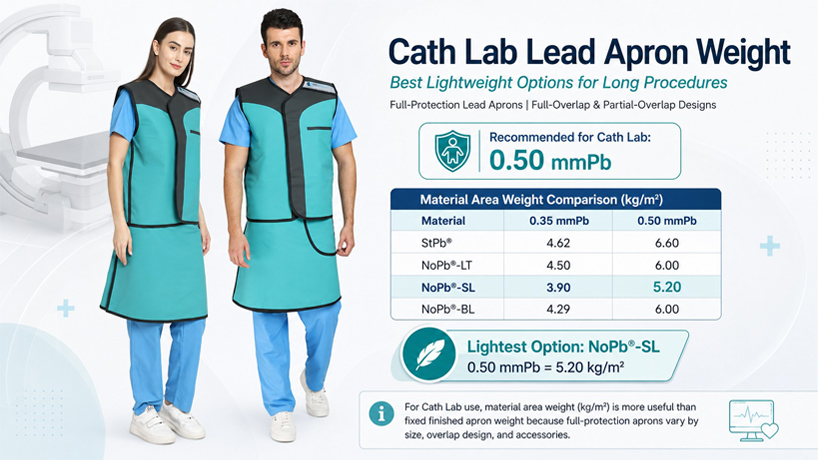
Cath Lab Radiation Protection & Wearing Comfort
Best Lightweight Options for Long Procedures
Cath lab procedures often require doctors, technicians and healthcare professionals to wear radiation protection aprons for long working hours. In such environments, apron weight becomes an important factor because a heavy apron can cause discomfort, shoulder fatigue, back strain and reduced mobility during procedures.
For cath lab, C-arm, fluoroscopy and interventional procedures, users generally prefer full protection lead aprons, including full-overlap and partial-overlap designs. These apron patterns provide front and back coverage and are more suitable for users who may move during procedures or require protection from multiple exposure directions.
Because full protection aprons use different front-panel and back-panel constructions, the final finished weight depends on the apron size, pattern, panel overlap, outer fabric, closures, pockets and accessories. Therefore, for cath lab apron selection, it is more accurate to compare the core material area weight in kg/m² instead of giving one fixed finished apron weight.
IndoSurgicals offers multiple radiation protection core materials, including StPb®, NoPb®-LT, NoPb®-SL and NoPb®-BL, so users can select the most suitable apron material for cath lab, C-arm, fluoroscopy and interventional procedures.
0.50 mmPbcommonly preferred for cath lab use
5.20 kg/m²NoPb®-SL at 0.50 mmPb
Full Protectionfront + back coverage for mobile users
Area Weightbetter comparison than one finished weight
Why Cath Lab Lead Apron Weight Matters
Cath lab users often work in procedures where fluoroscopy or imaging equipment is used for an extended time. During these procedures, the apron may be worn continuously, so even a small weight difference can affect daily comfort.
A lighter cath lab apron can help improve:
- Wearing comfort
- Shoulder and back comfort
- Mobility during procedures
- Long-duration usability
- Overall working experience
However, weight should never be considered alone. The apron must also provide the required lead equivalent protection according to the procedure and institutional radiation safety policy.
Recommended Apron Type for Cath Lab Use
For routine diagnostic X-ray work, a frontal protection apron may be sufficient in many cases. However, for cath lab, C-arm, fluoroscopy and interventional procedures, full protection lead aprons are generally preferred.
IndoSurgicals offers two main full protection apron styles:
| Cath Lab Apron Type |
Description |
| Full-Overlap Full Protection Lead Apron |
Front protection is achieved when both front panels overlap. Back panel is also provided. |
| Partial-Overlap Full Protection Lead Apron |
Each front panel is made with the full claimed protection level. Overlapped front area gives additional protection. |
For cath lab use, many buyers prefer 0.50 mmPb lead equivalent protection because cath lab procedures may involve longer exposure duration and higher scatter radiation compared with routine diagnostic applications.
Recommended Protection Level for Cath Lab Aprons
IndoSurgicals supplies radiation protection aprons mainly in two protection levels:
| Protection Level |
Common Use |
| 0.35 mmPb |
Routine X-ray, general radiology, dental, veterinary and diagnostic use |
| 0.50 mmPb |
Cath lab, C-arm, fluoroscopy, urology and interventional procedures |
For cath lab use, 0.50 mmPb is commonly preferred because it provides a higher protection level compared with 0.35 mmPb. The final selection should always follow institutional radiation safety guidelines and procedure requirements.
Cath Lab Lead Apron Material Weight Comparison
For cath lab apron selection, comparing material area weight is more useful than comparing one fixed finished apron weight, because full protection apron weight changes according to design, size and overlap pattern.
| Core Material |
0.35 mmPb Material Area Weight |
0.50 mmPb Material Area Weight |
Material Type |
| StPb® |
4.62 kg/m² |
6.60 kg/m² |
Traditional lead vinyl |
| NoPb®-LT |
4.50 kg/m² |
6.00 kg/m² |
Lead-free lightweight |
| NoPb®-SL |
3.90 kg/m² |
5.20 kg/m² |
Lead-free super lightweight |
| NoPb®-BL |
Approx. 4.29 kg/m² |
Approx. 6.00 kg/m² |
Lead-free broad beam tested |
From this comparison, NoPb®-SL has the lowest material area weight among IndoSurgicals cath lab apron core materials.
Best Lightweight Options for Cath Lab Use
1. NoPb®-SL – Best Lightweight Option for Long Procedures
NoPb®-SL is the best lightweight option when comfort is the priority. It is a super lightweight lead-free radiation protection core material designed for users who wear aprons for extended periods.
For 0.50 mmPb apron construction, NoPb®-SL has an approximate material area weight of 5.20 kg/m², making it the lightest among the listed IndoSurgicals core materials.
NoPb®-SL is suitable for:
- Cath lab users
- C-arm procedures
- Fluoroscopy users
- Interventional procedure teams
- Doctors and technicians wearing aprons for long hours
2. NoPb®-BL – Premium Broad Beam Tested Lead-Free Option
NoPb®-BL is a premium lead-free radiation protection core material tested under broad beam geometry conditions. It is suitable for users who want lead-free protection with strong technical documentation.
For 0.50 mmPb apron construction, NoPb®-BL has an approximate material area weight of 6.00 kg/m².
NoPb®-BL is suitable for:
- Cath labs
- Interventional radiology
- C-arm procedures
- Diagnostic imaging departments
- Users who prefer premium tested lead-free material
3. NoPb®-LT – Balanced Lead-Free Lightweight Option
NoPb®-LT is a lead-free lightweight radiation protection core material designed for reliable shielding with good flexibility and durability.
For 0.50 mmPb apron construction, NoPb®-LT has an approximate material area weight of 6.00 kg/m².
NoPb®-LT is suitable for users who want a balanced lead-free option with reliable protection and moderate weight.
4. StPb® – Conventional Lead Vinyl Option
StPb® is a traditional lead-vinyl radiation protection core material. It is a cost-effective option for users who prefer conventional lead-based shielding.
For 0.50 mmPb apron construction, StPb® has an approximate material area weight of 6.60 kg/m².
StPb® is suitable for users who prefer a standard lead vinyl apron and want a conventional, economical radiation protection solution.
Which Cath Lab Apron Material Is Lightest?
For 0.50 mmPb cath lab apron construction, the ranking by material area weight is:
| Rank |
Core Material |
0.50 mmPb Material Area Weight |
Material Type |
| 1 |
NoPb®-SL |
5.20 kg/m² |
Lead-free super lightweight |
| 2 |
NoPb®-LT |
6.00 kg/m² |
Lead-free lightweight |
| 2 |
NoPb®-BL |
Approx. 6.00 kg/m² |
Lead-free broad beam tested |
| 4 |
StPb® |
6.60 kg/m² |
Traditional lead vinyl |
If the priority is comfort during long procedures, NoPb®-SL is the most suitable lightweight core material option.
Why Lightweight Aprons Are Important in Cath Labs
Cath lab professionals may wear lead aprons for long periods while standing, moving, bending, adjusting equipment or assisting during procedures. A heavy apron can create fatigue over time, especially around the shoulders, neck, back and waist.
A lighter apron can help improve comfort, but the design also matters. Apron pattern, weight distribution, shoulder design, waist support, skirt-and-vest style, closures and sizing all affect the user experience.
For long cath lab procedures, users should consider:
| Factor |
Why It Matters |
| Core material area weight |
Directly affects apron heaviness |
| Lead equivalency |
Determines protection level |
| Apron pattern |
Affects weight distribution and coverage |
| Fit and size |
Poor fit can increase discomfort |
| Closure system |
Helps secure the apron properly |
| Wear duration |
Longer procedures need better comfort |
Full-Overlap vs Partial-Overlap Full Protection Lead Aprons
Full-Overlap Full Protection Lead Apron
 Full-Overlap Full Protection Lead Apron • SKU 91581
In a Full-Overlap Full Protection Lead Apron, the required front protection is achieved when both front panels overlap each other. The back panel is always made with one 0.25 mmPb sheet.
| Claimed Protection |
Front Panel 1 |
Front Panel 2 |
Back Panel |
Front Overlapped Area |
| 0.35 mmPb |
0.175 mmPb |
0.175 mmPb |
0.25 mmPb |
0.35 mmPb |
| 0.50 mmPb |
0.25 mmPb |
0.25 mmPb |
0.25 mmPb |
0.50 mmPb |
This design provides full protection with front overlap and back coverage.
Partial-Overlap Full Protection Lead Apron
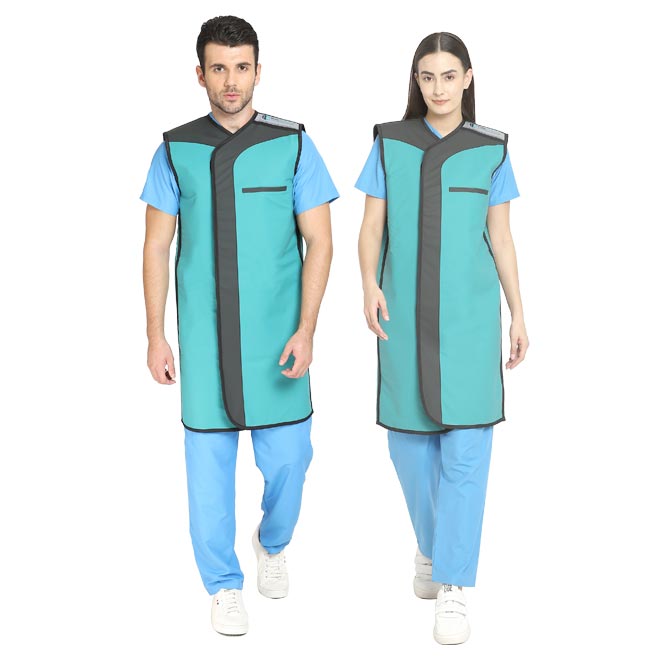 Partial-Overlap Full Protection Lead Apron • SKU 91641
In a Partial-Overlap Full Protection Lead Apron, both front panels are made with the full claimed protection level.
| Claimed Protection |
Each Front Panel |
Back Panel |
Overlapped Front Area |
| 0.35 mmPb |
0.35 mmPb |
0.25 mmPb |
Approx. 0.70 mmPb |
| 0.50 mmPb |
0.50 mmPb |
0.25 mmPb |
Approx. 1.00 mmPb |
In the overlapped front area, protection is effectively doubled. This means 0.35 mmPb becomes approximately 0.70 mmPb, and 0.50 mmPb becomes approximately 1.00 mmPb in the overlapped portion.
The back panel remains 0.25 mmPb lead equivalent in both 0.35 mmPb and 0.50 mmPb full protection apron designs.
How to Choose the Best Cath Lab Lead Apron
The right cath lab lead apron should be selected based on protection requirement, wearing comfort and procedure duration.
| User Priority |
Recommended Option |
| Lightest core material for long procedures |
NoPb®-SL |
| Premium broad beam tested protection |
NoPb®-BL |
| Balanced lead-free lightweight option |
NoPb®-LT |
| Conventional lead-based apron |
StPb® |
| Higher protection requirement |
0.50 mmPb |
| Better comfort for long wear |
Lightweight lead-free material + proper fit |
| Full protection requirement |
Full-overlap or partial-overlap apron |
For most long cath lab procedures, 0.50 mmPb NoPb®-SL full protection apron is a strong option when both protection and wearing comfort are important.
Frequently Asked Questions
How much does a cath lab lead apron weigh?
Cath lab lead apron weight depends on size, protection level, apron pattern and core material. Because cath lab users generally prefer full protection aprons, it is more accurate to compare material area weight in kg/m². IndoSurgicals 0.50 mmPb core material area weight ranges from 5.20 kg/m² to 6.60 kg/m², depending on the selected material.
Which lead apron is best for long cath lab procedures?
For long procedures, a lightweight apron is usually preferred. NoPb®-SL is the lightest IndoSurgicals option and is suitable for users who need better comfort during extended wearing.
Is 0.50 mmPb necessary for cath lab use?
0.50 mmPb is commonly preferred for cath lab, C-arm, fluoroscopy and interventional procedures because these applications may involve higher scatter radiation and longer exposure duration. Final selection should follow institutional radiation safety guidelines.
Are full protection aprons better for cath lab use?
For cath lab and interventional procedures, full protection aprons are often preferred because they provide front and back coverage. IndoSurgicals offers full-overlap and partial-overlap full protection apron designs.
Are lead-free cath lab aprons lighter than lead aprons?
Lead-free aprons can be lighter, depending on the material formulation. IndoSurgicals NoPb®-SL has the lowest material area weight among the listed options and is designed for better comfort during long procedures.
Why are cath lab aprons heavy?
Cath lab aprons are heavy because they contain dense shielding materials required to reduce scattered X-ray radiation exposure. Higher protection levels and full protection designs require more shielding material than simple frontal aprons.
Conclusion
Cath lab lead apron weight is important because users often wear aprons for long procedures. For cath lab applications, users generally prefer Full Protection Lead Aprons, including Full-Overlap and Partial-Overlap designs.
Because final finished weight varies by apron size, panel design, overlap, fabric and accessories, it is more accurate to compare material area weight in kg/m² for cath lab apron selection.
Among IndoSurgicals core materials, NoPb®-SL is the lightest option with 5.20 kg/m² material area weight for 0.50 mmPb construction. NoPb®-LT provides a balanced lead-free lightweight option, NoPb®-BL offers premium broad beam tested protection, and StPb® remains the conventional lead vinyl option.
For long cath lab procedures, the best choice is usually a combination of 0.50 mmPb protection, full protection apron design, lightweight core material, proper fit and comfortable weight distribution.
Explore the Complete IndoSurgicals Product Range – Click Here