

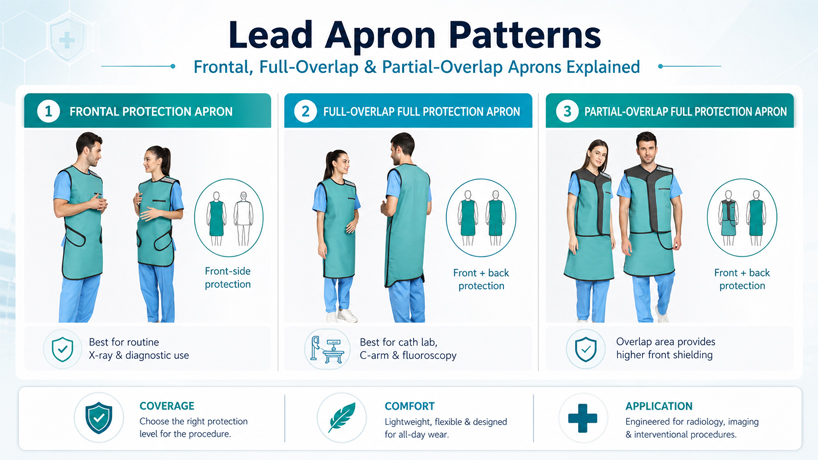
Frontal, Full-Overlap or Partial-Overlap: Which Lead Apron Pattern Should You Choose?
Not every lead apron provides the same type of coverage. This practical guide explains frontal, full-overlap and partial-overlap lead apron patterns, their construction, suitable applications and important differences.
Selecting a radiation protection apron involves more than choosing a lead-equivalent protection level. Its pattern determines the area covered, the way protective material is distributed and how freely the wearer can move during a procedure.
This guide compares the three principal designs offered for different working requirements: Frontal Protection, Full-Overlap Full Protection and Partial-Overlap Full Protection.
What Does a Lead Apron Pattern Mean?
A lead apron pattern is the physical arrangement of the apron and its protective panels. It determines whether coverage is concentrated at the front or extends around both the front and back of the body.
Frontal Protection Lead Apron
A frontal protection apron is intended mainly for situations in which the wearer usually faces the radiation source and substantial exposure from behind is not anticipated. Because it does not contain a protective back panel, it is generally lighter than a full-protection design.
Common applications
- General radiology
- Diagnostic X-ray rooms
- Dental X-ray procedures
- Veterinary imaging
- Patient protection
- Routine imaging support
- Selected front-facing C-arm applications
Practical characteristics
- Protective coverage concentrated at the front
- No primary protective back panel
- Generally lighter than full-protection designs
- Suitable where exposure direction remains predictable
Core construction
| Claimed Protection | Core Sheet Construction |
|---|---|
| 0.35 mmPb | Two sheets of 0.175 mmPb |
| 0.50 mmPb | Two sheets of 0.25 mmPb |
Full-Overlap Full Protection Lead Apron
A full-overlap apron surrounds the wearer with front and back coverage. Its two lighter front panels overlap to produce the stated protection across the covered frontal region.
This arrangement is useful where the wearer may turn, move around the patient or remain close to imaging equipment for an extended period.
Frequently considered for
Panel construction
| Claimed Protection | Front Panel 1 | Front Panel 2 | Back Panel | Overlapped Front |
|---|---|---|---|---|
| 0.35 mmPb | 0.175 mmPb | 0.175 mmPb | 0.25 mmPb | 0.35 mmPb |
| 0.50 mmPb | 0.25 mmPb | 0.25 mmPb | 0.25 mmPb | 0.50 mmPb |
Partial-Overlap Full Protection Lead Apron
A partial-overlap full-protection apron also covers the front and back, but its front-panel construction differs significantly from the full-overlap pattern.
Panel construction
| Claimed Protection | Each Front Panel | Back Panel | Overlapped Front Area |
|---|---|---|---|
| 0.35 mmPb | 0.35 mmPb | 0.25 mmPb | Approximately 0.70 mmPb |
| 0.50 mmPb | 0.50 mmPb | 0.25 mmPb | Approximately 1.00 mmPb |
Because each front panel carries the full claimed protection, this design contains more protective material than a comparable full-overlap apron and may consequently be heavier.
Quick Comparison of Lead Apron Patterns
| Feature | Frontal Protection | Full-Overlap | Partial-Overlap |
|---|---|---|---|
| Coverage | Front | Front and back | Front and back |
| Back panel | No primary back protection | 0.25 mmPb | 0.25 mmPb |
| Front construction | Full claimed front protection | Claimed protection achieved through overlap | Each panel carries full claimed protection |
| Overlap area | Not applicable | Matches the claimed 0.35 or 0.50 mmPb | Approximately 0.70 or 1.00 mmPb |
| Relative weight | Usually lighter | Moderate to higher | Usually higher than full-overlap |
Which Pattern Should You Choose?
No single pattern is suitable for every application. Selection should reflect the procedure, direction of exposure, wearer movement, working duration and the facility’s radiation-safety protocol.
Choosing Between 0.35 mmPb and 0.50 mmPb
IndoSurgicals supplies radiation protection aprons mainly in 0.35 mmPb and 0.50 mmPb protection levels.
Generally lighter and commonly considered for routine X-ray, dental, veterinary, general radiology and diagnostic applications.
Commonly selected for cath lab, C-arm, fluoroscopy, urology and interventional applications where the higher protection level is preferred.
Protection level is only one part of the decision
Apron size, coverage, working duration, core material and wearer comfort should also be considered. Final selection should follow the facility’s radiation-safety procedures and the guidance of the responsible radiation-safety professional.
Frequently Asked Questions
Which lead apron pattern is usually the lightest?
A frontal protection apron is generally lighter because it concentrates protection at the front and does not contain a full protective back panel.
Which apron pattern is generally considered for cath lab work?
Full-protection designs are commonly preferred. The choice between full-overlap and partial-overlap depends on the required construction, overlap protection and weight preference.
What is the principal difference between full-overlap and partial-overlap?
In a full-overlap design, the two lighter front panels combine to achieve the stated protection. In a partial-overlap design, each front panel already carries the full claimed protection, so the overlap area provides approximately twice that level.
Does a frontal apron provide back protection?
A frontal apron is designed principally for front-side coverage and is not intended to provide primary protection to the back of the wearer.
Making an Informed Selection
Frontal Protection Lead Aprons are practical for many routine applications where exposure is expected mainly from the front. Full-Overlap and Partial-Overlap Full Protection Aprons provide broader coverage for procedures in which the wearer may turn or work near changing radiation directions.
Understanding panel construction, overlap behaviour, relative weight and intended coverage makes it easier to identify the most appropriate apron pattern for a particular working environment.
Need Assistance Selecting a Lead Apron Pattern?
Explore the detailed IndoSurgicals lead apron pattern guide or contact our team with your application and coverage requirements.